Motivating Questions
- What are the derivatives of the tangent, cotangent, secant, and cosecant functions?
- How do the derivatives of and combine with other derivative rules we have developed to expand the library of functions we can quickly differentiate?
One of the powerful themes in trigonometry comes from a very simple idea: locating a point on the unit circle.
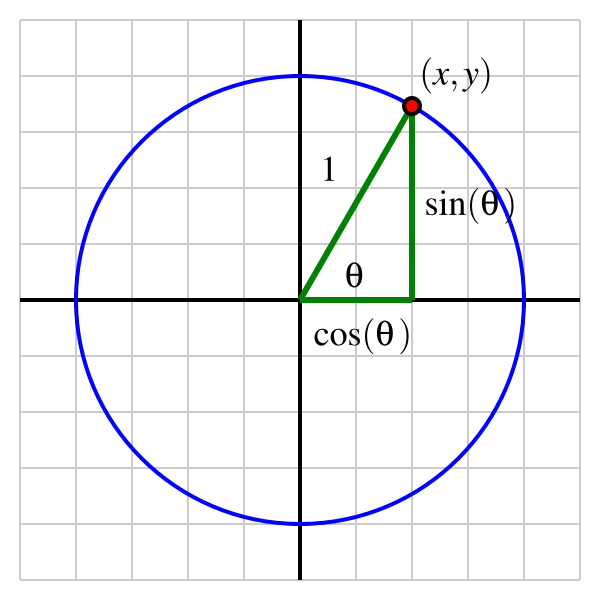
Because each angle in standard position corresponds to one and only one point on the unit circle, the - and -coordinates of this point are each functions of In fact, this is the very definition of and is the -coordinate of the point on the unit circle corresponding to the angle and is the -coordinate. From this simple definition, all of trigonometry is founded. For instance, the Fundamental Trigonometric Identity,
is a restatement of the Pythagorean Theorem, applied to the right triangle shown in Figure .
There are four other trigonometric functions, each defined in terms of the sine and/or cosine functions.
- The tangent function is defined by
- the cotangent function is its reciprocal:
- The secant function is the reciprocal of the cosine function,
- and the cosecant function is the reciprocal of the sine function,
These six trigonometric functions together offer us a wide range of flexibility in problems involving right triangles.
Because we know the derivatives of the sine and cosine function, we can now develop shortcut differentiation rules for the tangent, cotangent, secant, and cosecant functions. In this section's preview activity, we work through the steps to find the derivative of
Preview Activity
Consider the function and remember that
- What is the domain of
- Use the quotient rule to show that one expression for is
- What is the Fundamental Trigonometric Identity? How can this identity be used to find a simpler form for
- Recall that How can we express in terms of the secant function?
- For what values of is defined? How does this set compare to the domain of
Derivatives of the cotangent, secant, and cosecant functions
In Preview Activity , we found that the derivative of the tangent function can be expressed in several ways, but most simply in terms of the secant function. Next, we develop the derivative of the cotangent function.
Let To find we observe that and apply the quotient rule. Hence
By the Fundamental Trigonometric Identity, we see that and recalling that it follows that we can express by the rule
Note that neither nor is defined when which occurs at every integer multiple of Hence we have the following rule.
Cotangent Function
For all real numbers such that where
Notice that the derivative of the cotangent function is very similar to the derivative of the tangent function we discovered in Preview Activity .
Tangent Function
For all real numbers such that where
In the next two activities, we develop the rules for differentiating the secant and cosecant functions.
Activity
Let and recall that
- What is the domain of
- Use the quotient rule to develop a formula for that is expressed completely in terms of and
- How can you use other relationships among trigonometric functions to write only in terms of and
- What is the domain of How does this compare to the domain of
Using the quotient rule we have determined the derivatives of the tangent, cotangent, secant, and cosecant functions, expanding our overall library of functions we can differentiate. Observe that just as the derivative of any polynomial function is a polynomial, and the derivative of any exponential function is another exponential function, so it is that the derivative of any basic trigonometric function is another function that consists of basic trigonometric functions. This makes sense because all trigonometric functions are periodic, and hence their derivatives will be periodic, too.
The derivative retains all of its fundamental meaning as an instantaneous rate of change and as the slope of the tangent line to the function under consideration.
Activity
Answer each of the following questions. Where a derivative is requested, be sure to label the derivative function with its name using proper notation.
- Let Find the slope of the tangent line to at the point where
- Let Find the instantaneous rate of change of at the point where
- Let Find
- Let Find
- When a mass hangs from a spring and is set in motion, the object's position oscillates in a way that the size of the oscillations decrease. This is usually called a damped oscillation. Suppose that for a particular object, its displacement from equilibrium (where the object sits at rest) is modeled by the function
Assume that is measured in inches and in seconds. Sketch a graph of this function for to see how it represents the situation described. Then compute state the units on this function, and explain what it tells you about the object's motion. Finally, compute and interpret
Summary
- The derivatives of the other four trigonometric functions are
Each derivative exists and is defined on the same domain as the original function. For example, both the tangent function and its derivative are defined for all real numbers such that where
- The four rules for the derivatives of the tangent, cotangent, secant, and cosecant can be used along with the rules for power functions, exponential functions, and the sine and cosine, as well as the sum, constant multiple, product, and quotient rules, to quickly differentiate a wide range of different functions.