Motivating Questions
- What is a graphical justification for why
- What do the graphs of and suggest as formulas for their respective derivatives?
- Once we know the derivatives of and how do previous derivative rules work when these functions are involved?
Throughout Chapter 2, we will develop shortcut derivative rules to help us bypass the limit definition and quickly compute from a formula for In Section 2.1, we stated the rule for power functions,
and the rule for exponential functions,
Later in this section, we will use a graphical argument to conjecture derivative formulas for the sine and cosine functions.
Preview Activity
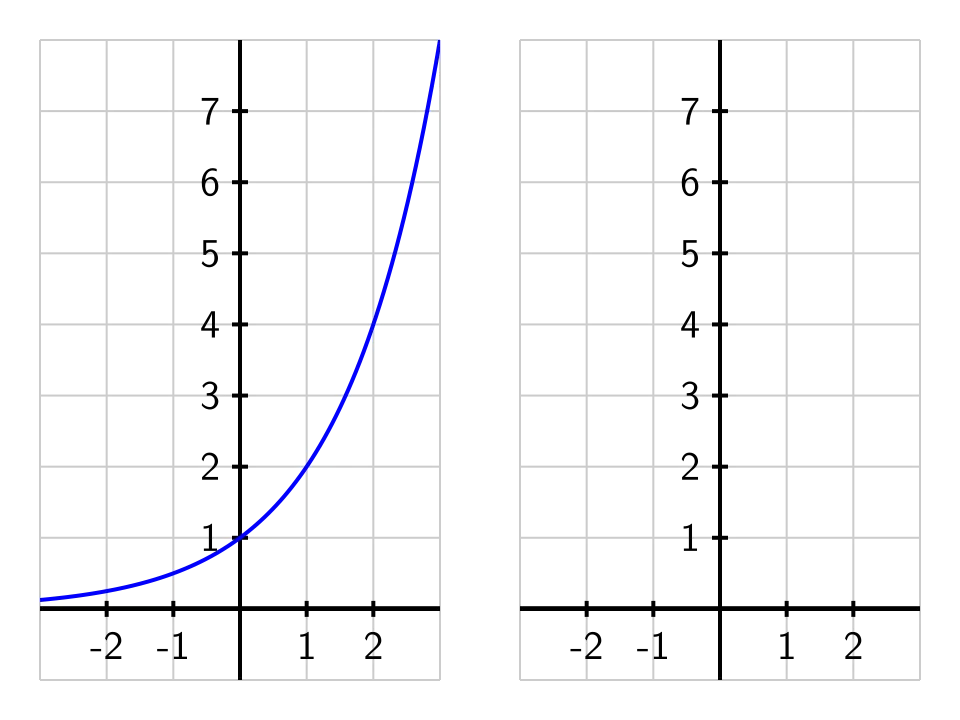
Consider the function which is graphed in Figure .
- At each of use a straightedge to sketch an accurate tangent line to
- Use the provided grid to estimate the slope of the tangent line you drew at each point in (a).
- Use the limit definition of the derivative to estimate by using small values of and compare the result to your visual estimate for the slope of the tangent line to at in (b).
- Based on your work in (a), (b), and (c), sketch an accurate graph of on the axes adjacent to the graph of
- Write at least one sentence that explains why it is reasonable to think that where is a constant. In addition, calculate and then discuss how this value, combined with your work above, reasonably suggests that
The sine and cosine functions
The sine and cosine functions are among the most important functions in all of mathematics. Sometimes called the circular functions due to their definition on the unit circle, these periodic functions play a key role in modeling repeating phenomena such as tidal elevations, the behavior of an oscillating mass attached to a spring, or the location of a point on a bicycle tire. Like polynomial and exponential functions, the sine and cosine functions are considered basic functions, ones that are often used in building more complicated functions. As such, we would like to know formulas for and and the next two activities lead us to that end.
Activity
Consider the function which is graphed in Figure below. Note carefully that the grid in the diagram does not have boxes that are but rather approximately as the horizontal scale of the grid is units per box.

- At each of use a straightedge to sketch an accurate tangent line to
- Use the provided grid to estimate the slope of the tangent line you drew at each point. Pay careful attention to the scale of the grid.
- Use the limit definition of the derivative to estimate by using small values of and compare the result to your visual estimate for the slope of the tangent line to at in (b). Using periodicity, what does this result suggest about about
- Based on your work in (a), (b), and (c), sketch an accurate graph of on the axes adjacent to the graph of
- What familiar function do you think is the derivative of
Activity
Consider the function which is graphed in Figure below. Note carefully that the grid in the diagram does not have boxes that are but rather approximately as the horizontal scale of the grid is units per box.

- At each of use a straightedge to sketch an accurate tangent line to
- Use the provided grid to estimate the slope of the tangent line you drew at each point. Again, note the scale of the axes and grid.
- Use the limit definition of the derivative to estimate by using small values of and compare the result to your visual estimate for the slope of the tangent line to at in (b). Using periodicity, what does this result suggest about can symmetry on the graph help you estimate other slopes easily?
- Based on your work in (a), (b), and (c), sketch an accurate graph of on the axes adjacent to the graph of
- What familiar function do you think is the derivative of
The results of the two preceding activities suggest that the sine and cosine functions not only have beautiful connections such as the identities and but that they are even further linked through calculus, as the derivative of each involves the other. The following rules summarize the results of the activities 1 .
These two rules may be formally proved using the limit definition of the derivative and the expansion identities for and
Sine and Cosine Functions
For all real numbers
We have now added the sine and cosine functions to our library of basic functions whose derivatives we know. The constant multiple and sum rules still hold, of course, as well as all of the inherent meaning of the derivative.
Activity
Answer each of the following questions. Where a derivative is requested, be sure to label the derivative function with its name using proper notation.
- Determine the derivative of
- Find the exact slope of the tangent line to at the point where
- Find the equation of the tangent line to at the point where
- Determine the derivative of
- The function represents a population of a particular kind of animal that lives on a small island, where is measured in hundreds and is measured in decades since January 1, 2010. What is the instantaneous rate of change of on January 1, 2030? What are the units of this quantity? Write a sentence in everyday language that explains how the population is behaving at this point in time.
Summary
- For an exponential function the graph of appears to be a scaled version of the original function. In particular, careful analysis of the graph of suggests that which is a special case of the rule we stated in Section 2.1.
- By carefully analyzing the graphs of and and by using the limit definition of the derivative at select points, we found that and
- We note that all previously encountered derivative rules still hold, but now may also be applied to functions involving the sine and cosine. All of the established meaning of the derivative applies to these trigonometric functions as well.