Motivating Questions
- How are lines in similar to and different from lines in
- What is the role that vectors play in representing equations of lines, particularly in
- How can we think of a plane as a set of points determined by a point and a vector?
- How do we find the equation of a plane through three given non-collinear points?
In single variable calculus, we learn that a differentiable function is locally linear. In other words, if we zoom in on the graph of a differentiable function at a point, the graph looks like the tangent line to the function at that point. Linear functions played important roles in single variable calculus, useful in approximating differentiable functions, in approximating roots of functions (see Newton's Method), and approximating solutions to first order differential equations (see Euler's Method). In multivariable calculus, we will soon study curves in space; differentiable curves turn out to be locally linear as well. In addition, as we study functions of two variables, we will see that such a function is locally linear at a point if the surface defined by the function looks like a plane (the tangent plane) as we zoom in on the graph.
Consequently, it is important for us to understand both lines and planes in space, as these define the linear functions in and (Recall that a function is linear if it is a polynomial function whose terms all have degree less than or equal to 1. For example, defines a single variable linear function and a two variable linear function, but is not linear since it has degree two, the sum of the degress of its factors.) We begin our work by considering some familiar ideas in but from a new perspective.
Preview Activity
We are familiar with equations of lines in the plane in the form where is the slope of the line and is the -intercept. In this activity, we explore a more flexible way of representing lines that we can use not only in the plane, but in higher dimensions as well.
To begin, consider the line through the point with slope as shown in Figure .
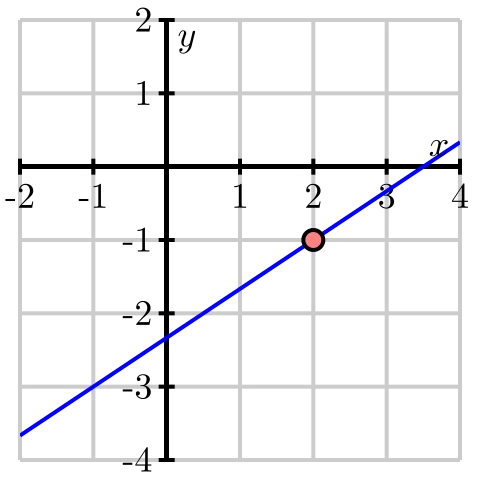
- Suppose we increase by 1 from the point How does the -value change? What is the point on the line with -coordinate
- Suppose we decrease by 3.25 from the point How does the -value change? What is the point on the line with -coordinate
- Now, suppose we increase by some arbitrary value from the point How does the -value change? What is the point on the line with -coordinate
- Observe that the slope of the line is related to any vector whose -component divided by the -component is the slope of the line. For the line in this exercise, we might use the vector which describes the direction of the line. Explain why the terminal points of the vectors where
trace out the graph of the line through the point with slope
- Now we extend this vector approach to and consider a second example. Let be the line in through the point in the direction of the vector Find the coordinates of three distinct points on line Explain your thinking.
- Find a vector in the form
whose terminal points trace out the line that is described in (e). That is, you should be able to locate any point on the line by determining a corresponding value of
Lines in Space
In two-dimensional space, a non-vertical line is defined to be the set of points satisfying the equation
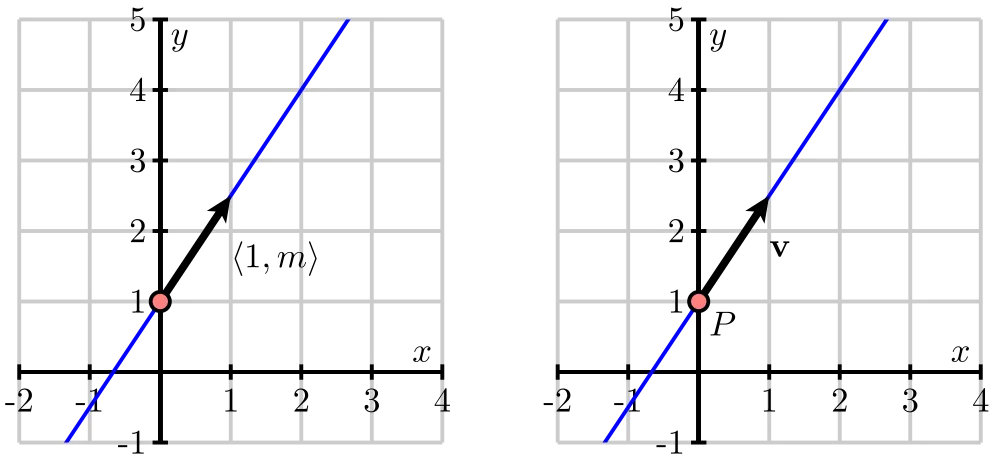
for some constants and The value of (the slope) tells us how the dependent variable changes for every one unit increase in the independent variable, while the point is the -intercept and anchors the line to a location on the -axis. Alternatively, we can think of the slope as being related to the vector which tells us the direction of the line, as shown on the left in Figure . Thus, we can identify a line in space by fixing a point and a direction as shown on the right. Since we also have vectors in space to provide direction, this same idea of a point and a direction determining a line works in for any
Definition
A line in space is the set of terminal points of vectors emanating from a given point that are parallel to a fixed vector
The fixed vector in the definition is called a direction vector for the line. As we saw in Preview Activity , to find an equation for a line through point in the direction of vector observe that any vector parallel to will have the form for some scalar So, any vector emanating from the point in a direction parallel to the vector will be of the form
for some scalar (where is the origin).
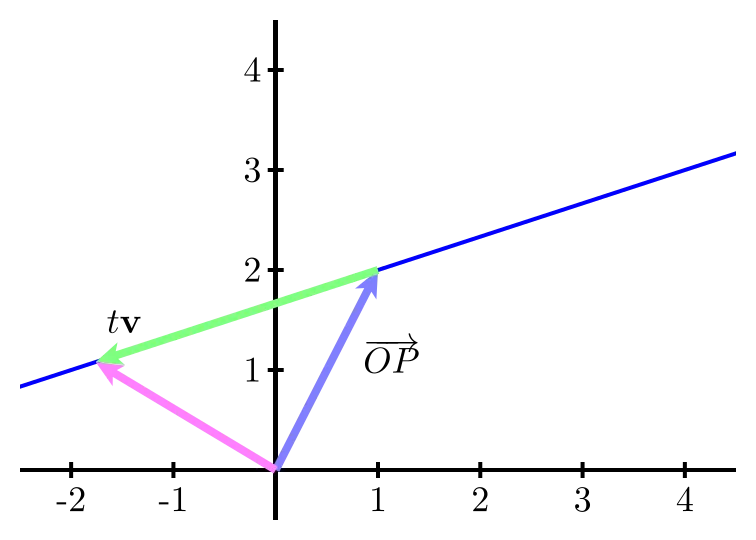
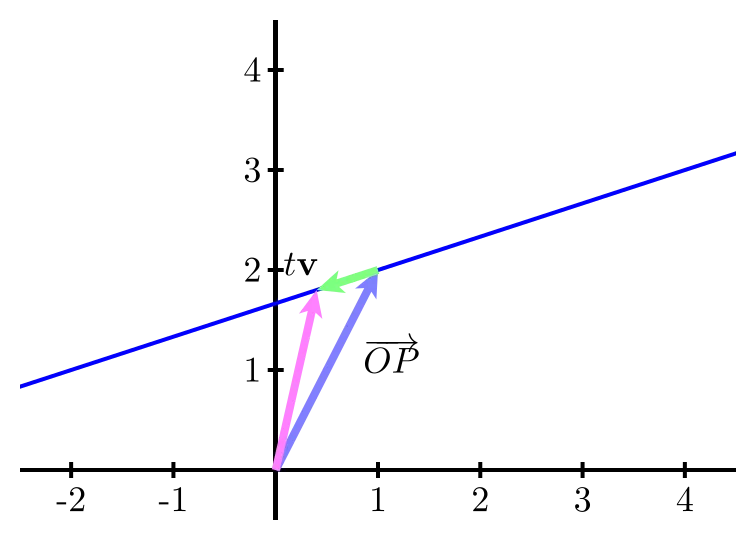
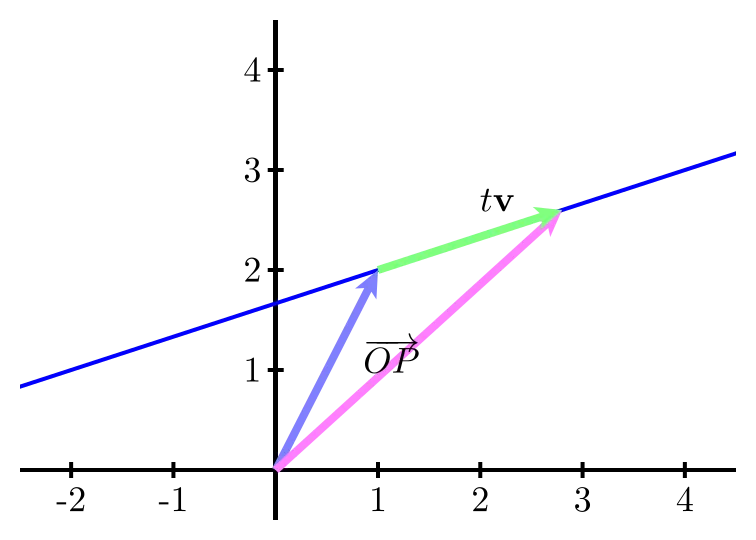
Figure presents three images of a line in two-space in which we can identify the vector and the vector as in Equation (). Here, is the fixed vector shown in blue, while the direction vector is the vector parallel to the vector shown in green (that is, the green vector represents and the line is traced out by the terminal points of the magenta vector). In other words, the tips (terminal points) of the magenta vectors (the vectors of the form ) trace out the line as changes.
In particular, the terminal points of the vectors of the form in () define a linear function in space of the following form, which is valid in any dimension.
The vector form of a line
The vector form of a line through the point in the direction of the vector is
where is the position vector from the origin to the point
Of course, it is common to represent lines in the plane using the slope-intercept equation The vector form of the line, described above, is an alternative way to represent lines that has the following two advantages. First, in two dimensions, we are able to represent vertical lines, whose slope is not defined, using a vertical direction vector, such as Second, this description of lines works in any dimension even though there is no concept of the slope of a line in more than two dimensions.
Activity
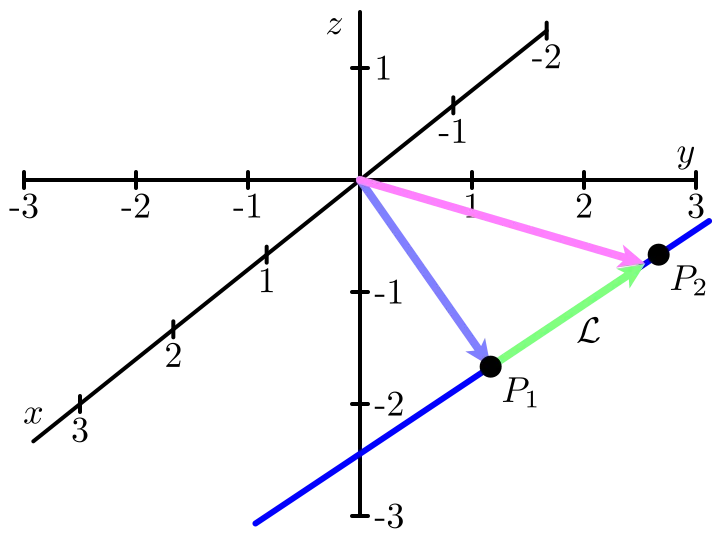
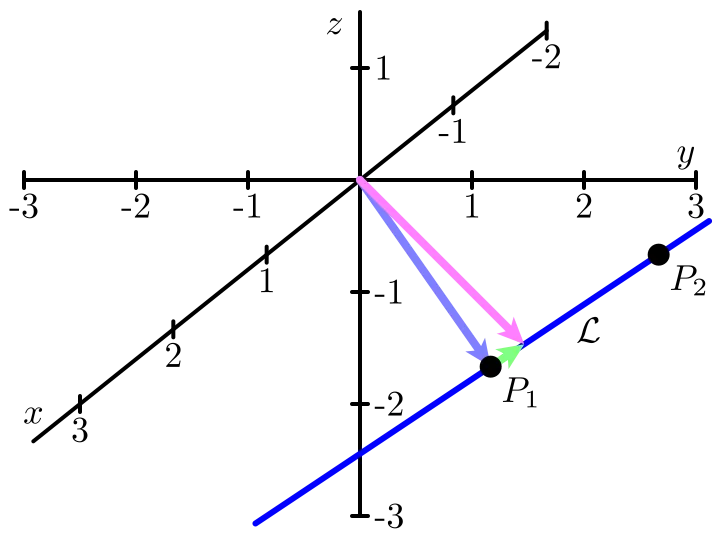
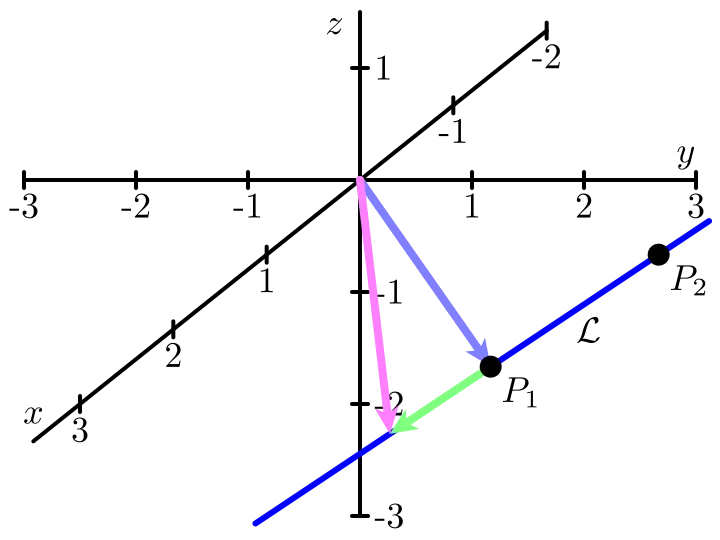
Let and Let be the line in through and and note that three snapshots of this line are shown in Figure .
- Find a direction vector for the line
- Find a vector equation of in the form
- Consider the vector equation What is the direction of the line given by Is this new line parallel to line
- Do and represent the same line, Explain.
The Parametric Equations of a Line
The vector form of a line, in Equation (), describes a line as the set of terminal points of the vectors If we write this in terms of components letting
then we can equate the components on both sides of to obtain the equations
which describe the coordinates of the points on the line. The variable represents an arbitrary scalar and is called a parameter. In particular, we use the following language.
The parametric equations of a line
The parametric equations for a line through the point in the direction of the vector are
Notice that there are many different parametric equations for the same line. For example, choosing another point on the line or another direction vector produces another set of parametric equations. It is sometimes useful to think of as a time parameter and the parametric equations as telling us where we are on the line at each time. In this way, the parametric equations describe a particular walk taken along the line; there are, of course, many possible ways to walk along a line.
Activity
Let and and let be the line in through and which is the same line as in Activity .
- Find parametric equations of the line
- Does the point lie on If so, what value of results in this point?
- Consider another line, whose parametric equations are
What is the direction of the line
- Do the lines and intersect? If so, provide the point of intersection and the and values, respectively, that result in the point. If not, explain why.
Planes in Space
Now that we have a way of describing lines, we would like to develop a means of describing planes in three dimensions. We studied the coordinate planes and planes parallel to them in Section 9.1. Each of those planes had one of the variables or equal to a constant. We can note that any vector in a plane with constant is orthogonal to the vector any vector in a plane with constant is orthogonal to the vector and any vector in a plane with constant is orthogonal to the vector This idea works in general to define a plane.
Definition
A plane in space is the set of all terminal points of vectors emanating from a given point perpendicular to a fixed vector as shown in Figure .
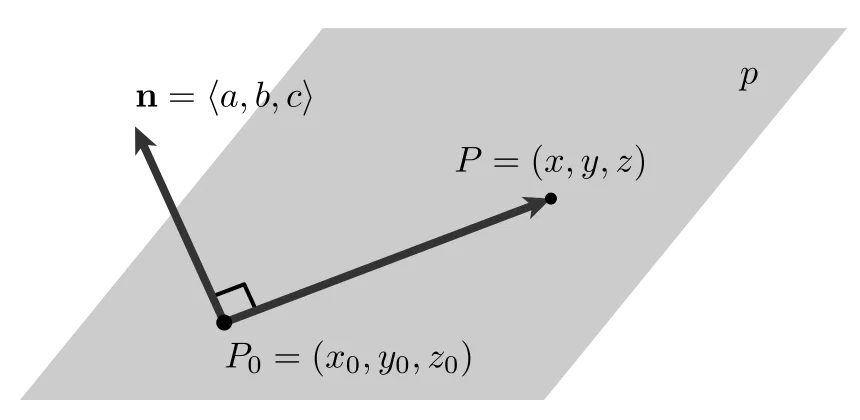
The definition allows us to find the equation of a plane. Assume that and that is an arbitrary point on the plane. Since the vector lies in the plane, it must be perpendicular to This means that
The fixed vector perpendicular to the plane is frequently called a normal vector to the plane. We may now summarize as follows.
Equations of a plane
- The scalar equation of the plane with normal vector containing the point is
- The vector equation of the plane with normal vector containing the points and is
We may take the scalar equation of a plane a little further and note that since
it equivalently follows that
That is, we may write an equation of a plane as where
For instance, if we would like to describe the plane passing through the point and perpendicular to the vector we have
or
Notice that the coefficients of and in this description give a vector perpendicular to the plane. For instance, if we are presented with the plane
we know that is a vector perpendicular to the plane.
Activity
- Write a scalar equation of the plane passing through the point and perpendicular to the vector
- Is the point on the plane
- Write a scalar equation of the plane that is parallel to and passing through the point (Hint: Compare normal vectors of the planes.)
- Write a parametric description of the line passing through the point and perpendicular to the plane described by the equation
- Find the point at which intersects the plane
Just as two distinct points in space determine a line, three non-collinear points in space determine a plane. Consider three points and in space, not all lying on the same line as shown in Figure .
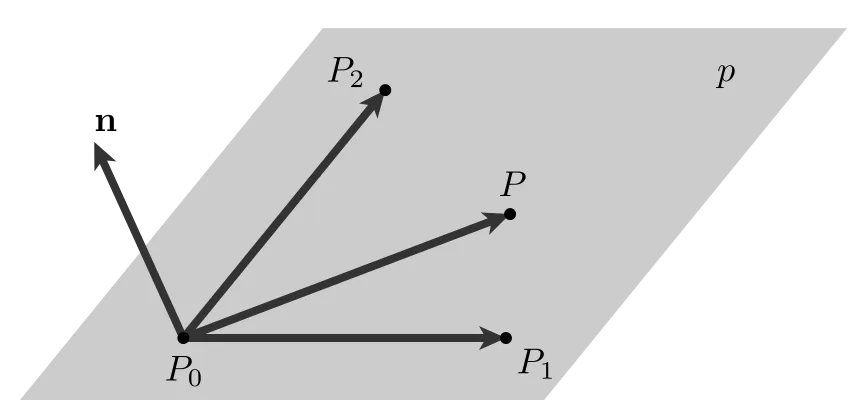
Observe that the vectors and both lie in the plane If we form their cross-product
we obtain a normal vector to the plane Therefore, if is any other point on it then follows that will be perpendicular to and we have, as before, the equation
Activity
Let and and let be the plane containing and
- Determine the components of the vectors and
- Find a normal vector to the plane
- Find a scalar equation of the plane
- Consider a second plane, with scalar equation Find two different points on plane as well as a vector that is normal to
- The angle between two planes is the acute angle between their respective normal vectors. What is the angle between planes and
Summary
- While lines in do not have a slope, like lines in they can be characterized by a point and a direction vector. Indeed, we define a line in space to be the set of terminal points of vectors emanating from a given point that are parallel to a fixed vector.
- Vectors play a critical role in representing the equation of a line. In particular, the terminal points of the vector define a linear function in space through the terminal point of the vector in the direction of the vector tracing out a line in space.
- A plane in space is the set of all terminal points of vectors emanating from a given point perpendicular to a fixed vector.
- If and are non-collinear points in space, the vectors and and are vectors in the plane and the vector is a normal vector to the plane. So any point in the plane satisfies the equation If we let be the normal vector, and we can also represent the plane with the equation