Motivating Questions
- What is a sequence?
- What does it mean for a sequence to converge?
- What does it mean for a sequence to diverge?
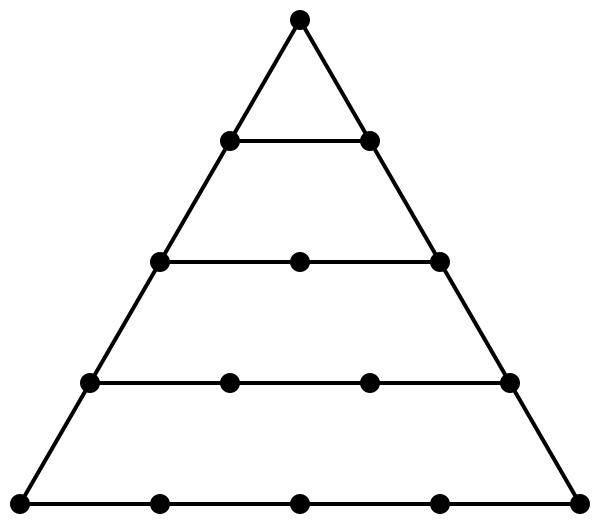
We encounter sequences every day. Your monthly utility payments, the annual interest you earn on investments, the amount you spend on groceries each week; all are examples of sequences. Other sequences with which you may be familiar include the Fibonacci sequence where each term is the sum of the two preceding terms, and the triangular numbers the number of vertices in the triangles shown in Figure .
Sequences of integers are of such interest to mathematicians and others that they have a journal 1 devoted to them and an on-line encyclopedia 2 that catalogs a huge number of integer sequences and their connections. Sequences are also used in digital recordings and images.
http://www.cs.uwaterloo.ca/journals/JIS/http://oeis.org/Our studies in calculus have dealt with continuous functions. Sequences model discrete instead of continuous information. We will study ways to represent and work with discrete information in this chapter as we investigate sequences and series, and ultimately see key connections between the discrete and continuous.
Preview Activity
Suppose you receive through an inheritance. You decide to invest this money into a fund that pays annually, compounded monthly. That means that each month your investment earns additional dollars, where is your principal balance at the start of the month. So in the first month your investment earns
or If you reinvest this money, you will then have in your account at the end of the first month. From this point on, assume that you reinvest all of the interest you earn.
- How much interest will you earn in the second month? How much money will you have in your account at the end of the second month?
- Complete Table to determine the interest earned and total amount of money in this investment each month for one year.
Table . Interest Month Interest
earnedTotal amount
of money
in the account - As we will see later, the amount of money in the account after month is given by
Use this formula to check your calculations in Table . Then find the amount of money in the account after 5 years.
- How many years will it be before the account has doubled in value to $10000?
As Preview Activity illustrates, many discrete phenomena can be represented as lists of numbers (like the amount of money in an account over a period of months). We call any such list a sequence. A sequence is nothing more than list of terms in some order. We often list the entries of the sequence with subscripts,
where the subscript denotes the position of the entry in the sequence.
Definition
A sequence is a list of terms in a specified order.
We can think of a sequence as a function whose domain is the set of positive integers where for each positive integer This alternative view will be be useful in many situations.
We often denote the sequence
by The value (alternatively ) is called the th term in the sequence. If the terms are all 0 after some fixed value of we say the sequence is finite. Otherwise the sequence is infinite. With infinite sequences, we are often interested in their end behavior and the idea of convergent sequences.
Activity
- Let be the th term in the sequence Find a formula for and use appropriate technological tools to draw a graph of entries in this sequence by plotting points of the form for some values of Most graphing calculators can plot sequences; directions follow for the TI-84.
- In the
MODEmenu, highlightSEQin theFUNCline and pressENTER. - In the
Y=menu, you will now see lines to enter sequences. Enter a value fornMin(where the sequence starts), a function foru(n)(the th term in the sequence), and the value ofu(nMin). - Set your window coordinates (this involves choosing limits for as well as the window coordinates
XMin,XMax,YMin, andYMax. - The
GRAPHkey will draw a plot of your sequence.
Using your knowledge of limits of continuous functions as decide if this sequence has a limit as Explain your reasoning.
- In the
- Let be the th term in the sequence Find a formula for Draw a graph of some points in this sequence. Using your knowledge of limits of continuous functions as decide if this sequence has a limit as Explain your reasoning.
- Let be the th term in the sequence Find a formula for Using your knowledge of limits of continuous functions as decide if this sequence has a limit as Explain your reasoning.
Next we formalize the ideas from Activity .
Activity
- Recall our earlier work with limits involving infinity in Section 2.8. State clearly what it means for a continuous function to have a limit as
- Given that an infinite sequence of real numbers is a function from the integers to the real numbers, apply the idea from part (a) to explain what you think it means for a sequence to have a limit as
- Based on your response to the part (b), decide if the sequence has a limit as If so, what is the limit? If not, why not?
In Activities and we investigated a sequence that has a limit as goes to infinity. More formally, we make the following definition.
Definition
A sequence converges or is a convergent sequence provided that there is a number such that we can make as close to as we want by taking sufficiently large. In this situation, we call the limit of the convergent sequence and write
If the sequence does not converge, we say that the sequence diverges.
The idea of sequence having a limit as is the same as the idea of a continuous function having a limit as The only difference is that sequences are discrete instead of continuous.
Activity
Use graphical and/or algebraic methods to determine whether each of the following sequences converges or diverges.
- (where is the factorial symbol and for any positive integer (as convention we define to be 1)).
Summary
- A sequence is a list of objects in a specified order. We will typically work with sequences of real numbers. We can think of a sequence as a function from the positive integers to the set of real numbers.
- A sequence of real numbers converges to a number if we can make every value of for as close as we want to by choosing sufficiently large.
- A sequence diverges if it does not converge.