Motivating Questions
- What is an infinite series?
- What is the th partial sum of an infinite series?
- How do we add up an infinite number of numbers? In other words, what does it mean for an infinite series of real numbers to converge?
- What does it mean for an infinite series of real numbers to diverge?
In Section 8.2, we encountered infinite geometric series. For example, by writing
as a geometric series, we found a way to write as a single fraction: In this section, we explore other types of infinite sums. In Preview Activity we see how one such sum is related to the famous number
Preview Activity
Have you ever wondered how your calculator can produce a numeric approximation for complicated numbers like or After all, the only operations a calculator can really perform are addition, subtraction, multiplication, and division, the operations that make up polynomials. This activity provides the first steps in understanding how this process works. Throughout the activity, let
- Find the tangent line to at and use this linearization to approximate That is, find a formula for the tangent line, and compute since
- The linearization of does not provide a good approximation to since 1 is not very close to 0. To obtain a better approximation, we alter our approach a bit. Instead of using a straight line to approximate we put an appropriate bend in our estimating function to make it better fit the graph of for close to 0. With the linearization, we had both and share the same value as the linearization at We will now use a quadratic approximation to centered at which has the property that and
- Let Show that and Then, use to approximate by observing that
- We can continue approximating with polynomials of larger degree whose higher derivatives agree with those of at 0. This turns out to make the polynomials fit the graph of better for more values of around 0. For example, let Show that and Use to approximate in a way similar to how you did so with above.
Infinite Series
Preview Activity shows that an approximation to using a linear polynomial is 2, an approximation to using a quadratic polynomial is and an approximation using a cubic polynomial is 2.6667. If we continue this process we can obtain approximations from quartic (degree 4) and quintic (degree 5) polynomials, giving us the following approximations to
| linear | ||
|---|---|---|
| quadratic | ||
| cubic | ||
| quartic | ||
| quintic |
We see an interesting pattern here. The number is being approximated by the sum
for increasing values of
We can use summation notation as a shorthand 1 for writing the sum in Equation () to get
We can calculate this sum using as large an as we want, and the larger is the more accurate the approximation () is. This suggests that we can write the number as the infinite sum
This sum is an example of an infinite series. Note that the series () is the sum of the terms of the infinite sequence In general, we use the following notation and terminology.
Definition
An infinite series of real numbers is the sum of the entries in an infinite sequence of real numbers. In other words, an infinite series is sum of the form
where are real numbers.
We use summation notation to identify a series. If the series adds the entries of a sequence we will write the series as
or
Each of these notations is simply shorthand for the infinite sum
Is it even possible to sum an infinite list of numbers? That doing so is possible in some situations shouldn't come as a surprise. We have already examined the special case of geometric series in the previous section. Moreover, the definite integral is defineed as the limit of a sequence of finite sums, which provides insight into how we'll think of infinite sums generally. As we investigate other infinite sums, there are two key questions we seek to answer: (1) is the sum finite? and (2) if yes, what is its value?
Activity
Consider the series
While it is physically impossible to add an infinite collection of numbers, we can, of course, add any finite collection of them. In what follows, we investigate how understanding how to find the th partial sum (that is, the sum of the first terms) enables us to make sense of the infinite sum.
- Sum the first two numbers in this series. That is, find a numeric value for
- Next, add the first three numbers in the series.
- Continue adding terms in this series to complete the list below. Carry each sum to at least 8 decimal places.
- The sums in the table in part c form a sequence whose th term is Based on your calculations in the table, do you think the sequence converges or diverges? Explain. How do you think this sequence is related to the series
The example in Activity illustrates how we define the sum of an infinite series. We construct a new sequence of numbers (called the sequence of partial sums) where the th term in the sequence consists of the sum of the first terms of the series. If this sequence converges, the corresponding infinite series is said to converge, and we say that we can find the sum of the series. More formally, we have the following definition.
Definition
The th partial sum of the series is the finite sum
In other words, the th partial sum of a series is the sum of the first terms in the series,
We investigate the behavior of the series by examining the sequence
of its partial sums. If the sequence of partial sums converges to some finite number, we say that the corresponding series converges. Otherwise, we say the series diverges. From our work in Activity , the series
appears to converge to some number near 1.54977. We formalize the concept of convergence and divergence of an infinite series in the following definition.
Definition
The infinite series
converges (or is convergent) if the sequence of partial sums converges, where
If then we call the sum of the series That is,
If the sequence of partial sums does not converge, then the series
diverges (or is divergent).
The early terms in a series do not influence whether or not the series converges or diverges. Rather, the convergence or divergence of a series
is determined by what happens to the terms for very large values of To see why, suppose that is some constant larger than 1. Then
Since is a finite number, the series will converge if and only if the series converges. Because the starting index of the series doesn't affect whether the series converges or diverges, we will often just write
when we are interested in questions of convergence/divergence as opposed to the exact sum of a series.
In Section 8.2 we encountered the special family of infinite geometric series. Recall that a geometric series has the form where and are real numbers (and ). We found that the th partial sum of a geometric series is given by the convenient formula
and thus a geometric series converges if Geometric series diverge for all other values of
It is generally a difficult question to determine if a given nongeometric series converges or diverges. There are several tests we can use that we will consider in the following sections.
The Divergence Test
The first question we ask about any infinite series is usually “Does the series converge or diverge?” There is a straightforward way to check that certain series diverge, and we explore this test in the next activity.
Activity
If the series converges, then an important result necessarily follows regarding the sequence This activity explores this result.
Assume that the series converges and has sum equal to
- What is the th partial sum of the series
- What is the st partial sum of the series
- What is the difference between the th partial sum and the st partial sum of the series
- Since we are assuming that what does that tell us about Why? What does that tell us about Why?
- Combine the results of the previous two parts of this activity to determine
The result of Activity is the following important conditional statement:
If the series converges, then the sequence of th terms converges to 0.
It is logically equivalent to say that if the sequence does not converge to 0, then the series cannot converge. This statement is called the Divergence Test.
The Divergence Test
If then the series diverges.
Activity
Determine if the Divergence Test applies to the following series. If the test does not apply, explain why. If the test does apply, what does it tell us about the series?
Note well: be very careful with the Divergence Test. This test only tells us what happens to a series if the terms of the corresponding sequence do not converge to 0. If the sequence of the terms of the series does converge to 0, the Divergence Test does not apply: indeed, as we will soon see, a series whose terms go to zero may either converge or diverge.
The Integral Test
The Divergence Test settles the questions of divergence or convergence of series in which Determining the convergence or divergence of series in which turns out to be more complicated. Often, we have to investigate the sequence of partial sums or apply some other technique.
Next, we consider the harmonic series 2
The first 9 partial sums of this series are shown following.
This information alone doesn't seem to be enough to tell us if the series converges or diverges. The partial sums could eventually level off to some fixed number or continue to grow without bound. Even if we look at larger partial sums, such as the result isn't particularly convincing one way or another. The Integral Test is one way to determine whether or not the harmonic series converges, and we explore this test further in the next activity.
Activity
Consider the harmonic series Recall that the harmonic series will converge provided that its sequence of partial sums converges. The th partial sum of the series is
Through this last expression for we can visualize this partial sum as a sum of areas of rectangles with heights and bases of length 1, as shown in Figure , which uses the 9th partial sum.
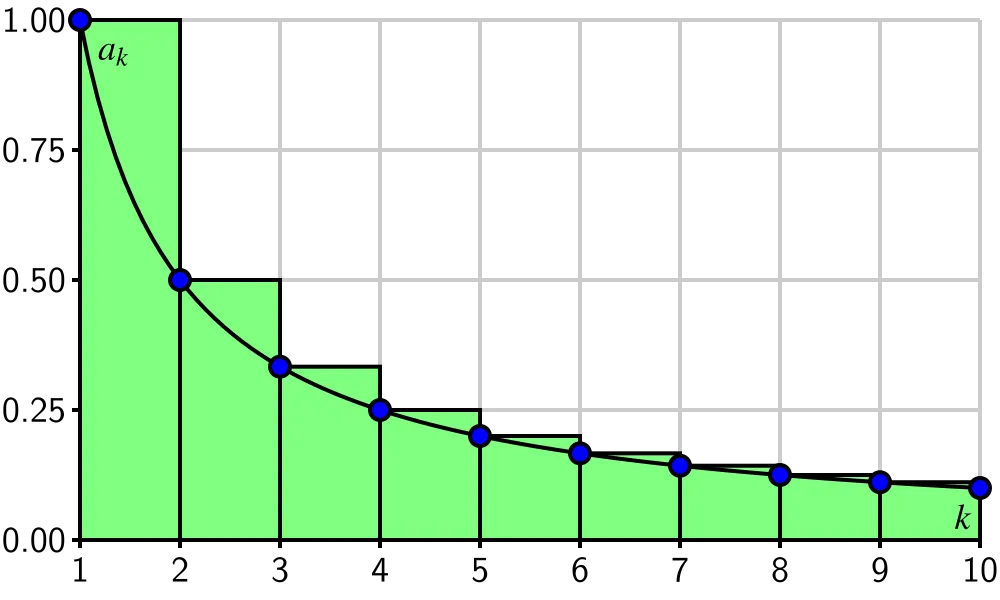
The graph of the continuous function defined by is overlaid on this plot.
- Explain how this picture represents a particular Riemann sum.
- What is the definite integral that corresponds to the Riemann sum you considered in (a)?
- Which is larger, the definite integral in (b), or the corresponding partial sum of the series? Why?
- If instead of considering the 9th partial sum, we consider the th partial sum, and we let go to infinity, we can then compare the series to the improper integral Which of these quantities is larger? Why?
- Does the improper integral converge or diverge? What does that result, together with your work in (d), tell us about the series
The ideas from Activity hold more generally. Suppose that is a continuous decreasing function and that for each value of Consider the corresponding series The partial sum
can always be viewed as a left hand Riemann sum of using rectangles with bases of width 1 and heights given by the values A representative picture is shown at left in Figure . Since is a decreasing function, we have that
Taking the limit as goes to infinity shows that
Therefore, if the improper integral diverges, so does the series
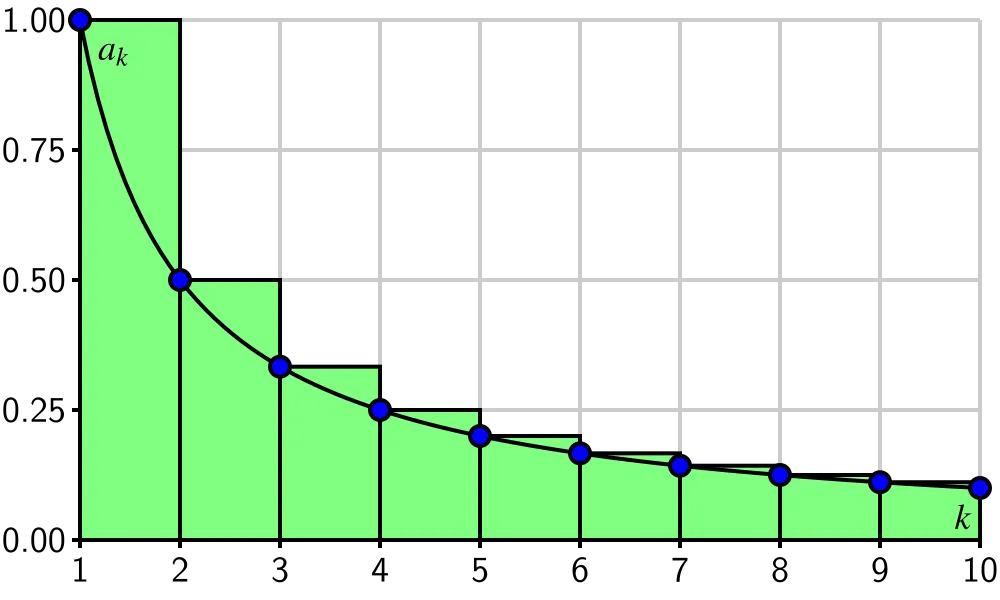
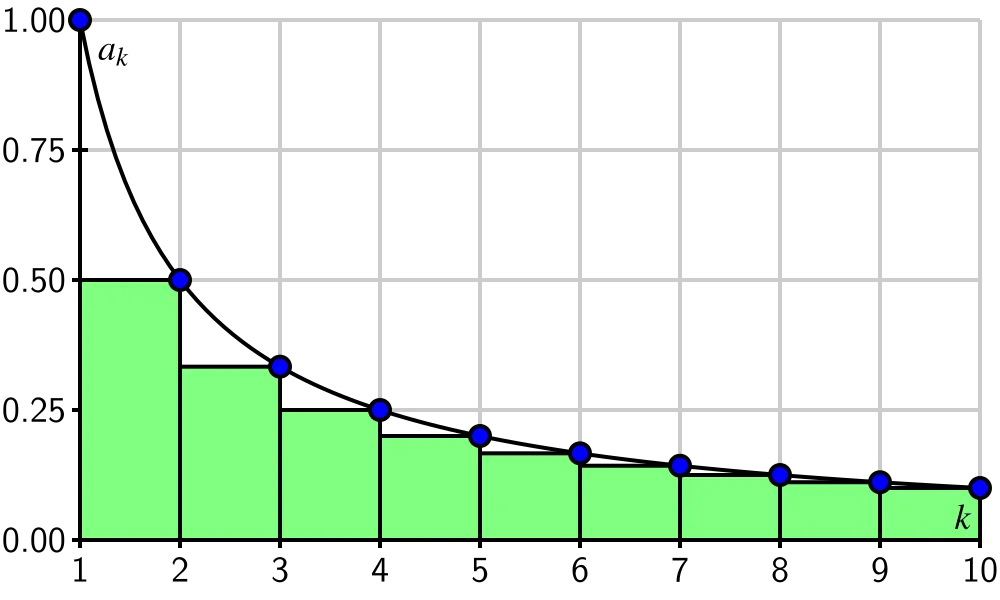
What's more, if we look at the right hand Riemann sums of on as shown at right in Figure , we see that
So if converges, then so does which also means that the series also converges. Our preceding discussion has demonstrated the truth of the Integral Test.
The Integral Test
Let be a real valued function and assume is decreasing and positive for all larger than some number Let for each positive integer
- If the improper integral converges, then the series converges.
- If the improper integral diverges, then the series diverges.
The Integral Test compares a given infinite series to a natural, corresponding improper integral and says that the infinite series and corresponding improper integral both have the same convergence status. In the next activity, we apply the Integral Test to determine the convergence or divergence of a class of important series.
Activity
The series are special series called -series. We have already seen that the -series with (the harmonic series) diverges. We investigate the behavior of other -series in this activity.
- Evaluate the improper integral Does the series converge or diverge? Explain.
- Evaluate the improper integral where For which values of can we conclude that the series converges?
- Evaluate the improper integral where What does this tell us about the corresponding -series
- Summarize your work in this activity by completing the following statement.
The -series converges if and only if .
The Limit Comparison Test
The Integral Test allows us to determine the convergence of an entire family of series: the -series. However, we have seen that it is often difficult to integrate functions, so the Integral Test is not one that we can use all of the time. In fact, even for a relatively simple series such as the Integral Test is not an option. In what follows we develop a test that applies to series of rational functions by comparing their behavior to the behavior of -series.
Activity
Consider the series Since the convergence or divergence of a series only depends on the behavior of the series for large values of we might examine the terms of this series more closely as gets large.
- By computing the value of for and explain why the terms are essentially when is large.
- Let's formalize our observations in (a) a bit more. Let and Calculate
What does the value of the limit tell you about and for large values of Compare your response from part (a).
- Does the series converge or diverge? Why? What do you think that tells us about the convergence or divergence of the series Explain.
Activity illustrates how we can compare one series with positive terms to another whose convergence status we know. Suppose we have two series and with positive terms and we know the convergence status of the series Recall that the convergence or divergence of a series depends only on the terms of the series for large values of so if we know that and are proportional for large then the two series and should behave the same way. In other words, if there is a positive finite constant such that
then for large values of So
Since multiplying by a nonzero constant does not affect the convergence or divergence of a series, it follows that the series and either both converge or both diverge. The formal statement of this fact is called the Limit Comparison Test.
The Limit Comparison Test
Let and be series with positive terms. If
for some positive (finite) constant then and either both converge or both diverge.
The Limit Comparison Test shows that if we have a series of rational functions where is a polynomial of degree and a polynomial of degree then the series will behave like the series So this test allows us to determine the convergence or divergence of series whose terms are rational functions.
Activity
Use the Limit Comparison Test to determine the convergence or divergence of the series
by comparing it to the series
The Ratio Test
The Limit Comparison Test works well if we can find a series with known behavior to compare. But such series are not always easy to find. In this section we will examine a test that allows us to examine the behavior of a series by comparing it to a geometric series, without knowing in advance which geometric series we need.
Activity
Consider the series defined by
This series is not a geometric series, but this activity will illustrate how we might compare this series to a geometric one. Recall that a series is geometric if the ratio is always the same. For the series in (), note that
- To see if is comparable to a geometric series, we analyze the ratios of successive terms in the series. Complete Table , listing your calculations to at least 8 decimal places.
Table . Ratios of successive terms in the series - Based on your calculations in Table , what can we say about the ratio if is large?
- Do you agree or disagree with the statement: “the series is approximately geometric when is large”? If not, why not? If so, do you think the series converges or diverges? Explain.
We can generalize the argument in Activity in the following way. Consider the series If
for large values of then for large and the series is approximately the geometric series for large Since the geometric series with ratio converges only for we see that the series will converge if
for a value of such that This result is known as the Ratio Test.
The Ratio Test
Let be an infinite series. Suppose
- If then the series converges.
- If then the series diverges.
- If then the test is inconclusive.
Note well: The Ratio Test looks at the limit of the ratio of consecutive terms of a given series; in so doing, the test is asking, “is this series approximately geometric?” If so, the test uses the limit of the ratio of consecutive terms to determine if the given series converges.
We have now encountered several tests for determining convergence or divergence of series.
- The Divergence Test can be used to show that a series diverges, but never to prove that a series converges.
- We used the Integral Test to determine the convergence status of an entire class of series, the -series.
- The Limit Comparison Test works well for series that involve rational functions and which can therefore by compared to -series.
- Finally, the Ratio Test allows us to compare our series to a geometric series; it is particularly useful for series that involve th powers and factorials.
- Two other tests, the Direct Comparison Test and the Root Test, are discussed in the exercises.
One of the challenges of determining whether a series converges or diverges is finding which test answers that question.
Activity
Determine whether each of the following series converges or diverges. Explicitly state which test you use.
Summary
- An infinite series is a sum of the elements in an infinite sequence. In other words, an infinite series is a sum of the form
where is a real number for each positive integer
- The th partial sum of the series is the sum of the first terms of the series. That is,
- The sequence of partial sums of a series tells us about the convergence or divergence of the series. In particular
- The series converges if the sequence of partial sums converges. In this case we say that the series is the limit of the sequence of partial sums and write
- The series diverges if the sequence of partial sums diverges.
- The series converges if the sequence of partial sums converges. In this case we say that the series is the limit of the sequence of partial sums and write