Motivating Questions
- What are improper integrals and why are they important?
- What does it mean to say that an improper integral converges or diverges?
- What are some typical improper integrals that we can classify as convergent or divergent?
Another important application of the definite integral measures the likelihood of certain events. For instance, consider a company that manufactures incandescent light bulbs. Based on a large volume of test results, they have determined that the fraction of light bulbs that fail between times and of use (where is measured in months) is given by
For example, the fraction of light bulbs that fail during their third month of use is given by
Thus about 14.22% of all lightbulbs fail between and Clearly we could adjust the limits of integration to measure the fraction of light bulbs that fail during any time period of interest.
Preview Activity
A company with a large customer base has a call center that receives thousands of calls a day. After studying the data that represents how long callers wait for assistance, they find that the function models the time customers wait in the following way: the fraction of customers who wait between and minutes is given by
Use this information to answer the following questions.
- Determine the fraction of callers who wait between 5 and 10 minutes.
- Determine the fraction of callers who wait between 10 and 20 minutes.
- Next, let's study the fraction who wait up to a certain number of minutes:
- What is the fraction of callers who wait between 0 and 5 minutes?
- What is the fraction of callers who wait between 0 and 10 minutes?
- Between 0 and 15 minutes? Between 0 and 20?
- Let represent the fraction of callers who wait between and minutes. Find a formula for that involves a definite integral, and then use the First FTC to find a formula for that does not involve a definite integral.
- What is the value of the limit What is its meaning in the context of the problem?
Improper Integrals Involving Unbounded Intervals
In view of the above examples, we see that we may want to integrate over an interval whose upper limit grows without bound. For example, to find the fraction of light bulbs that fail eventually, we wish to find
for which we will also use the notation
Such an integral can be interpreted as the area of an unbounded region, as pictured at right in Figure .
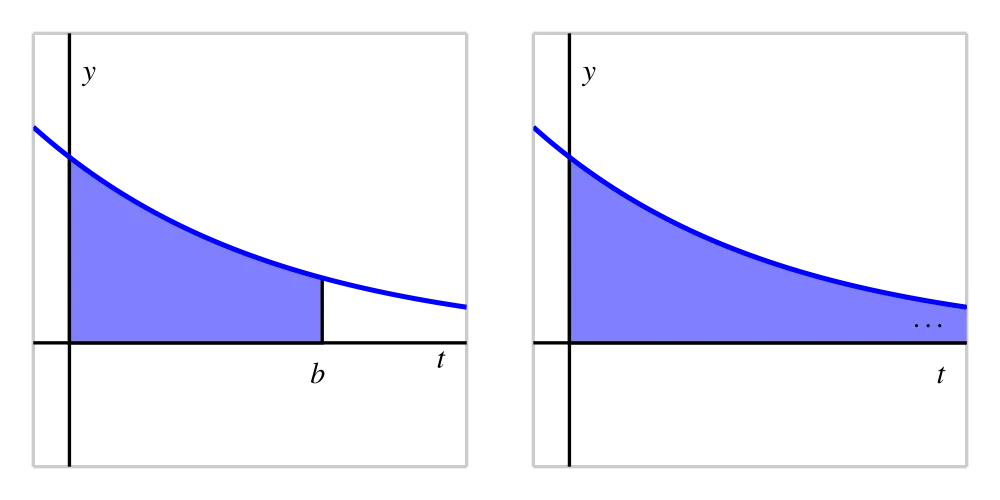
We call an integral for which the interval of integration is unbounded improper. For instance, the integrals
are all improper because they have limits of integration that involve To evaluate an improper integral we replace it with a limit of proper integrals. That is,
We first attempt to evaluate using the First FTC, and then evaluate the limit. Is it even possible for the area of an unbounded region to be finite? The following activity explores this issue and others in more detail.
Activity
In this activity we explore the improper integrals and
- First we investigate
- Use the First FTC to determine the exact values of and Then, use your computational device to compute a decimal approximation of each result.
- Use the First FTC to evaluate the definite integral (which results in an expression that depends on ).
- Now, use your work from (ii.) to evaluate the limit given by
- Next, we investigate
- Use the First FTC to determine the exact values of and Then, use your calculator to compute a decimal approximation of each result.
- Use the First FTC to evaluate the definite integral (which results in an expression that depends on ).
- Now, use your work from (ii.) to evaluate the limit given by
- Plot the functions and on the same coordinate axes for the values How would you compare their behavior as increases without bound? What is similar? What is different?
- How would you characterize the value of of What does this tell us about the respective areas bounded by these two curves for
Convergence and Divergence
Activity suggests that is either finite or infinite (or it doesn't exist). With these possibilities in mind, we introduce the following terminology.
Note
If is nonnegative for then we say that the improper integral converges provided that
exists and is finite. Otherwise, we say that diverges.
We will restrict our interest to improper integrals for which the integrand is nonnegative. Also, we require that for if does not approach as then it is impossible for to converge.
Activity
Determine whether each of the following improper integrals converges or diverges. For each integral that converges, find its exact value.
- where is a positive real number
Improper Integrals Involving Unbounded Integrands
An integral is also called improper if the integrand is unbounded on the interval of integration. For example, consider
Because has a vertical asymptote at is not continuous on and the integral represents the area of the unbounded region shown at right in Figure .
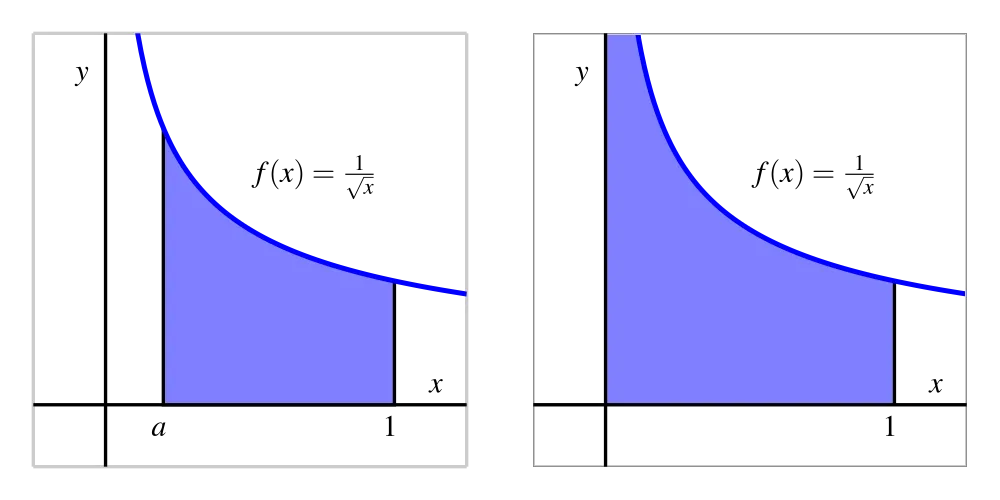
We address the problem of the integrand being unbounded by replacing the improper integral with a limit of proper integrals. For example, to evaluate we replace with and let approach 0 from the right. Thus,
We evaluate the proper integral and then take the limit. We will say that the improper integral converges if this limit exists, and diverges otherwise. In this example, we observe that
so the improper integral converges (to the value 2).
We have to be particularly careful with unbounded integrands, for they may arise in ways that may not initially be obvious. Consider, for instance, the integral
At first glance we might think that we can simply apply the Fundamental Theorem of Calculus by antidifferentiating to get and then evaluating from to Were we to do so, we would be erroneously applying the FTC because fails to be continuous throughout the interval, as seen in Figure .
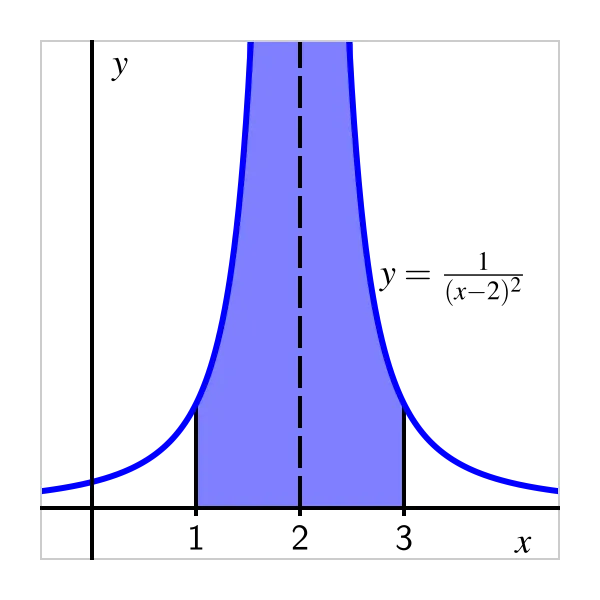
Such an incorrect application of the FTC leads to an impossible result (), which would itself suggest that something we did must be wrong. Instead, we must address the vertical asymptote at by writing
We then evaluate two separate limits of proper integrals. For instance, doing so for the integral with approaching from the left, we find
since as approaches 2 from the left. Thus, the improper integral diverges; similar work shows that also diverges. From either of these two results, we can conclude that that the original integral, diverges, too.
Activity
For each of the following definite integrals, decide whether the integral is improper or not. If the integral is proper, evaluate it using the First FTC. If the integral is improper, determine whether or not the integral converges or diverges; if the integral converges, find its exact value.
Summary
- An integral can be improper if at least one of or is making the interval unbounded, or if has a vertical asymptote at for some value of that satisfies One reason that improper integrals are important is that certain probabilities can be represented by integrals that involve infinite limits.
- When we encounter an improper integral, we work to understand it by replacing the improper integral with a limit of proper integrals. For instance, we write
and then work to determine whether the limit exists and is finite. For any improper integral, if the resulting limit of proper integrals exists and is finite, we say the improper integral converges. Otherwise, the improper integral diverges.
- An important class of improper integrals is given by
where is a positive real number. We can show that this improper integral converges whenever and diverges whenever A related class of improper integrals is which converges for and diverges for