9.79(a) False. These are independent trials. (b) False. There are red face cards. (c) True. A card cannot be both a face card and an ace.
9.81(a) 10 tosses. Fewer tosses mean more variability in the sample fraction of heads, meaning there’s a better chance of getting at least 60% heads. (b) 100 tosses. More flips means the observed proportion of heads would often be closer to the average, 0.50, and therefore also above 0.40. (c) 100 tosses. With more flips, the observed proportion of heads would often be closer to the average, 0.50. (d) 10 tosses. Fewer flips would increase variability in the fraction of tosses that are heads.
9.83(a) = 0.00098. (b) = 0.00098. (c) (at least one tails) = (no tails) = .
9.85(a) No, there are voters who are both independent and swing voters.
(b)
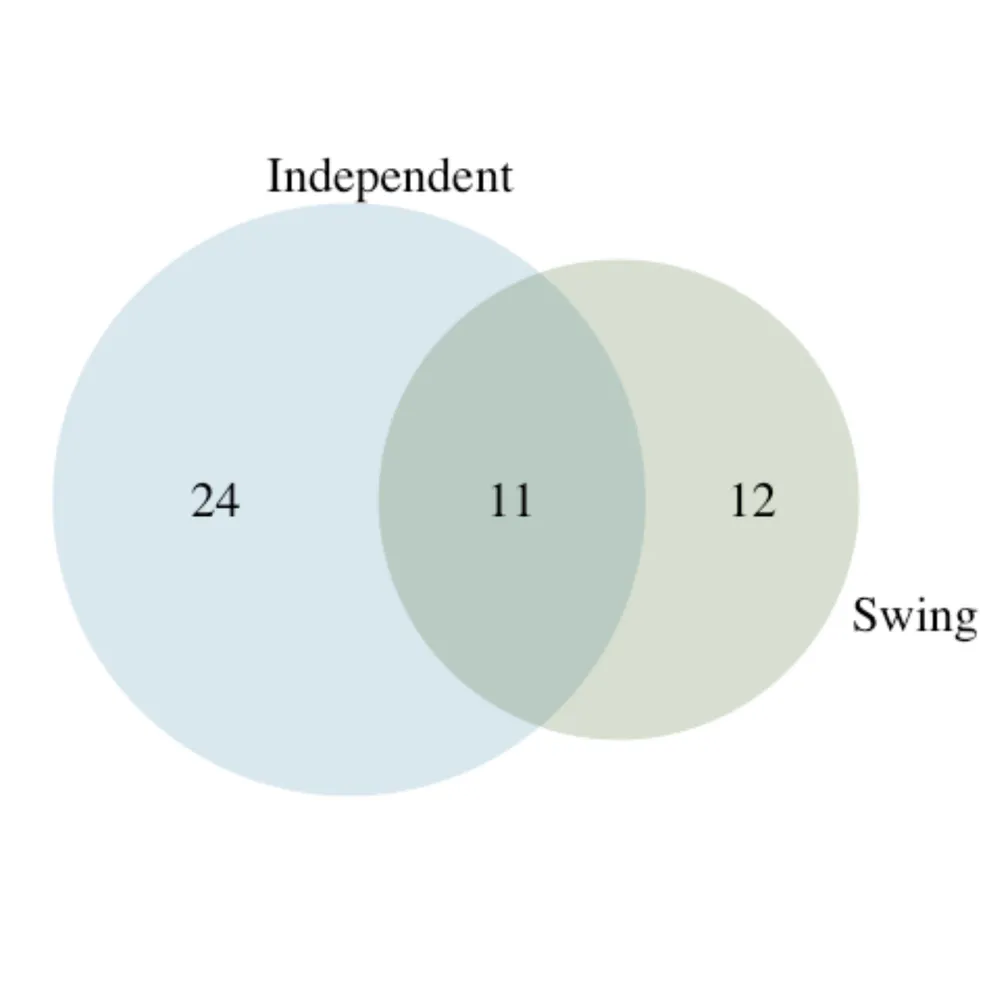
(c) Each Independent voter is either a swing voter or not. Since 35% of voters are Independents and 11% are both Independent and swing voters, the other 24% must not be swing voters. (d) 0.47. (e) 0.53. (f) P(Independent) P(swing) = , which does not equal P(Independent and swing) = 0.11, so the events are dependent.
9.87(a) If the class is not graded on a curve, they are independent. If graded on a curve, then neither independent nor disjoint – unless the instructor will only give one A, which is a situation we will ignore in parts (b) and (c). (b) They are probably not independent: if you study together, your study habits would be related, which suggests your course performances are also related. (c) No. See the answer to part (a) when the course is not graded on a curve. More generally: if two things are unrelated (independent), then one occurring does not preclude the other from occurring.
9.89(a) . (b) . (c) Assuming that the education level of the husband and wife are independent: . You might also notice we actually made a second assumption: that the decision to get married is unrelated to education level. (d) The husband/wife independence assumption is probably not reasonable, because people often marry another person with a comparable level of education. We will leave it to you to think about whether the second assumption noted in part (c) is reasonable.
9.91(a) No, but we could if A and B are independent. (b-i) 0.21. (b-ii) 0.79. (b-iii) 0.3. (c) No, because 0.1 0.21, where 0.21 was the value computed under independence from part (a). (d) 0.143.
9.93(a) No, 0.18 of respondents fall into this combination. (b) . (c) . (d) . (e) No, otherwise the answers to (c) and (d) would be the same. (f) .
9.95(a) No. There are 6 females who like Five Guys Burgers. (b) . (c) . (d) Under the assumption of a dating choices being independent of hamburger preference, which on the surface seems reasonable: . (e) .
9.97(a)
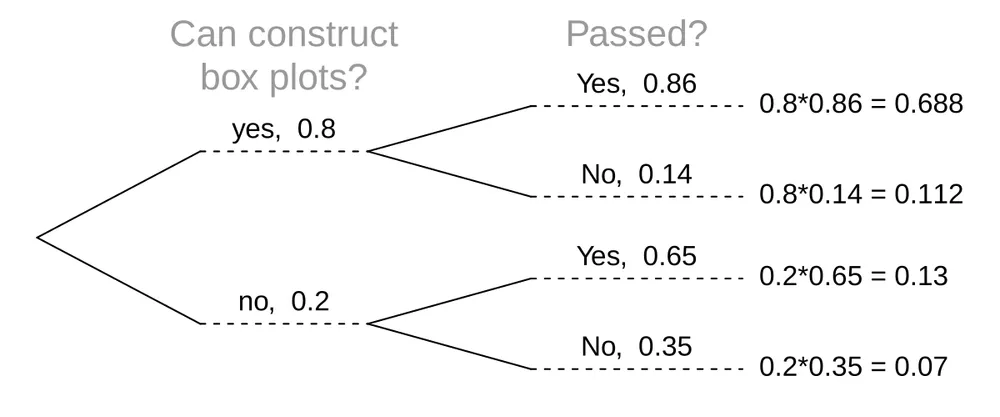 (b) 0.84
9.99. Even when a patient tests positive for lupus, there is only a 7.14% chance that he actually has lupus. House may be right.
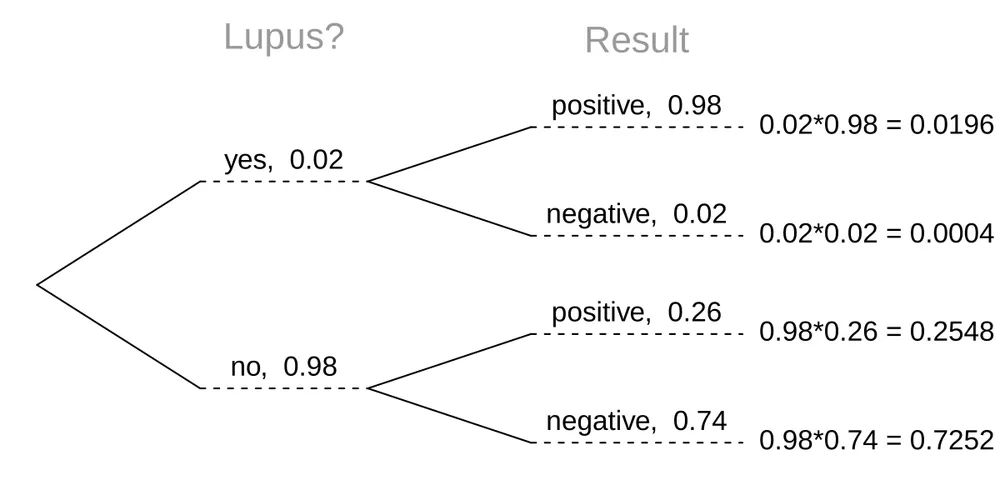
9.101(a) 0.3. (b) 0.3. (c) 0.3. (d) . (e) Yes, the population that is being sampled from is identical in each draw.
9.103(a) . (b) . (c) . (d) No, e.g. in this exercise, removing one chip meaningfully changes the probability of what might be drawn next.
9.105leggings, jeans, jeans. However, the person with leggings could have come 2nd or 3rd, and these each have this same probability, so .
9.107(a) 13. (b) No, these 27 students are not a random sample from the university’s student population. For example, it might be argued that the proportion of smokers among students who go to the gym at 9 am on a Saturday morning would be lower than the proportion of smokers in the university as a whole.
9.109(a) E(X) = 3.59. SD(X) = 9.64. (b) E(X) = -1.41. SD(X) = 9.64. (c) No, the expected net profit is negative, so on average you expect to lose money.
9.111% increase in value.
9.113E = -0.0526. SD = 0.9986.
9.115Approximate answers are OK.
(a) . (b) . (c) .
9.117(a) Invalid. Sum is greater than 1. (b) Valid. Probabilities are between 0 and 1, and they sum to 1. In this class, every student gets a C. (c) Invalid. Sum is less than 1. (d) Invalid. There is a negative probability. (e) Valid. Probabilities are between 0 and 1, and they sum to 1. (f) Invalid. There is a negative probability.
9.119.
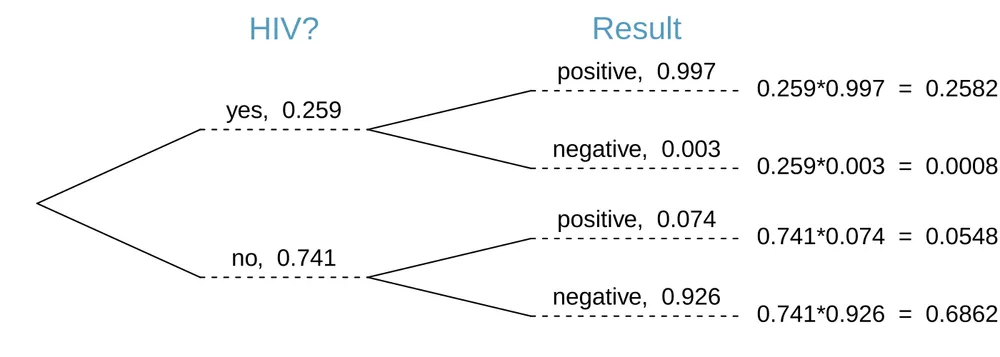
9.121(a) E = $3.90. SD = $0.34.
(b) E = $27.30. SD = $0.89.
9.123
9.125
(there are of these terms)