2.1: Elementary Derivative Rules
1. Derivative of a power function
2. Derivative of a rational function
3. Derivative of a root function
4. Derivative of a quadratic
5. Derivative of a sum of power functions
6. Simplifying a product before differentiating
7. Simplifying a quotient before differentiating
8. Finding a tangent line equation
9. Determining where
10
Let and be differentiable functions for which the following information is known:
- Let be the new function defined by the rule Determine and
- Find an equation for the tangent line to at the point
- Let be the function defined by the rule Is increasing, decreasing, or neither at Why?
- Estimate the value of by using the local linearization of at the point
11
Let functions and be the piecewise linear functions given by their respective graphs in Figure 2.1.6. Use the graphs to answer the following questions.
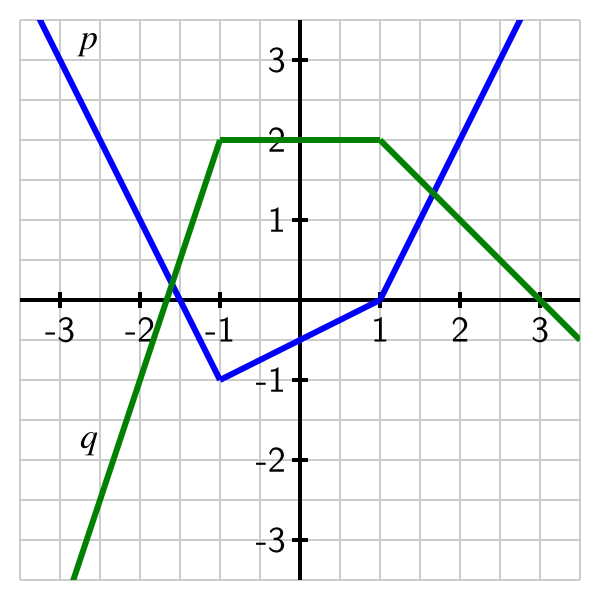
- At what values of is not differentiable? At what values of is not differentiable? Why?
- Let At what values of is not differentiable? Why?
- Determine and
- Find an equation for the tangent line to at the point
12
Consider the functions and for which you are given the facts that and Do not be concerned with where these derivative formulas come from. We restrict our interest in both functions to the domain
- Let Determine
- Find an equation for the tangent line to at the point
- Let Is increasing or decreasing at the instant Why?
13
Let The goal of this problem is to explore how the value of affects the derivative of without assuming we know the rule for that we have stated and used in earlier work in this section.
- Use the limit definition of the derivative to show that
- Explain why it is also true that
- Use computing technology and small values of to estimate the value of
when Do likewise when
- Note that it would be ideal if the value of the limit was for then would be a particularly special function: its derivative would be simply which would mean that its derivative is itself. By experimenting with different values of between and try to find a value for for which
- Compute and What does your work in (b) and (c) suggest is true about and
- How do your investigations in (d) lead to a particularly important fact about the function
2.2: The Sine and Cosine Function
1
Suppose that represents the value of a person's investment portfolio in thousands of dollars in year where corresponds to January 1, 2010.
- At what instantaneous rate is the portfolio's value changing on January 1, 2012? Include units on your answer.
- Determine the value of What are the units on this quantity and what does it tell you about how the portfolio's value is changing?
- On the interval graph the function and describe its behavior in the context of the problem. Then, compare the graphs of the functions and as well as the graphs of their derivatives and What is the impact of the term on the behavior of the function
2.
Let
- Determine the exact slope of the tangent line to at the point where
- Determine the tangent line approximation to at the point where
- At the point where is increasing, decreasing, or neither?
- At the point where does the tangent line to lie above the curve, below the curve, or neither? How can you answer this question without even graphing the function or the tangent line?
3
In this exercise, we explore how the limit definition of the derivative more formally shows that Letting note that the limit definition of the derivative tells us that
- Recall the trigonometric identity for the sine of a sum of angles and Use this identity and some algebra to show that
- Next, note that as changes, remains constant. Explain why it therefore makes sense to say that
- Finally, use small values of to estimate the values of the two limits in (c):
- What do your results in (b) and (c) thus tell you about
- By emulating the steps taken above, use the limit definition of the derivative to argue convincingly that
2.3: The Product and Quotient Rules
1. Derivative of a basic product
2. Derivative of a product
3. Derivative of a quotient of linear functions
4. Derivative of a rational function
5. Derivative of a product of trigonometric functions
6. Derivative of a product of power and trigonmetric functions
7. Derivative of a sum that involves a product
8. Product and quotient rules with graphs
9. Product and quotient rules with given function values
10
Let and be differentiable functions for which the following information is known:
- Let be the new function defined by the rule Determine and
- Find an equation for the tangent line to at the point (where is the function defined in (a)).
- Let be the function defined by the rule Is increasing, decreasing, or neither at Why?
- Estimate the value of (where is the function defined in (c)) by using the local linearization of at the point
11
Consider the functions and for which you are given the facts that and Do not be concerned with where these derivative formulas come from. We restrict our interest in both functions to the domain
- Let Determine
- Find an equation for the tangent line to at the point
- Let Is increasing or decreasing at the instant Why?
12
Let functions and be the piecewise linear functions given by their respective graphs in Figure 2.3.6. Use the graphs to answer the following questions.
- Let Determine and
- Are there values of for which does not exist? If so, which values, and why?
- Find an equation for the tangent line to at the point
- Let Determine and
- Are there values of for which does not exist? If so, which values, and why?
13
A farmer with large land holdings has historically grown a wide variety of crops. With the price of ethanol fuel rising, he decides that it would be prudent to devote more and more of his acreage to producing corn. As he grows more and more corn, he learns efficiencies that increase his yield per acre. In the present year, he used 7000 acres of his land to grow corn, and that land had an average yield of 170 bushels per acre. At the current time, he plans to increase his number of acres devoted to growing corn at a rate of 600 acres/year, and he expects that right now his average yield is increasing at a rate of 8 bushels per acre per year. Use this information to answer the following questions.
- Say that the present year is that denotes the number of acres the farmer devotes to growing corn in year represents the average yield in year (measured in bushels per acre), and is the total number of bushels of corn the farmer produces. What is the formula for in terms of and Why?
- What is the value of What does it measure?
- Write an expression for in terms of and Explain your thinking.
- What is the value of What does it measure?
- Based on the given information and your work above, estimate the value of
14
Let be the gas consumption (in liters/km) of a car going at velocity (in km/hour). In other words, tells you how many liters of gas the car uses to go one kilometer if it is traveling at kilometers per hour. In addition, suppose that and
- Let be the distance the same car goes on one liter of gas at velocity What is the relationship between and Hence find and
- Let be the gas consumption in liters per hour of a car going at velocity In other words, tells you how many liters of gas the car uses in one hour if it is going at velocity What is the algebraic relationship between and Hence find and
- How would you explain the practical meaning of these function and derivative values to a driver who knows no calculus? Include units on each of the function and derivative values you discuss in your response.
2.4: Derivatives of Other Trigonometric Functions
1. A sum and product involving
2. A quotient involving
3. A quotient of trigonometric functions
4. A quotient that involves a product
5. Finding a tangent line equation
6
An object moving vertically has its height at time (measured in feet, with time in seconds) given by the function
- What is the object's instantaneous velocity when
- What is the object's acceleration at the instant
- Describe in everyday language the behavior of the object at the instant
7
Let
- Use the product rule to find
- True or false: for all real numbers
- Explain why the function that you found in (a) is almost the opposite of the sine function, but not quite. (Hint: convert all of the trigonometric functions in (a) to sines and cosines, and work to simplify. Think carefully about the domain of and the domain of )
8
Let be given by the rule
- Determine
- Find an equation for the tangent line to at the point where
- At is increasing, decreasing, or neither? Why?
2.5: The Chain Rule
1. Mixing rules: chain, product, sum
2. Mixing rules: chain and product
3. Using the chain rule repeatedly
4. Derivative involving arbitrary constants and
5. Chain rule with graphs
6. Chain rule with function values
7. A product involving a composite function
8
Consider the basic functions and
- Let Find the exact instantaneous rate of change of at the point where
- Which function is changing most rapidly at or Why?
- Let and Which of these functions has a derivative that is periodic? Why?
9
Let be a differentiable function. For each of the following functions, determine the derivative. Each response will involve and/or
10
Let functions and be the piecewise linear functions given by their respective graphs in Figure 2.5.9. Use the graphs to answer the following questions.
- Let Determine and
- Find a value of for which does not exist. Explain your thinking.
- Let and Determine and
11
If a spherical tank of radius 4 feet has feet of water present in the tank, then the volume of water in the tank is given by the formula
- At what instantaneous rate is the volume of water in the tank changing with respect to the height of the water at the instant What are the units on this quantity?
- Now suppose that the height of water in the tank is being regulated by an inflow and outflow (e.g., a faucet and a drain) so that the height of the water at time is given by the rule where is measured in hours (and is still measured in feet). At what rate is the height of the water changing with respect to time at the instant
- Continuing under the assumptions in (b), at what instantaneous rate is the volume of water in the tank changing with respect to time at the instant
- What are the main differences between the rates found in (a) and (c)? Include a discussion of the relevant units.
2.6: Derivatives of Inverse Functions
1. Composite function involving logarithms and polynomials
2. Composite function involving trigonometric functions and logarithms
3. Product involving
4. Derivative involving
5. Composite function from a graph
6. Composite function involving an inverse trigonometric function
7. Mixing rules: product, chain, and inverse trig
8. Mixing rules: product and inverse trig
9
Determine the derivative of each of the following functions. Use proper notation and clearly identify the derivative rules you use.
10
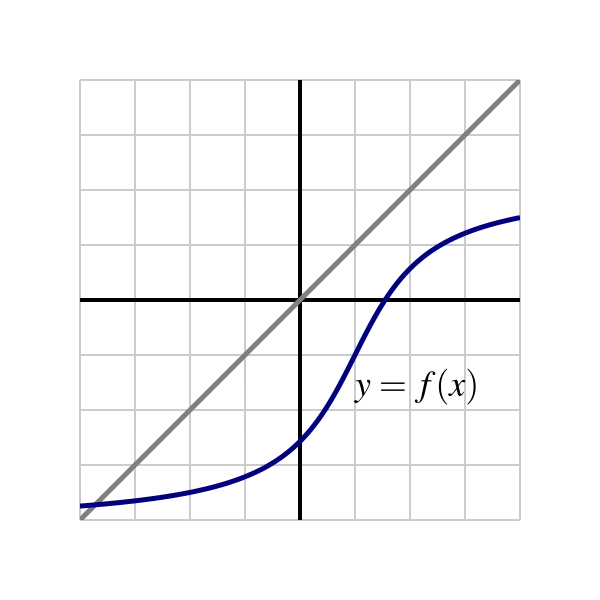
Consider the graph of provided in Figure 2.6.7 and use it to answer the following questions.
- Use the provided graph to estimate the value of
- Sketch an approximate graph of Label at least three distinct points on the graph that correspond to three points on the graph of
- Based on your work in (a), what is the value of Why?
11
Let
- Sketch a graph of and explain why is an invertible function.
- Let be the inverse of and determine a formula for
- Compute and What is the special relationship between and Why?
12
Let
- Sketch a graph of and explain why must be invertible.
- Explain why it does not appear to be algebraically possible to determine a formula for
- Observe that the point lies on the graph of Determine the value of
2.7: Derivatives of Functions Given Implicitely
1. Implicit differentiaion in a polynomial equation
2. Implicit differentiation in an equation with logarithms
3. Implicit differentiation in an equation with inverse trigonometric functions
4. Slope of the tangent line to an implicit curve
5. Equation of the tangent line to an implicit curve
6
Consider the curve given by the equation Find all points at which the tangent line to the curve is horizontal or vertical. Be sure to use a graphing utility to plot this implicit curve and to visually check the results of algebraic reasoning that you use to determine where the tangent lines are horizontal and vertical.
7
For the curve given by the equation find the equation of the tangent line to the curve at the point
8
Implicit differentiation enables us a different perspective from which to see why the rule holds, if we assume that This exercise leads you through the key steps to do so.
- Let Rewrite this equation using the natural logarithm function to write in terms of (and the constant ).
- Differentiate both sides of the equation you found in (a) with respect to keeping in mind that is implicitly a function of
- Solve the equation you found in (b) for and then use the definition of to write solely in terms of What have you found?
2.8: Using Derivatives to Evaluate Limits
1. L'Hôpital's Rule with graphs
2. L'Hôpital's Rule to evaluate a limit
3. Determining if L'Hôpital's Rule applies
4. Using L'Hôpital's Rule multiple times
5
Let and be differentiable functions about which the following information is known: and Let a new function be given by the rule On the same set of axes, sketch possible graphs of and near and use the provided information to determine the value of
Provide explanation to support your conclusion.
6
Find all vertical and horizontal asymptotes of the function
where and are distinct, arbitrary constants. In addition, state all values of for which is not continuous. Sketch a possible graph of clearly labeling the values of and
7
Consider the function which is defined for all Observe that is indeterminate due to its form of (Think about how we know that for all while for all but that neither rule can apply to )
- Let Explain why
- Next, explain why it is equivalent to write
- Use L'Hôpital's Rule and your work in (b) to compute
- Based on the value of determine
8
Recall we say that function dominates function provided that and
- Which function dominates the other: or
- Which function dominates the other: or ( can be any positive integer)
- Explain why will dominate any polynomial function.
- Explain why will dominate for any positive integer
- Give any example of two nonlinear functions such that neither dominates the other