Motivating Questions
- What does it mean to say that a curve is an implicit function of rather than an explicit function of
- How does implicit differentiation enable us to find a formula for when is an implicit function of
- In the context of an implicit curve, how can we use to answer important questions about the tangent line to the curve?
In all of our studies with derivatives so far, we have worked with functions whose formula is given explicitly in terms of But there are many interesting curves whose equations involving and are impossible to solve for in terms of
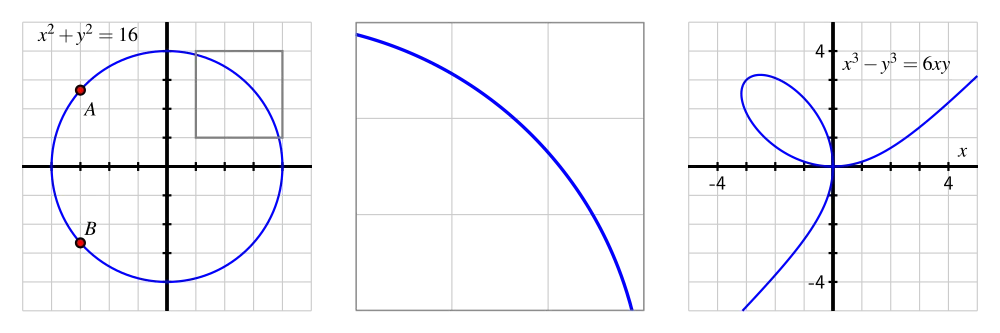
Perhaps the simplest and most natural of all such curves are circles. Because of the circle's symmetry, for each value strictly between the endpoints of the horizontal diameter, there are two corresponding -values. For instance, in Figure , we have labeled and and these points demonstrate that the circle fails the vertical line test. Hence, it is impossible to represent the circle through a single function of the form But portions of the circle can be represented explicitly as a function of such as the highlighted arc that is magnified in the center of Figure Moreover, it is evident that the circle is locally linear, so we ought to be able to find a tangent line to the curve at every point. Thus, it makes sense to wonder if we can compute at any point on the circle, even though we cannot write explicitly as a function of
We say that the equation defines implicitly as a function of The graph of the equation can be broken into pieces where each piece can be defined by an explicit function of For the circle, we could choose to take the top half as one function of namely and the bottom half as The equation for the circle defines two implicit functions of
The righthand curve in Figure is called a lemniscate and is just one of many fascinating possibilities for implicitly given curves.
How can we find an equation for without an explicit formula for in terms of The following preview activity reminds us of some ways we can compute derivatives of functions in settings where the function's formula is not known.
Preview Activity
Let be a differentiable function of (whose formula is not known) and recall that and are interchangeable notations. Determine each of the following derivatives of combinations of explicit functions of the unknown function and an arbitrary constant
Implicit Differentiation
We begin our exploration of implicit differentiation with the example of the circle given by How can we find a formula for
By viewing as an implicit function of we think of as some function whose formula is unknown, but which we can differentiate. Just as represents an unknown formula, so too its derivative with respect to will be (at least temporarily) unknown.
So we view as an unknown differentiable function of and differentiate both sides of the equation with respect to
On the right, the derivative of the constant is and on the left we can apply the sum rule, so it follows that
Note carefully the different roles being played by and Because is the independent variable, But is the dependent variable and is an implicit function of Recall Preview Activity , where we computed Computing is the same, and requires the chain rule, by which we find that We now have that
We solve this equation for by subtracting from both sides and dividing by
There are several important things to observe about the result that First, this expression for the derivative involves both and This makes sense because there are two corresponding points on the circle for each value of between and and the slope of the tangent line is different at each of these points.
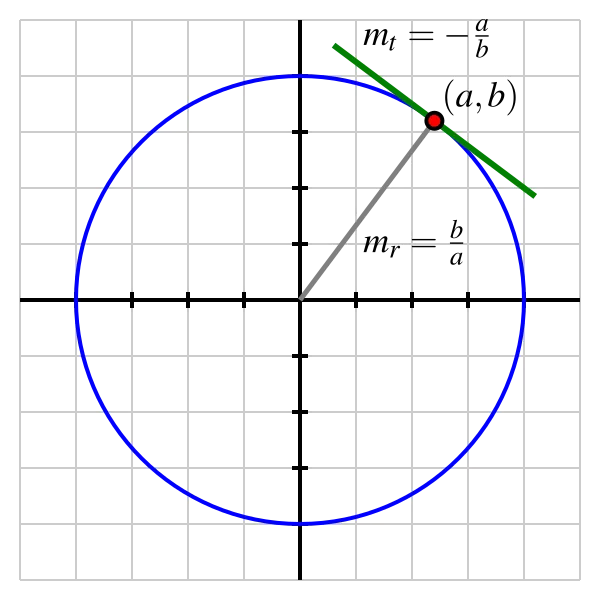
Second, this formula is entirely consistent with our understanding of circles. The slope of the radius from the origin to the point is The tangent line to the circle at is perpendicular to the radius, and thus has slope as shown in Figure . In particular, the slope of the tangent line is zero at and and is undefined at and All of these values are consistent with the formula
Example
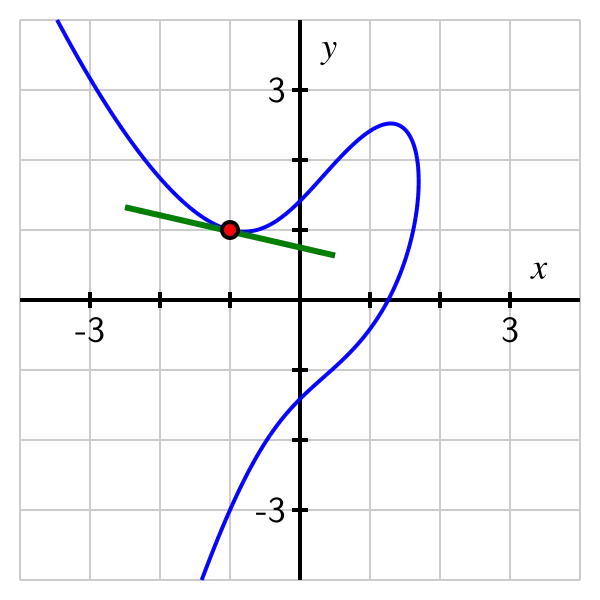
For the curve given implicitly by shown in Figure , find the slope of the tangent line at
- Answer
-
We begin by differentiating the curve's equation implicitly. Taking the derivative of each side with respect to
by the sum rule and the fact that the derivative of a constant is zero, we have
For the three derivatives we now must execute, the first uses the simple power rule, the second requires the chain rule (since is an implicit function of ), and the third necessitates the product rule (again since is a function of ). Applying these rules, we now find that
We want to solve this equation for To do so, we first collect all of the terms involving on one side of the equation.
Then we factor the left side to isolate
Finally, we divide both sides by and conclude that
Note that the expression for depends on both and To find the slope of the tangent line at we substitute the coordinates into the formula for using the notation
This value matches our visual estimate of the slope of the tangent line shown in Figure .
Example shows that it is possible when differentiating implicitly to have multiple terms involving We use addition and subtraction to collect all terms involving on one side of the equation, then factor to get a single term of Finally, we divide to solve for
We use the notation
to denote the evaluation of at the point This is analogous to writing when depends on a single variable.
There is a big difference between writing and For example,
gives an instruction to take the derivative with respect to of the quantity presumably where is a function of On the other hand,
means the product of the derivative of with respect to with the quantity Understanding this notational subtlety is essential.
Activity
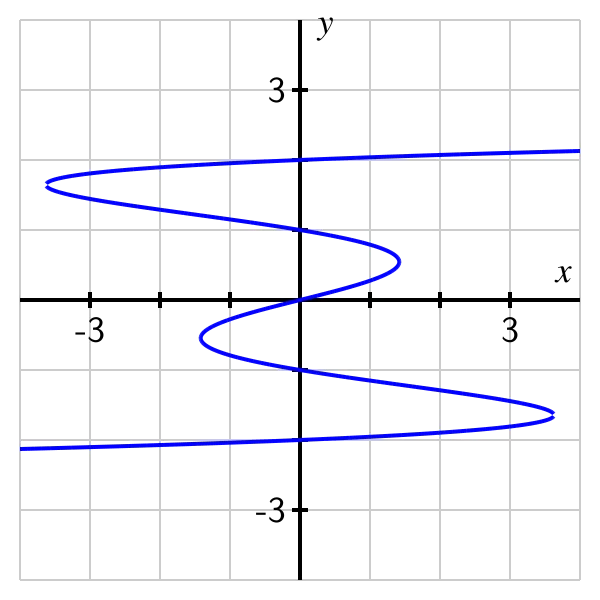
Consider the curve defined by the equation whose graph is pictured in Figure .
- Explain why it is not possible to express as an explicit function of
- Use implicit differentiation to find a formula for
- Use your result from part (b) to find an equation of the line tangent to the graph of at the point
- Use your result from part (b) to determine all of the points at which the graph of has a vertical tangent line.
It is natural to ask where the tangent line to a curve is vertical or horizontal. The slope of a horizontal tangent line must be zero, while the slope of a vertical tangent line is undefined. Often the formula for is expressed as a quotient of functions of and say
The tangent line is horizontal precisely when the numerator is zero and the denominator is nonzero, making the slope of the tangent line zero. If we can solve the equation for either and in terms of the other, we can substitute that expression into the original equation for the curve. This gives an equation in a single variable, and if we can solve that equation we can find the point(s) on the curve where At those points, the tangent line is horizontal.
Similarly, the tangent line is vertical whenever and making the slope undefined.
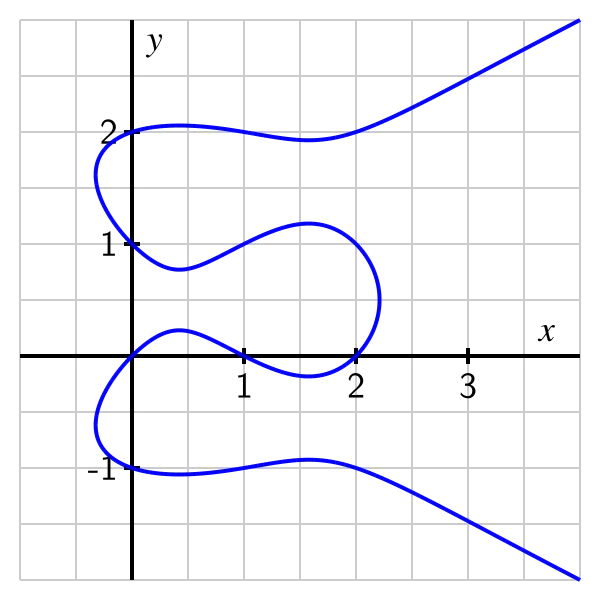
Activity
Consider the curve defined by the equation whose graph is pictured in Figure . Through implicit differentiation, it can be shown that
Use this fact to answer each of the following questions.
- Determine all points at which the tangent line to the curve is horizontal. (Use technology appropriately to find the needed zeros of the relevant polynomial function.)
- Determine all points at which the tangent line is vertical. (Use technology appropriately to find the needed zeros of the relevant polynomial function.)
- Find the equation of the tangent line to the curve at one of the points where
Activity
For each of the following curves, use implicit differentiation to find and determine the equation of the tangent line at the given point.
Summary
- In an equation involving and where portions of the graph can be defined by explicit functions of we say that is an implicit function of A good example of such a curve is the unit circle.
- We use implicit differentiation to differentiate an implicitly defined function. We differentiate both sides of the equation with respect to treating as a function of by applying the chain rule. If possible, we subsequently solve for using algebra.
- While may now involve both the variables and still gives the slope of the tangent line to the curve. It may be used to decide where the tangent line is horizontal () or vertical ( is undefined), or to find the equation of the tangent line at a particular point on the curve.