Motivating Questions
- What is the derivative of the natural logarithm function?
- What are the derivatives of the inverse trigonometric functions and
- If is the inverse of a differentiable function how is computed in terms of and
Much of mathematics centers on the notion of function. Indeed, throughout our study of calculus, we are investigating the behavior of functions, with particular emphasis on how fast the output of the function changes in response to changes in the input. Because each function represents a process, a natural question to ask is whether or not the particular process can be reversed. That is, if we know the output that results from the function, can we determine the input that led to it? And if we know how fast a particular process is changing, can we determine how fast the inverse process is changing?
One of the most important functions in all of mathematics is the natural exponential function Its inverse, the natural logarithm, is similarly important. One of our goals in this section is to learn how to differentiate the logarithm function. First, we review some of the basic concepts surrounding functions and their inverses.
Preview Activity
The equation relates a temperature given in degrees Fahrenheit to the corresponding temperature measured in degrees Celsius.
- Solve the equation for to write (Fahrenheit temperature) in terms of (Celsius temperature).
- Let be the function that takes a Fahrenheit temperature as input and produces the Celsius temperature as output. In addition, let be the function that converts a temperature given in degrees Celsius to the temperature measured in degrees Fahrenheit. Use your work in (a) to write a formula for
- Next consider the new function defined by Use the formulas for and to determine an expression for and simplify this expression as much as possible. What do you observe?
- Now, let Use the formulas for and to determine an expression for and simplify this expression as much as possible. What do you observe?
- What is the value of of How do these values appear to be related?
Basic facts about inverse functions
A function is a rule that associates each element in the set to one and only one element in the set We call the domain of and the codomain of If there exists a function such that for every possible choice of in the set and for every in the set then we say that is the inverse of
We often use the notation (read “-inverse”) to denote the inverse of The inverse function undoes the work of Indeed, if then
Thus, the equations and say the same thing. The only difference between the two equations is one of perspective — one is solved for while the other is solved for
Here we briefly remind ourselves of some key facts about inverse functions.
Note
For a function
- has an inverse if and only if is one-to-one 1 and onto 2 ;
- provided exists, the domain of is the codomain of and the codomain of is the domain of
- for every in the domain of and for every in the codomain of
- if and only if
A function is one-to-one provided that no two distinct inputs lead to the same output.
A function is onto provided that every possible element of the codomain can be realized as an output of the function for some choice of input from the domain.
The last fact reveals a special relationship between the graphs of and If a point that lies on the graph of then it is also true that which means that the point lies on the graph of This shows us that the graphs of and are the reflections of each other across the line because this reflection is precisely the geometric action that swaps the coordinates in an ordered pair. In Figure 2.6.2, we see this illustrated by the function and its inverse, with the points and highlighting the reflection of the curves across
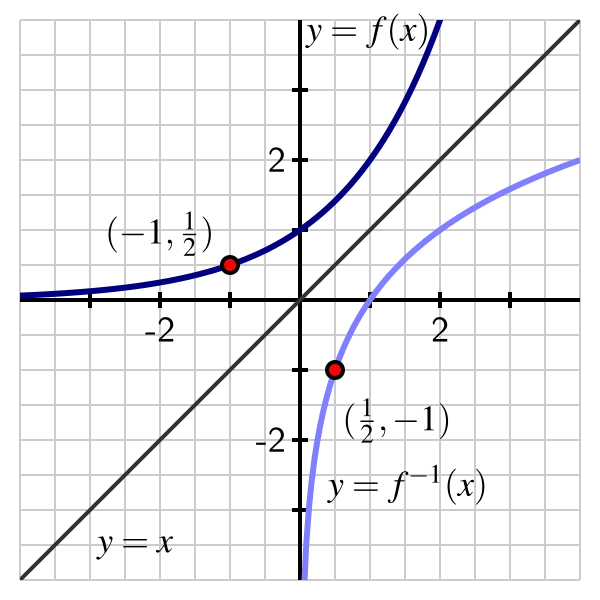
To close our review of important facts about inverses, we recall that the natural exponential function has an inverse function, namely the natural logarithm, Thus, writing is interchangeable with plus for every real number and for every positive real number
The derivative of the natural logarithm function
In what follows, we find a formula for the derivative of To do so, we take advantage of the fact that we know the derivative of the natural exponential function, the inverse of In particular, we know that writing is equivalent to writing Now we differentiate both sides of this equation and observe that
The righthand side is simply by applying the chain rule to the left side, we find that
Next we solve for to get
Finally, we recall that so and thus
Natural Logarithm
For all positive real numbers
This rule for the natural logarithm function now joins our list of basic derivative rules. Note that this rule applies only to positive values of as these are the only values for which is defined.
Also notice that for the first time in our work, differentiating a basic function of a particular type has led to a function of a very different nature: the derivative of the natural logarithm is not another logarithm, nor even an exponential function, but rather a rational one.
Derivatives of logarithms may now be computed in concert with all of the rules known to date. For instance, if then by the chain rule,
There are interesting connections between the graphs of and
In Figure 2.6.3, we are reminded that since the natural exponential function has the property that its derivative is itself, the slope of the tangent to is equal to the height of the curve at that point. For instance, at the point the slope of the tangent line is and at the tangent line's slope is
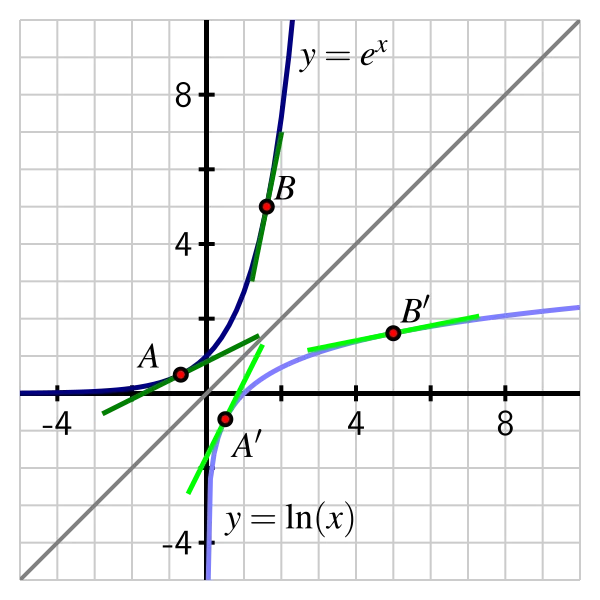
At the corresponding points and on the graph of the natural logarithm function (which come from reflecting and across the line ), we know that the slope of the tangent line is the reciprocal of the -coordinate of the point (since ). Thus, at we have and at
In particular, we observe that and This is not a coincidence, but in fact holds for any curve and its inverse, provided the inverse exists. This is due to the reflection across It changes the roles of and thus reversing the rise and run, so the slope of the inverse function at the reflected point is the reciprocal of the slope of the original function.
Activity
For each function given below, find its derivative.
Inverse trigonometric functions and their derivatives
Trigonometric functions are periodic, so they fail to be one-to-one, and thus do not have inverse functions. However, we can restrict the domain of each trigonometric function so that it is one-to-one on that domain.
For instance, consider the sine function on the domain Because no output of the sine function is repeated on this interval, the function is one-to-one and thus has an inverse. Thus, the function with and codomain has an inverse function such that
We call the arcsine (or inverse sine) function and write It is especially important to remember that
say the same thing. “The arcsine of ” means “the angle whose sine is ” For example, means that is the angle whose sine is which is equivalent to writing
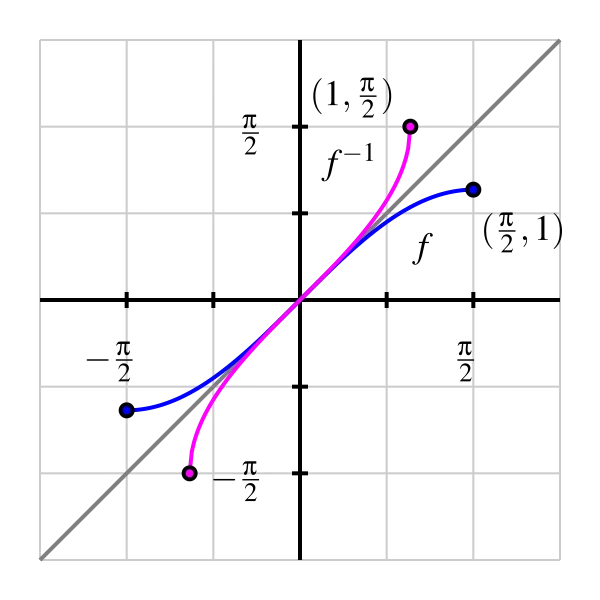
Next, we determine the derivative of the arcsine function. Letting our goal is to find Since is the angle whose sine is it is equivalent to write
Differentiating both sides of the previous equation, we have
The righthand side is simply and by applying the chain rule applied to the left side,
Solving for it follows that
Finally, we recall that so the denominator of is the function or in other words, “the cosine of the angle whose sine is ” A bit of right triangle trigonometry allows us to simplify this expression considerably.
Let's say that so that is the angle whose sine is We can picture as an angle in a right triangle with hypotenuse and a vertical leg of length as shown in Figure 2.6.5. The horizontal leg must be by the Pythagorean Theorem.
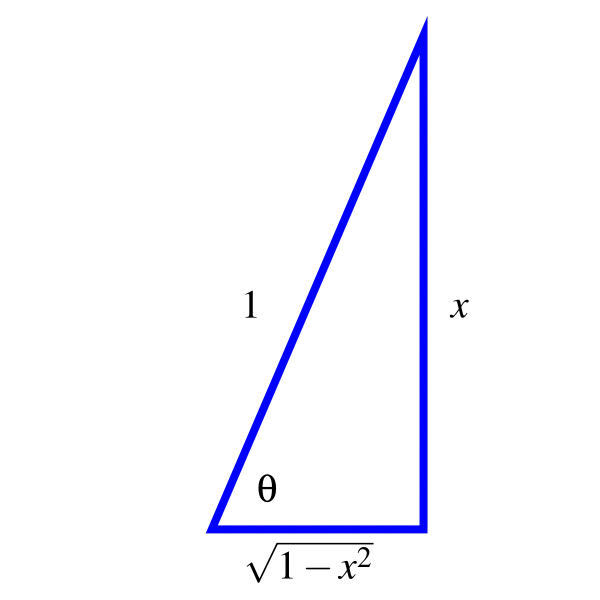
Now, because the expression for is equivalent to From the figure,
Substituting this expression into our formula, we have now shown that
Inverse sine
For all real numbers such that
Activity
The following prompts in this activity will lead you to develop the derivative of the inverse tangent function.
- Let Use the relationship between the arctangent and tangent functions to rewrite this equation using only the tangent function.
- Differentiate both sides of the equation you found in (a). Solve the resulting equation for writing as simply as possible in terms of a trigonometric function evaluated at
- Recall that Update your expression for so that it only involves trigonometric functions and the independent variable
- Introduce a right triangle with angle so that What are the three sides of the triangle?
- In terms of only and what is the value of
- Use the results of your work above to find an expression involving only and for
While derivatives for other inverse trigonometric functions can be established similarly, for now we limit ourselves to the arcsine and arctangent functions.
Activity
Determine the derivative of each of the following functions.
The link between the derivative of a function and the derivative of its inverse
In Figure 2.6.3, we saw an interesting relationship between the slopes of tangent lines to the natural exponential and natural logarithm functions at points reflected across the line In particular, we observed that at the point on the graph of the slope of the tangent line is while at the corresponding point on the graph of the slope of the tangent line is which is the reciprocal of
That the two corresponding tangent lines have reciprocal slopes is not a coincidence. If and are differentiable inverse functions, then if and only if then for every in the domain of Differentiating both sides of this equation, we have
and by the chain rule,
Solving for we have Here we see that the slope of the tangent line to the inverse function at the point is precisely the reciprocal of the slope of the tangent line to the original function at the point
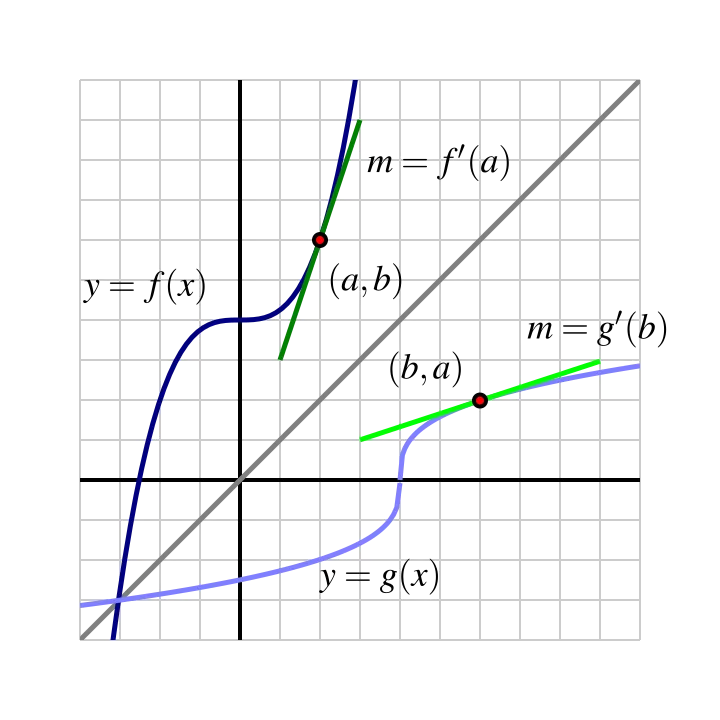
To see this more clearly, consider the graph of the function shown in Figure 2.6.6, along with its inverse Given a point that lies on the graph of we know that lies on the graph of because and Now, applying the rule that to the value we have
which is precisely what we see in the figure: the slope of the tangent line to at is the reciprocal of the slope of the tangent line to at since these two lines are reflections of one another across the line
Derivative of an inverse function
Suppose that is a differentiable function with inverse and that is a point that lies on the graph of at which Then
More generally, for any in the domain of we have
The rules we derived for and are all just specific examples of this general property of the derivative of an inverse function. For example, with and it follows that
Summary
- For all positive real numbers
- For all real numbers such that In addition, for all real numbers
- If is the inverse of a differentiable function then for any point in the domain of