Motivating Questions
- How do we define a double integral over a non-rectangular region?
- What general form does an iterated integral over a non-rectangular region have?
Recall that we defined the double integral of a continuous function over a rectangle as
where the notation is as described in Section 11.1. Furthermore, we have seen that we can evaluate a double integral over as an iterated integral of either of the forms
It is natural to wonder how we might define and evaluate a double integral over a non-rectangular region; we explore one such example in the following preview activity.
Preview Activity
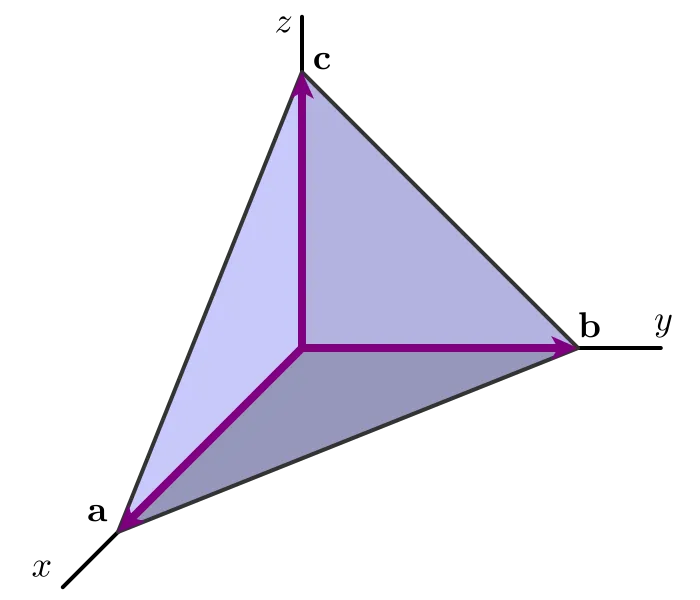
A tetrahedron is a three-dimensional figure with four faces, each of which is a triangle. A picture of the tetrahedron with vertices and is shown at left in Figure . If we place one vertex at the origin and let vectors and be determined by the edges of the tetrahedron that have one end at the origin, then a formula that tells us the volume of the tetrahedron is
- Use the formula () to find the volume of the tetrahedron
- Instead of memorizing or looking up the formula for the volume of a tetrahedron, we can use a double integral to calculate the volume of the tetrahedron To see how, notice that the top face of the tetrahedron is the plane whose equation is
Provided that we can use an iterated integral on a non-rectangular region, the volume of the tetrahedron will be given by an iterated integral of the form
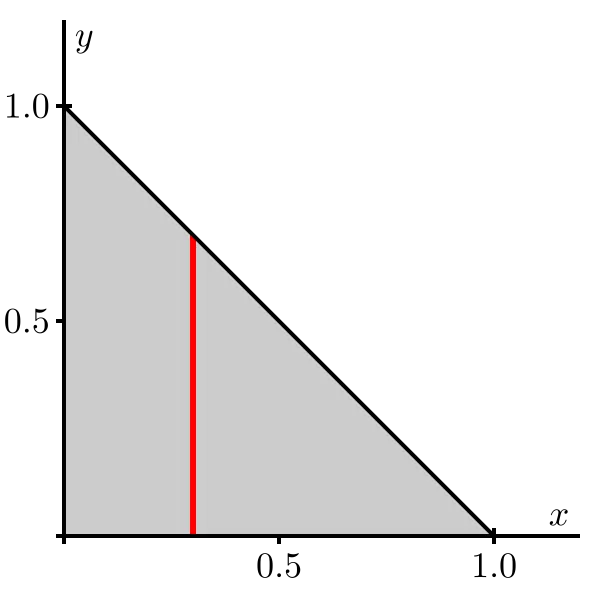
The issue that is new here is how we find the limits on the integrals; note that the outer integral's limits are in while the inner ones are in since we have chosen To see the domain over which we need to integrate, think of standing way above the tetrahedron looking straight down on it, which means we are projecting the entire tetrahedron onto the -plane. The resulting domain is the triangular region shown at right in Figure . Explain why we can represent the triangular region with the inequalities
(Hint: Consider the cross sectional slice shown at right in Figure .)
- Explain why it makes sense to now write the volume integral in the form
- Use the Fundamental Theorem of Calculus to evaluate the iterated integral
and compare to your result from part (a). (As with iterated integrals over rectangular regions, start with the inner integral.)
So far, we have learned that a double integral over a rectangular region may be interpreted in one of two ways:
- tells us the volume of the solids the graph of bounds above the -plane over the rectangle minus the volume of the solids the graph of bounds below the -plane under the rectangle
- where is the area of tells us the average value of the function on If on we can interpret this average value of on as the height of the box with base that has the same volume as the volume of the surface defined by over
As we saw in Preview Activity 11.1.1, a function may be considered over regions other than rectangular ones, and thus we want to understand how to set up and evaluate double integrals over non-rectangular regions. Note that if we can, then the two interpretations of the double integral noted above will naturally extend to solid regions with non-rectangular bases.
So, suppose is a continuous function on a closed, bounded domain For example, consider as the circular domain shown at left in Figure .
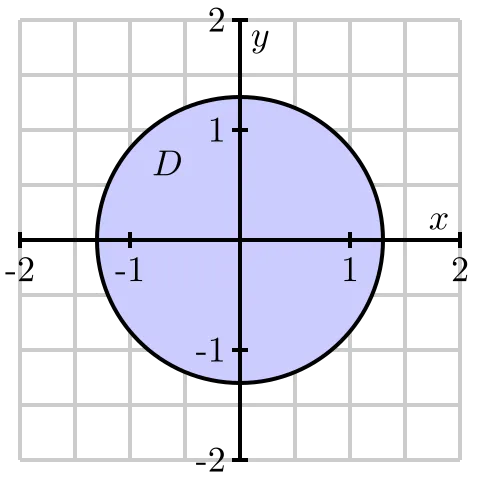
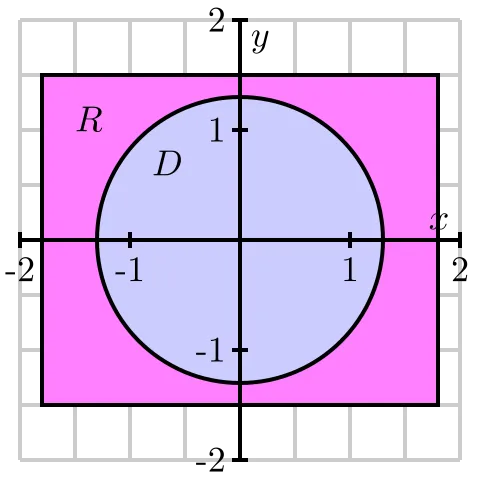
We can enclose in a rectangular domain as shown at right in Figure and extend the function to be defined over in order to be able to use the definition of the double integral over a rectangle. We extend in such a way that its values at the points in that are not in contribute 0 to the value of the integral. In other words, define a function on as
We then say that the double integral of over is the same as the double integral of over and thus
In practice, we just ignore everything that is in but not in since these regions contribute 0 to the value of the integral.
Just as with double integrals over rectangles, a double integral over a domain can be evaluated as an iterated integral. If the region can be described by the inequalities and where and are functions of only then
Alternatively, if the region is described by the inequalities and where and are functions of only we have
The structure of an iterated integral is of particular note:
In an iterated double integral:
- the limits on the outer integral must be constants;
- the limits on the inner integral must be constants or in terms of only the remaining variable — that is, if the inner integral is with respect to then its limits may only involve and constants, and vice versa.
We next consider a detailed example.
Example
Let be defined on the triangle with vertices and as shown at left in Figure .
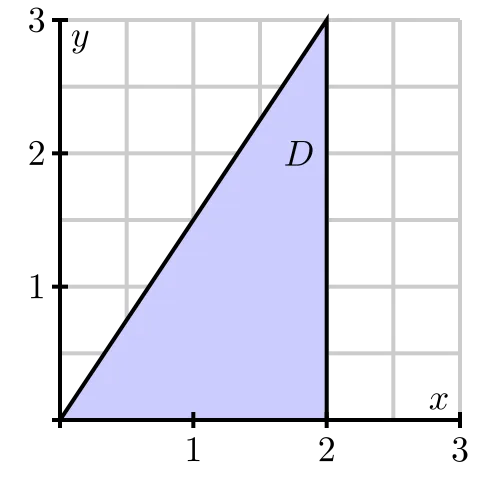
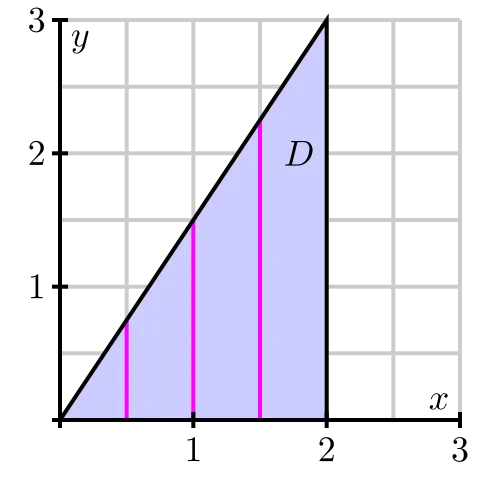
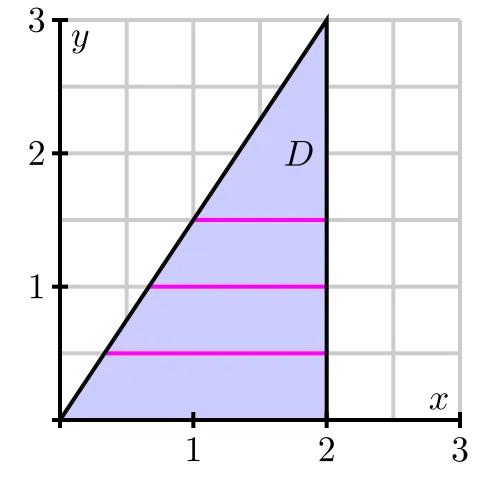
To evaluate we must first describe the region in terms of the variables and We take two approaches.
- Approach 1: Integrate first with respect to
-
In this case we choose to evaluate the double integral as an iterated integral in the form
and therefore we need to describe in terms of inequalities
Since we are integrating with respect to first, the iterated integral has the form
where is a cross sectional area in the direction. So we are slicing the domain perpendicular to the -axis and want to understand what a cross sectional area of the overall solid will look like. Several slices of the domain are shown in the middle image in Figure . On a slice with fixed value, the values are bounded below by 0 and above by the coordinate on the hypotenuse of the right triangle. Thus, to find we need to write the hypotenuse as a function of The hypotenuse connects the points (0,0) and (2,3) and hence has equation This gives the upper bound on as The leftmost vertical cross section is at and the rightmost one is at so we have and Therefore,
We evaluate the iterated integral by applying the Fundamental Theorem of Calculus first to the inner integral, and then to the outer one, and find that
- Approach 2: Integrate first with respect to
-
In this case, we choose to evaluate the double integral as an iterated integral in the form
and thus need to describe in terms of inequalities
Since we are integrating with respect to first, the iterated integral has the form
where is a cross sectional area of the solid in the direction. Several slices of the domain — perpendicular to the -axis — are shown at right in Figure . On a slice with fixed value, the values are bounded below by the coordinate on the hypotenuse of the right triangle and above by 2. So to find we need to write the hypotenuse as a function of Solving the earlier equation we have for the hypotenuse () for gives us This makes The lowest horizontal cross section is at and the uppermost one is at so we have and Therefore,
We evaluate the resulting iterated integral as before by twice applying the Fundamental Theorem of Calculus, and find that
We see, of course, that in the situation where can be described in two different ways, the order in which we choose to set up and evaluate the double integral doesn't matter, and the same value results in either case.
The meaning of a double integral over a non-rectangular region, parallels the meaning over a rectangular region. In particular,
- tells us the volume of the solids the graph of bounds above the -plane over the closed, bounded region minus the volume of the solids the graph of bounds below the -plane under the region
- where is the area of tells us the average value of the function on If on we can interpret this average value of on as the height of the solid with base and constant cross-sectional area that has the same volume as the volume of the surface defined by over
Activity
Consider the double integral where is the triangular region with vertices (0,0), (4,0), and (0,2).
- Write the given integral as an iterated integral of the form Draw a labeled picture of with relevant cross sections.
- Write the given integral as an iterated integral of the form Draw a labeled picture of with relevant cross sections.
- Evaluate the two iterated integrals from (a) and (b), and verify that they produce the same value. Give at least one interpretation of the meaning of your result.
Activity
Consider the iterated integral
- Sketch the region of integration, for which
- Determine the equivalent iterated integral that results from integrating in the opposite order ( instead of ). That is, determine the limits of integration for which
- Evaluate one of the two iterated integrals above. Explain what the value you obtained tells you.
- Set up and evaluate a single definite integral to determine the exact area of
- Determine the exact average value of over
Activity
Consider the iterated integral
- Explain why we cannot find a simple antiderivative for with respect to and thus are unable to evaluate in the indicated order using the Fundamental Theorem of Calculus.
- Given that sketch the region of integration,
- Rewrite the given iterated integral in the opposite order, using (Hint: You may need more than one integral.)
- Use the Fundamental Theorem of Calculus to evaluate the iterated integral you developed in (c). Write one sentence to explain the meaning of the value you found.
- What is the important lesson this activity offers regarding the order in which we set up an iterated integral?
Summary
- For a double integral over a non-rectangular region we enclose in a rectangle and then extend integrand to a function so that at all points in outside of and for all points in We then define to be equal to
- In an iterated double integral, the limits on the outer integral must be constants while the limits on the inner integral must be constants or in terms of only the remaining variable. In other words, an iterated double integral has one of the following forms (which result in the same value):
where and are functions of only and the region is described by the inequalities and or
where and are functions of only and the region is described by the inequalities and