11.1: Double Riemann Sums and Double Integrals over Rectangles
Motivating Questions
What is a double Riemann sum?
How is the double integral of a continuous function defined?
What are two things the double integral of a function can tell us?
In single-variable calculus, recall that we approximated the area under the graph of a positive function on an interval by adding areas of rectangles whose heights are determined by the curve. The general process involved subdividing the interval into smaller subintervals, constructing rectangles on each of these smaller intervals to approximate the region under the curve on that subinterval, then summing the areas of these rectangles to approximate the area under the curve. We will extend this process in this section to its three-dimensional analogs, double Riemann sums and double integrals over rectangles.
Preview Activity
In this activity we introduce the concept of a double Riemann sum.
Review the concept of the Riemann sum from single-variable calculus. Then, explain how we define the definite integral of a continuous function of a single variable on an interval Include a sketch of a continuous function on an interval with appropriate labeling in order to illustrate your definition.
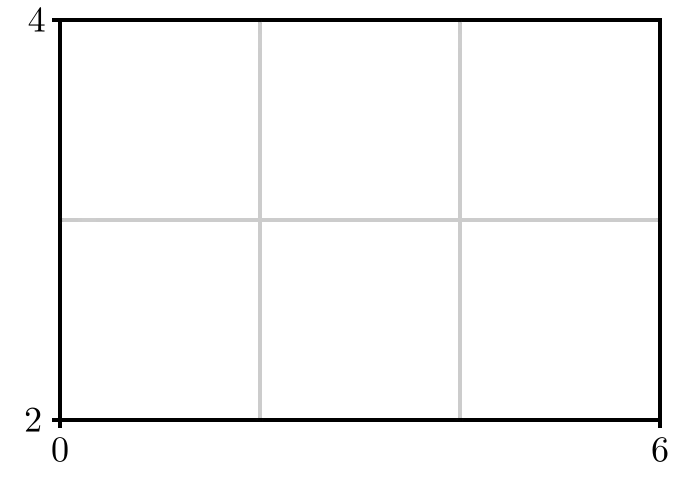
In our upcoming study of integral calculus for multivariable functions, we will first extend the idea of the single-variable definite integral to functions of two variables over rectangular domains. To do so, we will need to understand how to partition a rectangle into subrectangles. Let be rectangular domain (we can also represent this domain with the notation ), as pictured in Figure .
Figure . Rectangular domain with subrectangles.
To form a partition of the full rectangular region, we will partition both intervals and in particular, we choose to partition the interval into three uniformly sized subintervals and the interval into two evenly sized subintervals as shown in Figure . In the following questions, we discuss how to identify the endpoints of each subinterval and the resulting subrectangles.
Let be the endpoints of the subintervals of after partitioning. What is the length of each subinterval for from 1 to 3?
Explicitly identify and On Figure or your own version of the diagram, label these endpoints.
Let be the endpoints of the subintervals of after partitioning. What is the length of each subinterval for from 1 to 2? Identify and and label these endpoints on Figure .
Let denote the subrectangle Appropriately label each subrectangle in your drawing of Figure . How does the total number of subrectangles depend on the partitions of the intervals and
What is area of each subrectangle?
Double Riemann Sums over Rectangles
For the definite integral in single-variable calculus, we considered a continuous function over a closed, bounded interval In multivariable calculus, we will eventually develop the idea of a definite integral over a closed, bounded region (such as the interior of a circle). We begin with a simpler situation by thinking only about rectangular domains, and will address more complicated domains in Section 11.3.
Let be a continuous function defined on a rectangular domain As we saw in Preview Activity , the domain is a rectangle and we want to partition into subrectangles. We do this by partitioning each of the intervals and into subintervals and using those subintervals to create a partition of into subrectangles. In the first activity, we address the quantities and notations we will use in order to define double Riemann sums and double integrals.
Activity
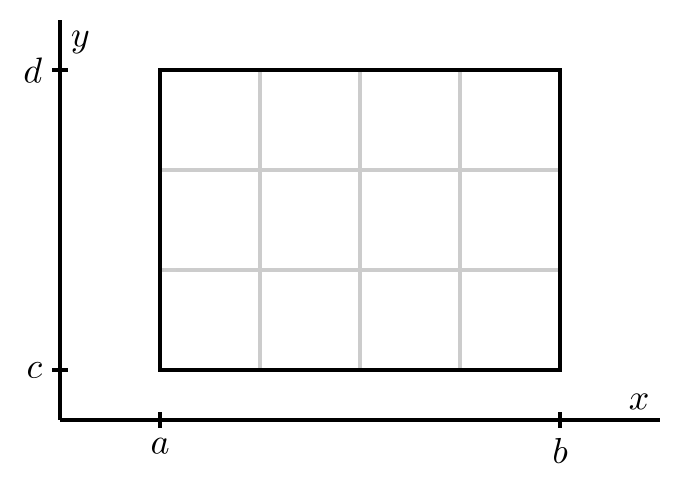
Let be defined on the rectangular domain Partition the interval into four uniformly sized subintervals and the interval into three evenly sized subintervals as shown in Figure . As we did in Preview Activity , we will need a method for identifying the endpoints of each subinterval and the resulting subrectangles.
Figure . Rectangular domain with subrectangles.
Let be the endpoints of the subintervals of after partitioning. Label these endpoints in Figure .
What is the length of each subinterval Your answer should be in terms of and
Let be the endpoints of the subintervals of after partitioning. Label these endpoints in Figure .
What is the length of each subinterval Your answer should be in terms of and
The partitions of the intervals and partition the rectangle into subrectangles. How many subrectangles are there?
Let denote the subrectangle Label each subrectangle in Figure .
What is area of each subrectangle?
Now let and Let be the point in the upper right corner of the subrectangle Identify and correctly label this point in Figure . Calculate the product
Explain, geometrically, what this product represents.
For each and choose a point in the subrectangle Identify and correctly label these points in Figure . Explain what the product
represents.
If we were to add all the values for each and what does the resulting number approximate about the surface defined by on the domain (You don't actually need to add these values.)
Write a double sum using summation notation that expresses the arbitrary sum from part ().
Double Riemann Sums and Double Integrals
Now we use the process from the most recent activity to formally define double Riemann sums and double integrals.
Definition
Let be a continuous function on a rectangle A double Riemann sum for over is created as follows.
Partition the interval into subintervals of equal length Let be the endpoints of these subintervals, where
Partition the interval into subintervals of equal length Let be the endpoints of these subintervals, where
These two partitions create a partition of the rectangle into subrectangles with opposite vertices and for between and and between and These rectangles all have equal area
Choose a point in each rectangle Then, a double Riemann sum for over is given by
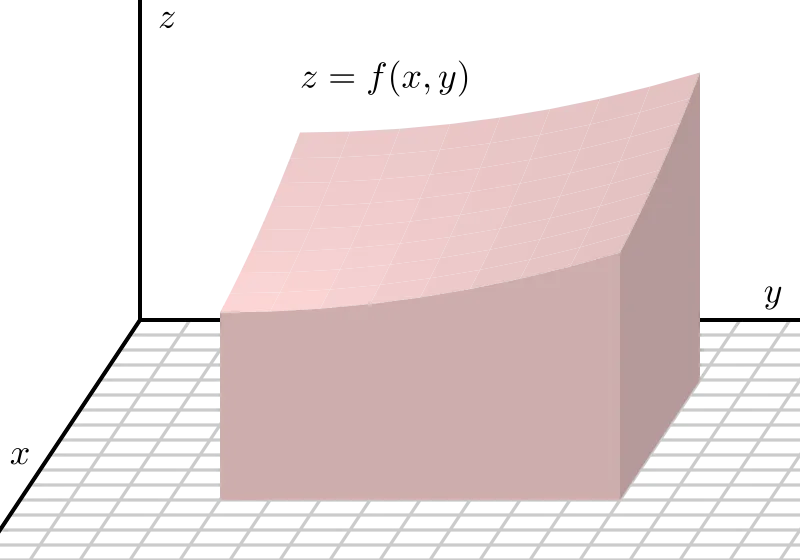
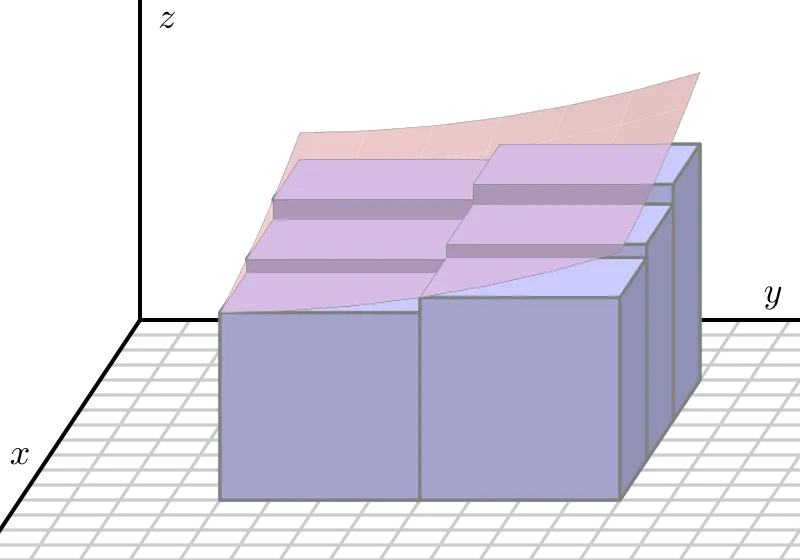
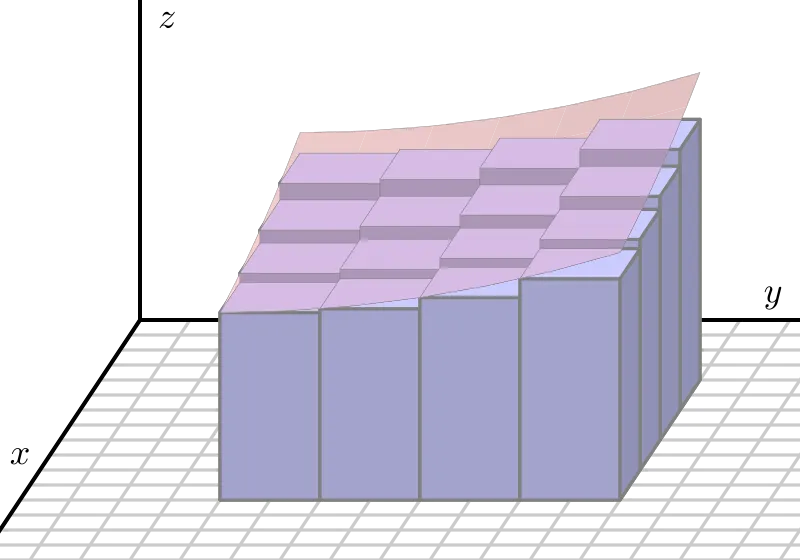
If on the rectangle we may ask to find the volume of the solid bounded above by over as illustrated on the left of Figure . This volume is approximated by a Riemann sum, which sums the volumes of the rectangular boxes shown on the right of Figure .
Figure . The volume under a graph approximated by a Riemann Sum.
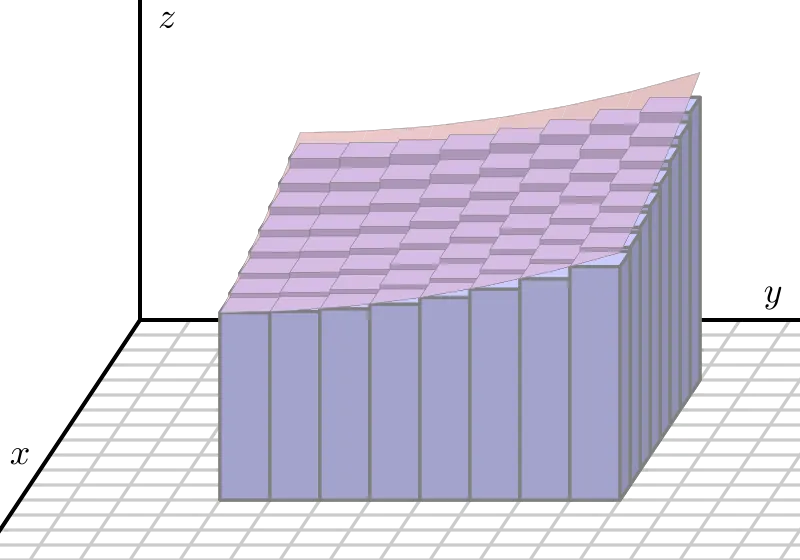
As we let the number of subrectangles increase without bound (in other words, as both and in a double Riemann sum go to infinity), as illustrated in Figure , the sum of the volumes of the rectangular boxes approaches the volume of the solid bounded above by over The value of this limit, provided it exists, is the double integral.
Figure . Finding better approximations by using smaller subrectangles.
Definition
Let be a rectangular region in the -plane and a continuous function over With terms defined as in a double Riemann sum, the double integral of over is
Some textbooks use the notation for a double integral. You will see this in some of the WeBWorK problems.
Interpretation of Double Riemann Sums and Double integrals.
At the moment, there are two ways we can interpret the value of the double integral.
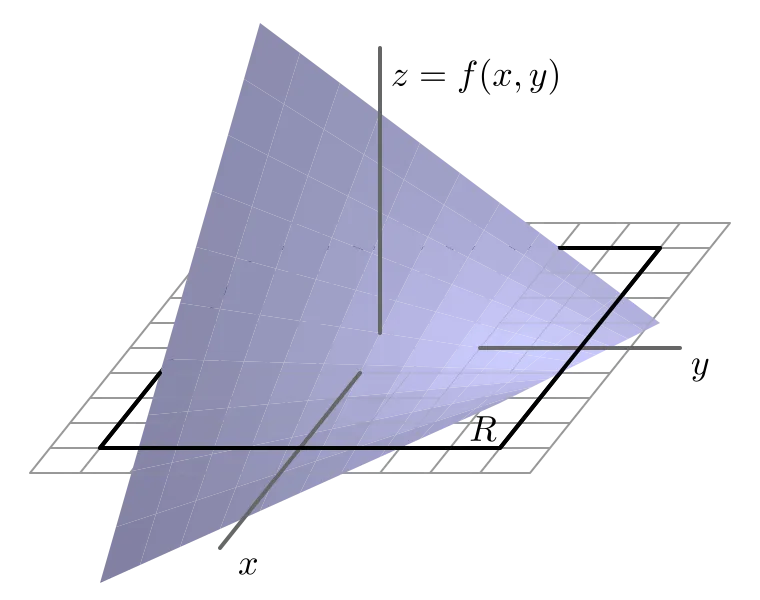
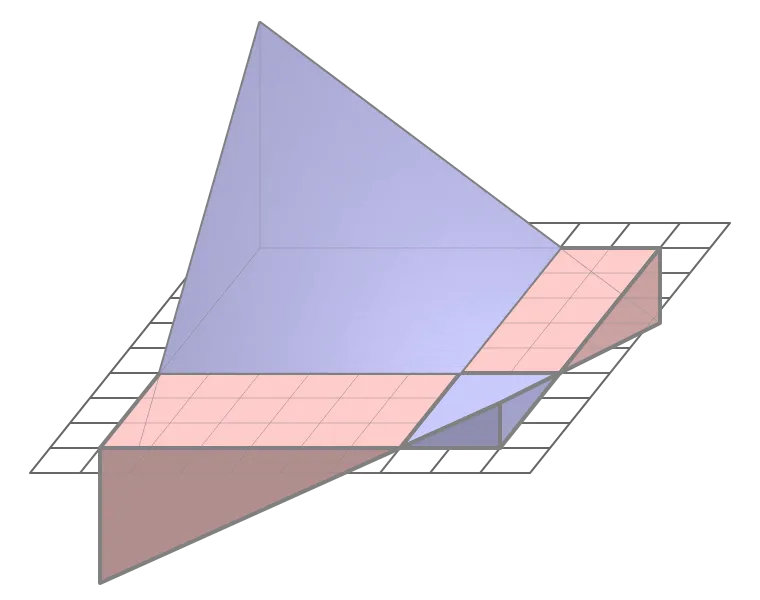
Suppose that assumes both positive and negatives values on the rectangle as shown on the left of Figure . When constructing a Riemann sum, for each and the product can be interpreted as a “signed” volume of a box with base area and “signed” height Since can have negative values, this “height” could be negative. The sum
can then be interpreted as a sum of “signed” volumes of boxes, with a negative sign attached to those boxes whose heights are below the -plane.
Figure . The integral measures signed volume.
We can then realize the double integral as a difference in volumes: tells us the volume of the solids the graph of bounds above the -plane over the rectangle minus the volume of the solids the graph of bounds below the -plane under the rectangle This is shown on the right of Figure .
The average of the finitely many values that we take in a double Riemann sum is given by
If we take the limit as and go to infinity, we obtain what we define as the average value of over the region which is connected to the value of the double integral. First, to view as a double Riemann sum, note that
Thus,
where denotes the area of the rectangle Then, the average value of the function over is given by
Therefore, the double integral of over divided by the area of gives us the average value of the function on Finally, if on we can interpret this average value of on as the height of the box with base that has the same volume as the volume of the surface defined by over
Activity
Let and let
Draw a picture of Partition into 2 subintervals of equal length and the interval into two subintervals of equal length. Draw these partitions on your picture of and label the resulting subrectangles using the labeling scheme we established in the definition of a double Riemann sum.
For each and let be the midpoint of the rectangle Identify the coordinates of each Draw these points on your picture of
Calculate the Riemann sum
using the partitions we have described. If we let be the midpoint of the rectangle for each and then the resulting Riemann sum is called a midpoint sum.
Give two interpretations for the meaning of the sum you just calculated.
Activity
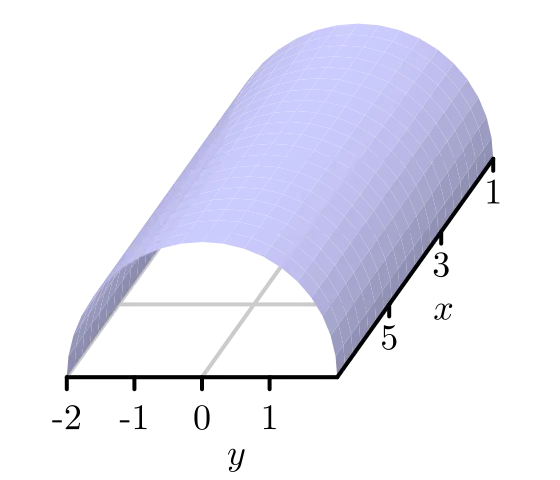
Let on the rectangular domain Partition into 3 equal length subintervals and into 2 equal length subintervals. A table of values of at some points in is given in Table , and a graph of with the indicated partitions is shown in Figure .
Table . Table of values of
Figure . Graph of on
Sketch the region in the plane using the values in Table as the partitions.
Calculate the double Riemann sum using the given partition of and the values of in the upper right corner of each subrectangle.
Use geometry to calculate the exact value of and compare it to your approximation. Describe one way we could obtain a better approximation using the given data.
We conclude this section with a list of properties of double integrals. Since similar properties are satisfied by single-variable integrals and the arguments for double integrals are essentially the same, we omit their justification.
Properties of Double Integrals
Let and be continuous functions on a rectangle and let be a constant. Then
If on then
Summary
Let be a continuous function on a rectangle The double Riemann sum for over is created as follows.
Partition the interval into subintervals of equal length Let be the endpoints of these subintervals, where
Partition the interval into subintervals of equal length Let be the endpoints of these subintervals, where
These two partitions create a partition of the rectangle into subrectangles with opposite vertices and for between and and between and These rectangles all have equal area
Choose a point in each rectangle Then a double Riemann sum for over is given by
With terms defined as in the Double Riemann Sum, the double integral of over is
Two interpretations of the double integral are:
The volume of the solids the graph of bounds above the -plane over the rectangle minus the volume of the solids the graph of bounds below the -plane under the rectangle
Dividing the double integral of over by the area of gives us the average value of the function on If on we can interpret this average value of on as the height of the box with base that has the same volume as the volume of the surface defined by over
Build status · Flash Infinity AI™ is a trademark of AI-Flash Inc.. WorldClass is not affiliated with, approved or accredited by any exam board, curriculum provider or university unless a page says so.