4.1: Determining Distance Traveled from Velocity
1. Estimating distance traveled from velocity data
2. Distance from a linear veloity function
3. Change in position from a linear velocity function
4. Comparing distance traveled from velocity graphs
5. Finding average acceleration from velocity data
6. Change in position from a quadratic velocity function
7
Along the eastern shore of Lake Michigan from Lake Macatawa (near Holland) to Grand Haven, there is a bike path that runs almost directly north-south. For the purposes of this problem, assume the road is completely straight, and that the function tracks the position of the biker along this path in miles north of Pigeon Lake, which lies roughly halfway between the ends of the bike path.
Suppose that the biker's velocity function is given by the graph in Figure 4.1.11 on the time interval (where is measured in hours), and that
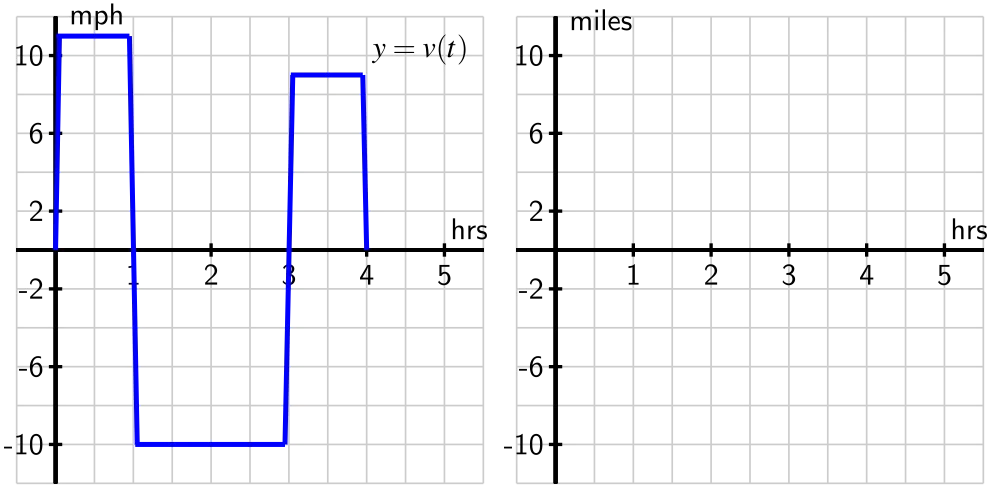
- Approximately how far north of Pigeon Lake was the cyclist when she was the greatest distance away from Pigeon Lake? At what time did this occur?
- What is the cyclist's total change in position on the time interval At was she north or south of Pigeon Lake?
- What is the total distance the biker traveled on At the end of the ride, how close was she to the point at which she started?
- Sketch an approximate graph of the position function of the cyclist, on the interval Label at least four important points on the graph of
8
A toy rocket is launched vertically from the ground on a day with no wind. The rocket's vertical velocity at time (in seconds) is given by feet/sec.
- At what time after the rocket is launched does the rocket's velocity equal zero? Call this time value What happens to the rocket at
- Find the value of the total area enclosed by and the -axis on the interval What does this area represent in terms of the physical setting of the problem?
- Find an antiderivative of the function That is, find a function such that
- Compute the value of What does this number represent in terms of the physical setting of the problem?
- Compute What does this number tell you about the rocket's flight?
9
An object moving along a horizontal axis has its instantaneous velocity at time in seconds given by the function pictured in Figure 4.1.12, where is measured in feet/sec. Assume that the curves that make up the parts of the graph of are either portions of straight lines or portions of circles.
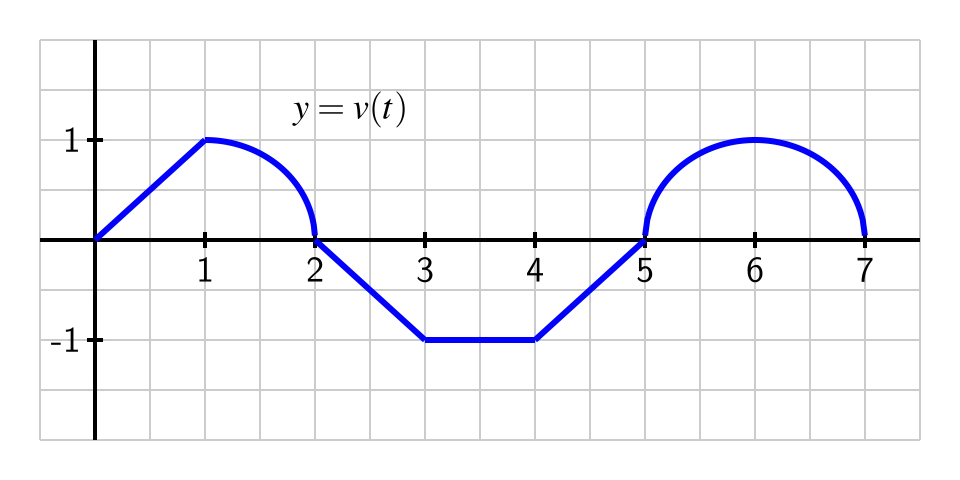
- Determine the exact total distance the object traveled on
- What is the value and meaning of where is the position function of the moving object?
- On which time interval did the object travel the greatest distance: or
- On which time interval(s) is the position function increasing? At which point(s) does achieve a relative maximum?
10
Filters at a water treatment plant become dirtier over time and thus become less effective; they are replaced every 30 days. During one 30-day period, the rate at which pollution passes through the filters into a nearby lake (in units of particulate matter per day) is measured every 6 days and is given in the following table. The time is measured in days since the filters were replaced.
| Day, | ||||||
|---|---|---|---|---|---|---|
| Rate of pollution in units per day, |
- Plot the given data on a set of axes with time on the horizontal axis and the rate of pollution on the vertical axis.
- Explain why the amount of pollution that entered the lake during this 30-day period would be given exactly by the area bounded by and the -axis on the time interval
- Estimate the total amount of pollution entering the lake during this 30-day period. Carefully explain how you determined your estimate.
4.2: Riemann Sums
1. Evaluating Riemann sums for a quadratic function
2. Estimating distance traveled with a Riemann sum from data
3. Writing basic Riemann sums
4
Consider the function
- Compute for on the interval Be sure to clearly identify the value of as well as the locations of Include a careful sketch of the function and the corresponding rectangles being used in the sum.
- Use a familiar geometric formula to determine the exact value of the area of the region bounded by and the -axis on
- Explain why the values you computed in (a) and (b) turn out to be the same. Will this be true if we use a number different than and compute Will or have the same value as the exact area of the region found in (b)?
- Describe the collection of functions for which it will always be the case that regardless of the value of gives the exact net signed area bounded between the function and the -axis on the interval
5
Let be the sum given by
- Assume that is a right Riemann sum. For what function and what interval is this function's Riemann sum? Why?
- How does your answer to (a) change if is a left Riemann sum? a middle Riemann sum?
- Suppose that really is a right Riemann sum. What is geometric quantity does approximate?
- Use sigma notation to write a new sum that is the right Riemann sum for the same function, but that uses twice as many subintervals as
6
A car traveling along a straight road is braking and its velocity is measured at several different points in time, as given in the following table.
| seconds, | |||||||
| Velocity in ft/sec, |
- Plot the given data on a set of axes with time on the horizontal axis and the velocity on the vertical axis.
- Estimate the total distance traveled during the car the time brakes using a middle Riemann sum with 3 subintervals.
- Estimate the total distance traveled on by computing and
- Assuming that is always decreasing on what is the maximum possible distance the car traveled before it stopped? Why?
7
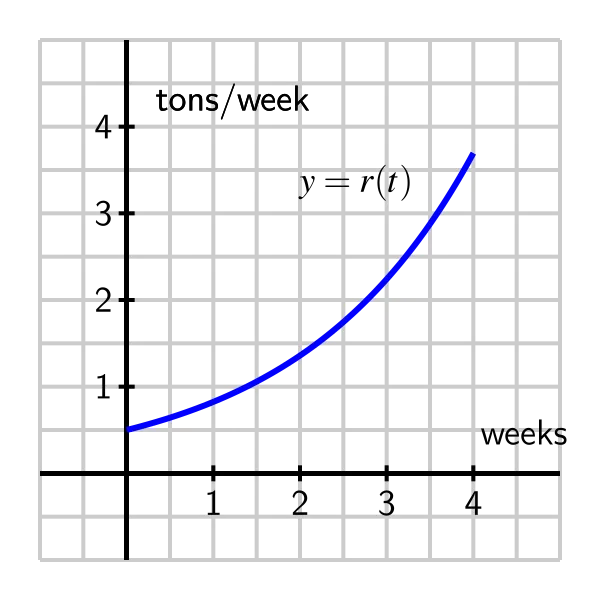
The rate at which pollution escapes a scrubbing process at a manufacturing plant increases over time as filters and other technologies become less effective. For this particular example, assume that the rate of pollution (in tons per week) is given by the function that is pictured in Figure 4.2.9.
- Use the graph to estimate the value of on the interval
- What is the meaning of in terms of the pollution discharged by the plant?
- Suppose that Use this formula for to compute on
- Determine an upper bound on the total amount of pollution that can escape the plant during the pictured four week time period that is accurate within an error of at most one ton of pollution.
4.3: The Definite Integral
1. Evaluating definite integrals from graphical information
2. Estimating definite integrals from a graph
3. Finding the average value of a linear function
4. Finding the average value of a function given graphically
5. Estimating a definite integral and average value from a graph
6. Using rules to combine known integral values
7
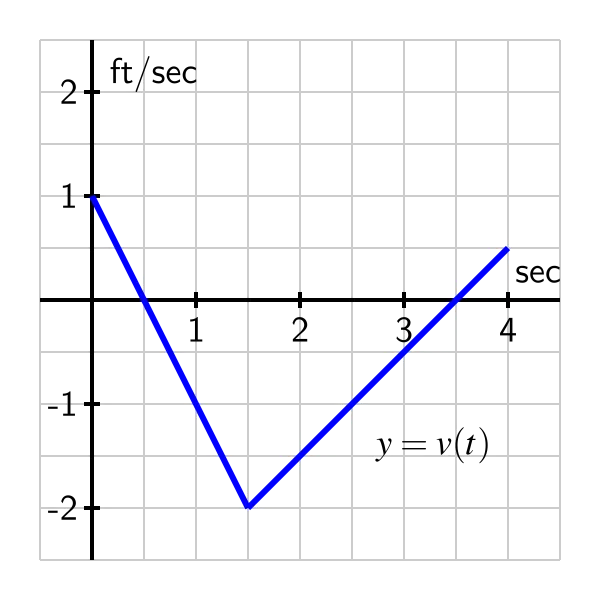
The velocity of an object moving along an axis is given by the piecewise linear function that is pictured in Figure 4.3.12. Assume that the object is moving to the right when its velocity is positive, and moving to the left when its velocity is negative. Assume that the given velocity function is valid for to
- Write an expression involving definite integrals whose value is the total change in position of the object on the interval
- Use the provided graph of to determine the value of the total change in position on
- Write an expression involving definite integrals whose value is the total distance traveled by the object on What is the exact value of the total distance traveled on
- What is the object's exact average velocity on
- Find an algebraic formula for the object's position function on that satisfies
8
Suppose that the velocity of a moving object is given by measured in feet per second, and that this function is valid for
- Write an expression involving definite integrals whose value is the total change in position of the object on the interval
- Use appropriate technology (such as http://gvsu.edu/s/a9 4 ) to compute Riemann sums to estimate the object's total change in position on Work to ensure that your estimate is accurate to two decimal places, and explain how you know this to be the case.
- Write an expression involving definite integrals whose value is the total distance traveled by the object on
- Use appropriate technology to compute Riemann sums to estimate the object's total distance travelled on Work to ensure that your estimate is accurate to two decimal places, and explain how you know this to be the case.
- What is the object's average velocity on accurate to two decimal places?
9
Consider the graphs of two functions and that are provided in Figure 4.3.13. Each piece of and is either part of a straight line or part of a circle.
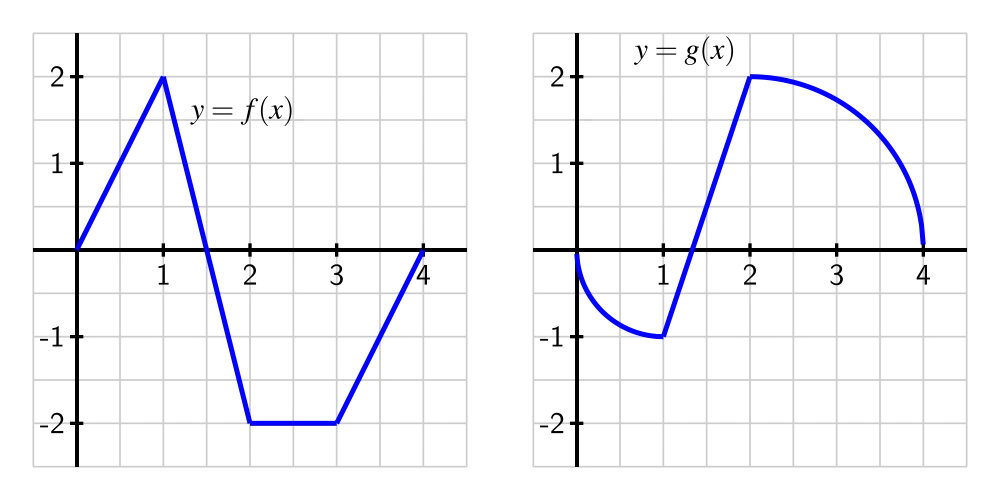
- Determine the exact value of
- Determine the exact value of
- Find the exact average value of on
- For what constant does the following equation hold?
10
Let and
- On the interval sketch a labeled graph of and write a definite integral whose value is the exact area bounded by on
- On the interval sketch a labeled graph of and write a definite integral whose value is the exact area bounded by on
- Write an expression involving a difference of definite integrals whose value is the exact area that lies between and on
- Explain why your expression in (c) has the same value as the single integral
- Explain why, in general, if for all in the exact area between and is given by
4.4: The Fundamental Theorem of Calculus
Finding exact displacement
Evaluating the definite integral of a rational function
Evaluating the definite integral of a linear function
Evaluating the definite integral of a quadratic function
Simplifying an integrand before integrating
Evaluating the definite integral of a trigonometric function
7
The instantaneous velocity (in meters per minute) of a moving object is given by the function as pictured in Figure . Assume that on the interval is given by and that on every other interval is piecewise linear, as shown.
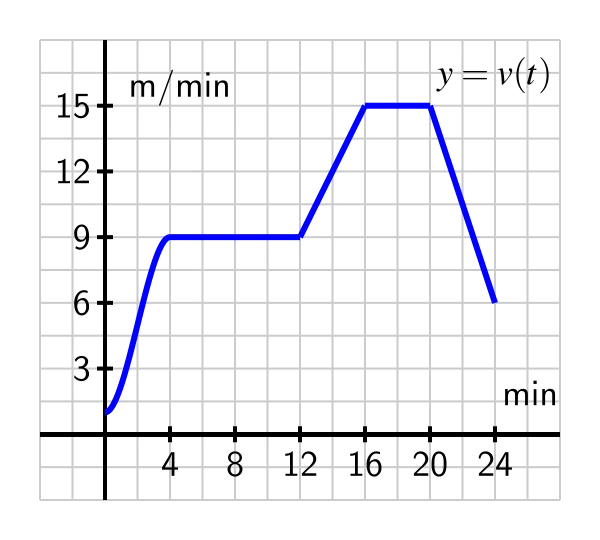 Figure 4.4.10. The velocity function of a moving body.
- Determine the exact distance traveled by the object on the time interval
- What is the object's average velocity on
- At what time is the object's acceleration greatest?
- Suppose that the velocity of the object is increased by a constant value for all values of What value of will make the object's total distance traveled on be 210 meters?
8
A function is given piecewise by the formula
- Determine the exact value of the net signed area enclosed by and the -axis on the interval
- Compute the exact average value of on
- Find a formula for a function on so that if we extend the above definition of so that if it follows that
9
When an aircraft attempts to climb as rapidly as possible, its climb rate (in feet per minute) decreases as altitude increases, because the air is less dense at higher altitudes. Given below is a table showing performance data for a certain single engine aircraft, giving its climb rate at various altitudes, where denotes the climb rate of the airplane at an altitude
| (feet) | |||||||||||
| (ft/min) |
Let a new function called measure the number of minutes required for a plane at altitude to climb the next foot of altitude.
- Determine a similar table of values for and explain how it is related to the table above. Be sure to explain the units.
- Give a careful interpretation of a function whose derivative is Describe what the input is and what the output is. Also, explain in plain English what the function tells us.
- Determine a definite integral whose value tells us exactly the number of minutes required for the airplane to ascend to 10,000 feet of altitude. Clearly explain why the value of this integral has the required meaning.
- Use the Riemann sum to estimate the value of the integral you found in (c). Include units on your result.
10
In Chapter 1, we showed that for an object moving along a straight line with position function the object's “average velocity on the interval ” is given by
More recently in Chapter 4, we found that for an object moving along a straight line with velocity function the object's “average value of its velocity function on ” is
Are the “average velocity on the interval ” and the “average value of the velocity function on ” the same thing? Why or why not? Explain.
11
In Table in Activity 4.4.3, we noted that for the antiderivative of is Here we observe that a key difference between and is that is defined for all while is only defined for and see how we can actually define the antiderivative of for all values of
- Suppose that and let Compute
- Explain why is an antiderivative of for
- Let and recall that
Explain why for and for
- Now discuss why we say that the antiderivative of is for all