Motivating Questions
- What is a change of variables?
- What is the Jacobian, and how is it related to a change of variables?
In single variable calculus, we encountered the idea of a change of variable in a definite integral through the method of substitution. For example, given the definite integral
we naturally consider the change of variable From this substitution, it follows that and since implies and implies we have transformed the original integral in into a new integral in In particular,
The latter integral, of course, is far easier to evaluate.
Through our work with polar, cylindrical, and spherical coordinates, we have already implicitly seen some of the issues that arise in using a change of variables with two or three variables present. In what follows, we seek to understand the general ideas behind any change of variables in a multiple integral.
Preview Activity
Consider the double integral
where is the upper half of the unit disk.
-
- Write the double integral given in Equation \ref{eq_11_9_COV_PA} as an iterated integral in rectangular coordinates.
- Write the double integral given in Equation \ref{eq_11_9_COV_PA} as an iterated integral in polar coordinates.
- When we write the double integral \ref{eq_11_9_COV_PA} as an iterated integral in polar coordinates we make a change of variables, namely
We also then have to change to This process also identifies a “polar rectangle” with the original Cartesian rectangle, under the transformation 1 in Equation \ref{eq_11_9_pol_to_rect}. The vertices of the polar rectangle are transformed into the vertices of a closed and bounded region in rectangular coordinates.
To work with a numerical example, let's now consider the polar rectangle given by so that and
- Use the transformation determined by the equations in \ref{eq_11_9_pol_to_rect} to find the rectangular vertices that correspond to the polar vertices in the polar rectangle In other words, by substituting appropriate values of and into the two equations in \ref{eq_11_9_pol_to_rect}, find the values of the corresponding and coordinates for the vertices of the polar rectangle Label the point that corresponds to the polar vertex as the point corresponding to the polar vertex as the point corresponding to the polar vertex as and the point corresponding to the polar vertex as
- Draw a picture of the figure in rectangular coordinates that has the points and as vertices. (Note carefully that because of the trigonometric functions in the transformation, this region will not look like a Cartesian rectangle.) What is the area of this region in rectangular coordinates? How does this area compare to the area of the original polar rectangle?
Change of Variables in Polar Coordinates
The general idea behind a change of variables is suggested by Preview Activity . There, we saw that in a change of variables from rectangular coordinates to polar coordinates, a polar rectangle gets mapped to a Cartesian rectangle under the transformation
The vertices of the polar rectangle are transformed into the vertices of a closed and bounded region in rectangular coordinates. If we view the standard coordinate system as having the horizontal axis represent and the vertical axis represent then the polar rectangle appears to us at left in Figure . The image of the polar rectangle under the transformation given by \ref{eq_11_9_pol_to_rect} is shown at right in Figure . We thus see that there is a correspondence between a simple region (a traditional, right-angled rectangle) and a more complicated region (a fraction of an annulus) under the function given by
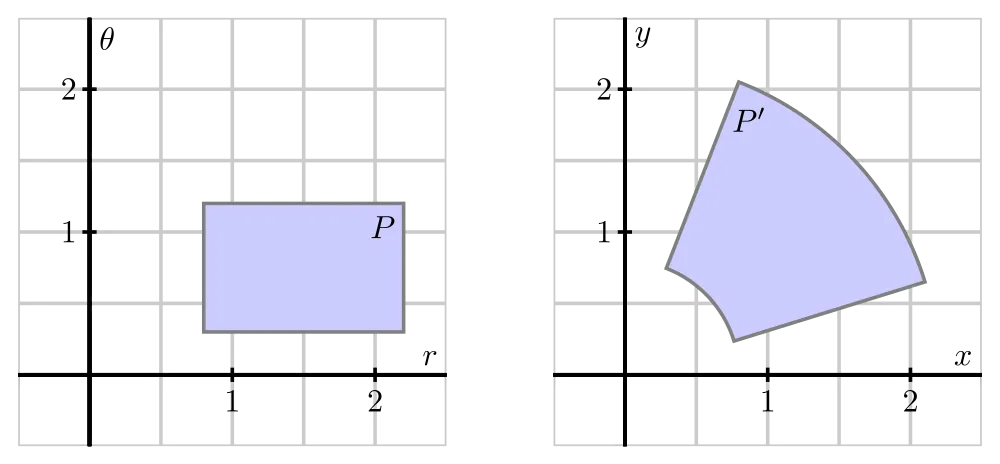
Furthermore, as Preview Activity suggests, it follows generally that for an original polar rectangle the area of the transformed rectangle is given by Therefore, as and go to 0 this area becomes the familiar area element in polar coordinates. When we proceed to working with other transformations for different changes in coordinates, we have to understand how the transformation affects area so that we may use the correct area element in the new system of variables.
General Change of Coordinates
We first focus on double integrals. As with single integrals, we may be able to simplify a double integral of the form
by making a change of variables (that is, a substitution) of the form
where and are functions of new variables and This transformation introduces a correspondence between a problem in the -plane and one in the the -plane. The equations and convert and to and we call these formulas the change of variable formulas. To complete the change to the new variables, we need to understand the area element, in this new system. The following activity helps to illustrate the idea.
Activity
Consider the change of variables
Let's see what happens to the rectangle in the -plane under this change of variable.
- Draw a labeled picture of in the -plane.
- Find the image of the -vertex in the -plane. Likewise, find the respective images of the other three vertices of the rectangle and
- In the -plane, draw a labeled picture of the image, of the original -rectangle What appears to be the shape of the image,
- To transform an integral with a change of variables, we need to determine the area element for image of the transformed rectangle. Note that is not exactly a parallelogram since the equations that define the transformation are not linear. But we can approximate the area of with the area of a parallelogram. How would we find the area of a parallelogram that approximates the area of the -figure (Hint: Remember what the cross product of two vectors tells us.)
Activity presents the general idea of how a change of variables works. We partition a rectangular domain in the system into subrectangles. Let be one of these subrectangles. Then we transform this into a region in the standard Cartesian coordinate system. The region is called the image of the region is the pre-image of Although the sides of this region aren't necessarily straight (linear), we will approximate the element of area for this region with the area of the parallelogram whose sides are given by the vectors and where is the vector from to and is the vector from to
An example of an image in the -plane that results from a transformation of a rectangle in the -plane is shown in Figure .
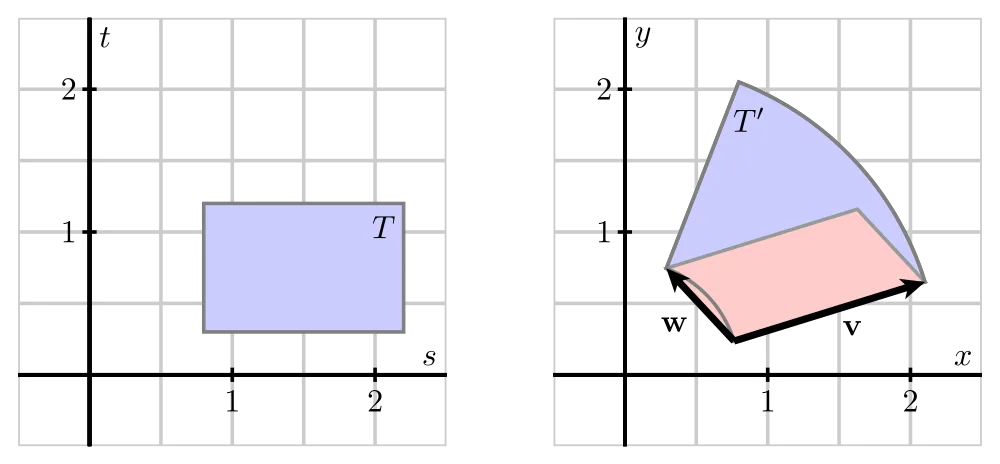
The components of the vector are
and similarly those for are
Slightly rewriting and we have
For small and the definition of the partial derivative tells us that
Recall that the area of the parallelogram with sides and is the length of the cross product of the two vectors, From this, we observe that
Finally, by computing the magnitude of the cross product, we see that
Therefore, as the number of subdivisions increases without bound in each direction, and both go to zero, and we have
Equation \ref{E_Area_Element} hence determines the general change of variable formula in a double integral, and we can now say that
The quantity
is called the Jacobian, and we denote the Jacobian using the shorthand notation
Recall from Section 9.4 that we can also write this Jacobian as the determinant of the matrix Note that, as discussed in Section 9.4, the absolute value of the determinant of is the area of the parallelogram determined by the vectors and and so the area element in -coordinates is also represented by the area element in -coordinates, and is the factor by which the transformation magnifies area.
To summarize, the preceding change of variable formula that we have derived now follows.
Change of Variables in a Double Integral
Suppose a change of variables and transforms a closed and bounded region in the -plane into a closed and bounded region in the -plane. Under modest conditions (that are studied in advanced calculus), it follows that
Activity
Find the Jacobian when changing from rectangular to polar coordinates. That is, for the transformation given by determine a simplified expression for the quantity
What do you observe about your result? How is this connected to our earlier work with double integrals in polar coordinates?
Activity
Let be the region in the -plane bounded by the lines and We will evaluate the double integral
with a change of variables.
- Sketch the region in the -plane.
- We would like to make a substitution that makes the integrand easier to antidifferentiate. Let and Explain why this should make antidifferentiation easier by making the corresponding substitutions and writing the new integrand in terms of and
- Solve the equations and for and (Doing so determines the standard form of the transformation, since we will have as a function of and and as a function of and )
- To actually execute this change of variables, we need to know the -region that corresponds to the -region
- What equation corresponds to the equation
- What equation corresponds to the equation
- What equation corresponds to the equation
- Sketch the region that corresponds to the domain
- Make the change of variables indicated by and in the double integral (\ref{eq_11_9_COV_ex}) and set up an iterated integral in variables whose value is the original given double integral. Finally, evaluate the iterated integral.
Change of Variables in a Triple Integral
The argument for the change of variable formula for triple integrals is complicated, and we will not go into the details. The general process, though, is the same as the two-dimensional case. Given a solid in the -coordinate system in a change of variables transformation and transforms into a region in -coordinates. Any function defined on can be considered as a function in -coordinates defined on The volume element in -coordinates cooresponds to a scaled volume element in -coordinates, where the scale factor is given by the absolute value of the Jacobian, which is the determinant of the matrix
(Recall that this determinant was introduced in Section 9.4.) That is, is given by
To summarize,
Change of Variables in a Triple Integral
Suppose a change of variables and transforms a closed and bounded region in -coordinates into a closed and bounded region in -coordinates. Under modest conditions (that are studied in advanced calculus), the triple integral is equal to
Activity
Find the Jacobian when changing from Cartesian to cylindrical coordinates. That is, for the transformation given by and determine a simplified expression for the quantity
What do you observe about your result? How is this connected to our earlier work with triple integrals in cylindrial coordinates?
Activity
Consider the solid defined by the inequalities and Consider the transformation defined by and Let
- The transformation turns the solid in -coordinates into a box in -coordinates. Apply the transformation to the boundries of the solid to find -coordinatte descriptions of the box
- Find the Jacobian
- Use the transformation to perform a change of variables and evaluate by evaluating
Summary
- If an integral is described in terms of one set of variables, we may write that set of variables in terms of another set of the same number of variables. If the new variables are chosen appropriately, the transformed integral may be easier to evaluate.
- The Jacobian is a scalar function that relates the area or volume element in one coordinate system to the corresponding element in a new system determined by a change of variables.