Motivating Questions
- What are the cylindrical coordinates of a point, and how are they related to Cartesian coordinates?
- What is the volume element in cylindrical coordinates? How does this inform us about evaluating a triple integral as an iterated integral in cylindrical coordinates?
- What are the spherical coordinates of a point, and how are they related to Cartesian coordinates?
- What is the volume element in spherical coordinates? How does this inform us about evaluating a triple integral as an iterated integral in spherical coordinates?
We have encountered two different coordinate systems in — the rectangular and polar coordinates systems — and seen how in certain situations, polar coordinates form a convenient alternative. In a similar way, there are two additional natural coordinate systems in Given that we are already familiar with the Cartesian coordinate system for we next investigate the cylindrical and spherical coordinate systems (each of which builds upon polar coordinates in ). In what follows, we will see how to convert among the different coordinate systems, how to evaluate triple integrals using them, and some situations in which these other coordinate systems prove advantageous.
Preview Activity
In the following questions, we investigate the two new coordinate systems that are the subject of this section: cylindrical and spherical coordinates. Our goal is to consider some examples of how to convert from rectangular coordinates to each of these systems, and vice versa. Triangles and trigonometry prove to be particularly important.
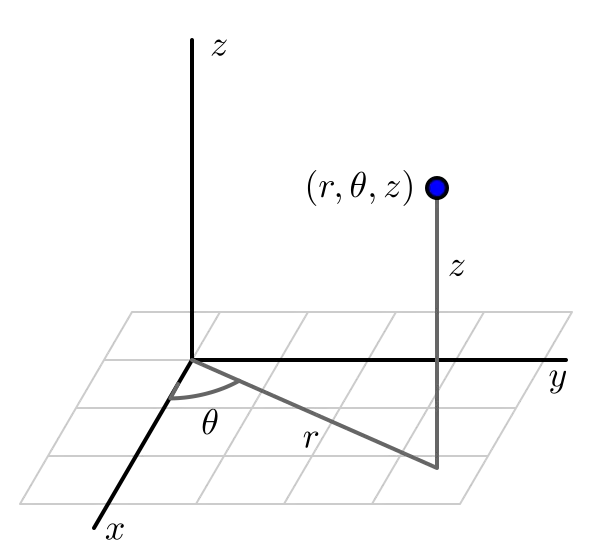
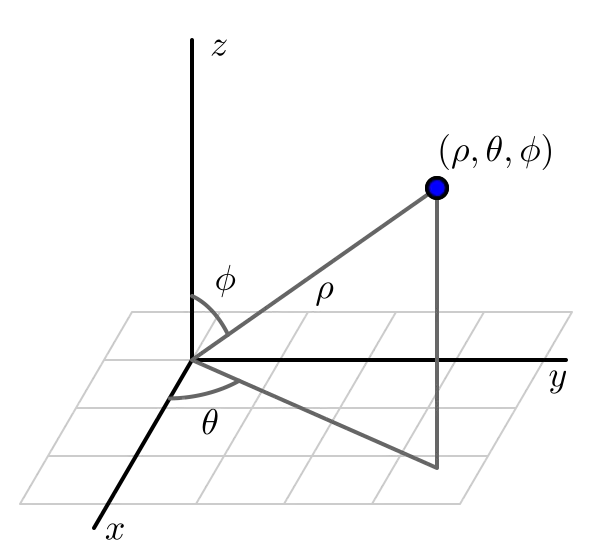
- The cylindrical coordinates of a point in are given by where and are the polar coordinates of the point and is the same coordinate as in Cartesian coordinates. An illustration is given at left in Figure .
- Find cylindrical coordinates for the point whose Cartesian coordinates are Draw a labeled picture illustrating all of the coordinates.
- Find the Cartesian coordinates of the point whose cylindrical coordinates are Draw a labeled picture illustrating all of the coordinates.
- The spherical coordinates of a point in are (rho), and (phi), where is the distance from the point to the origin, has the same interpretation it does in polar coordinates, and is the angle between the positive axis and the vector from the origin to the point, as illustrated at right in Figure . You should convince yourself that any point in can be represented in spherical coordinates with and
For the following questions, consider the point whose Cartesian coordinates are
- What is the distance from to the origin? Your result is the value of in the spherical coordinates of
- Determine the point that is the projection of onto the -plane. Then, use this projection to find the value of in the polar coordinates of the projection of that lies in the plane. Your result is also the value of for the spherical coordinates of the point.
- Based on the illustration in Figure , how is the angle determined by and the coordinate of Use a well-chosen right triangle to find the value of which is the final component in the spherical coordinates of Draw a carefully labeled picture that clearly illustrates the values of and in this example, along with the original rectangular coordinates of
- Based on your responses to i., ii., and iii., if we are given the Cartesian coordinates of a point how are the values of and in the spherical coordinates of determined by and
Cylindrical Coordinates
As we stated in Preview Activity , the cylindrical coordinates of a point are where and are the polar coordinates of the point and is the same coordinate as in Cartesian coordinates. The general situation is illustrated Figure .
Since we already know how to convert between rectangular and polar coordinates in the plane, and the coordinate is identical in both Cartesian and cylindrical coordinates, the conversion equations between the two systems in are essentially those we found for polar coordinates.
Converting between Cartesian and cylindrical coordinates
- If we are given the Cartesian coordinates of a point then the cylindrical coordinates of satisfy
- If we are given the cylindrical coordinates of a point then the Cartesian coordinates of satisfy
assuming
Just as with rectangular coordinates, where we usually write as a function of and to plot the resulting surface, in cylindrical coordinates, we often express as a function of and In the following activity, we explore several basic equations in cylindrical coordinates and the corresponding surface each generates.
Activity
In this activity, we graph some surfaces using cylindrical coordinates. To improve your intuition and test your understanding, you should first think about what each graph should look like before you plot it using appropriate technology.
- What familiar surface is described by the points in cylindrical coordinates with and How does this example suggest that we call these coordinates cylindrical coordinates? How does your answer change if we restrict to
- What familiar surface is described by the points in cylindrical coordinates with and
- What familiar surface is described by the points in cylindrical coordinates with and
- Plot the graph of the cylindrical equation where and What familiar surface results?
- Plot the graph of the cylindrical equation for What does this surface look like?
As the name and Activity suggests, cylindrical coordinates are useful for describing surfaces that are cylindrical in nature.
Triple Integrals in Cylindrical Coordinates
To evaluate a triple integral as an iterated integral in Cartesian coordinates, we use the fact that the volume element is equal to (which corresponds to the volume of a small box). To evaluate a triple integral in cylindrical coordinates, we similarly must understand the volume element in cylindrical coordinates.
Activity
A picture of a cylindrical box, is shown in Figure . Let and We want to determine the volume of in terms of and
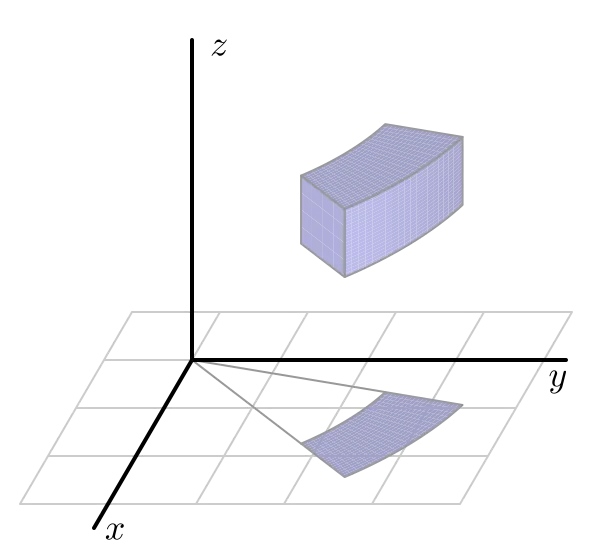
- Appropriately label and in Figure .
- Let be the area of the projection of the box, onto the -plane, which is shaded blue in Figure . Recall that we previously determined the area in polar coordinates in terms of and In light of the fact that we know and that is the standard coordinate from Cartesian coordinates, what is the volume in cylindrical coordinates?
Activity demonstrates that the volume element in cylindrical coordinates is given by and hence the following rule holds in general.
Triple integrals in cylindrical coordinates
Given a continuous function over a region in
The latter expression is an iterated integral in cylindrical coordinates.
Of course, to complete the task of writing an iterated integral in cylindrical coordinates, we need to determine the limits on the three integrals: and In the following activity, we explore how to do this in several situations where cylindrical coordinates are natural and advantageous.
Activity
In this activity we work with triple integrals in cylindrical coordinates.
- Let be the solid bounded above by the graph of and below by on the unit disk in the -plane.
- The projection of the solid onto the -plane is a disk. Describe this disk using polar coordinates.
- Now describe the surfaces bounding the solid using cylindrical coordinates.
- Determine an iterated triple integral expression in cylindrical coordinates that gives the volume of You do not need to evaluate this integral.
- Suppose the density of the cone defined by with is given by A picture of the cone is shown at left in Figure , and the projection of the cone onto the -plane in given at right in Figure . Set up an iterated integral in cylindrical coordinates that gives the mass of the cone. You do not need to evaluate this integral.
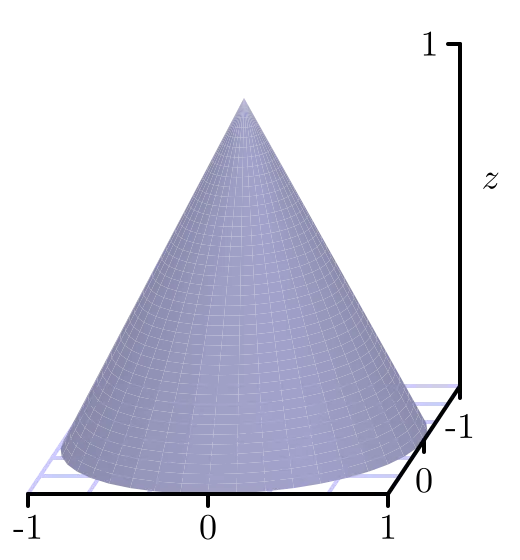
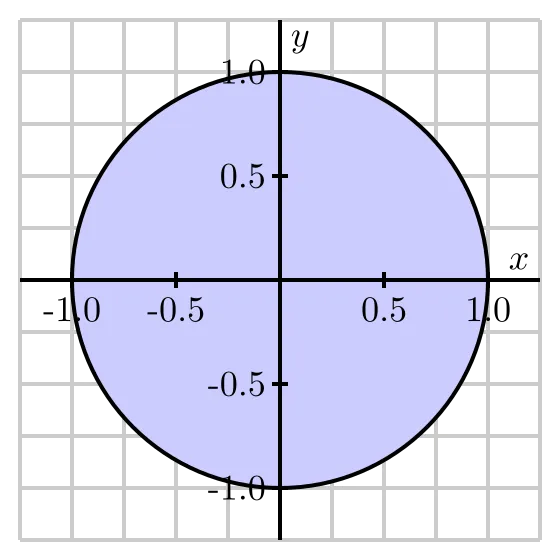
Figure . The cylindrical cone and its projection onto the -plane.
- Determine an iterated integral expression in cylindrical coordinates whose value is the volume of the solid bounded below by the cone and above by the cone A picture is shown in Figure . You do not need to evaluate this integral.
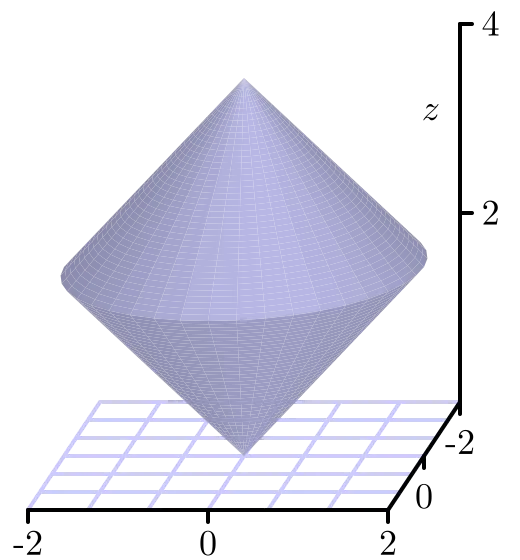
Figure . A solid bounded by the cones and
Spherical Coordinates
As we saw in Preview Activity , the spherical coordinates of a point in 3-space have the form where is the distance from the point to the origin, has the same meaning as in polar coordinates, and is the angle between the positive axis and the vector from the origin to the point. The overall situation is illustrated at right in Figure .
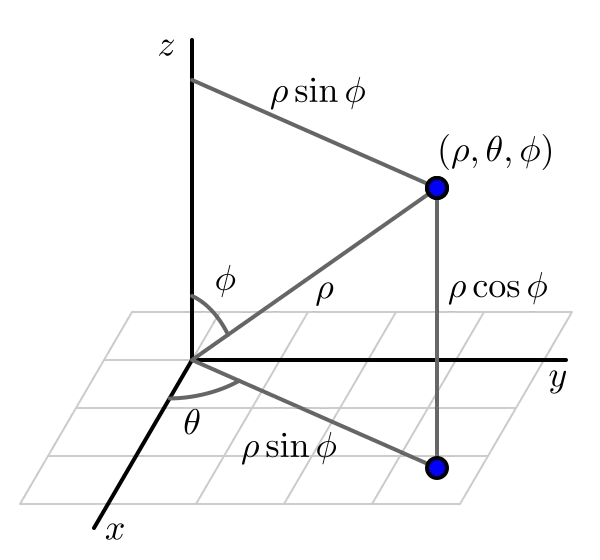
The example in Preview Activity and Figure suggest how to convert between Cartesian and spherical coordinates.
Coverting between Cartesian and spherical coordinates
- If we are given the Cartesian coordinates of a point then the spherical coordinates of satisfy
where in the latter two equations, we require and
- If we are given the spherical coordinates of a point then the Cartesian coordinates of satisfy
When it comes to thinking about particular surfaces in spherical coordinates, similar to our work with cylindrical and Cartesian coordinates, we usually write as a function of and this is a natural analog to polar coordinates, where we often think of our distance from the origin in the plane as being a function of In spherical coordinates, we likewise often view as a function of and thus viewing distance from the origin as a function of two key angles.
In the following activity, we explore several basic equations in spherical coordinates and the surfaces they generate.
Activity
In this activity, we graph some surfaces using spherical coordinates. To improve your intuition and test your understanding, you should first think about what each graph should look like before you plot it using appropriate technology.
- What familiar surface is described by the points in spherical coordinates with and How does this particular example demonstrate the reason for the name of this coordinate system? What if we restrict to
- What familiar surface is described by the points in spherical coordinates with and
- What familiar shape is described by the points in spherical coordinates with and
- Plot the graph of for and How does the resulting surface appear?
As the name and Activity indicate, spherical coordinates are particularly useful for describing surfaces that are spherical in nature; they are also convenient for working with certain conical surfaces.
Triple Integrals in Spherical Coordinates
As with rectangular and cylindrical coordinates, a triple integral in spherical coordinates can be evaluated as an iterated integral once we understand the volume element
Activity
To find the volume element in spherical coordinates, we need to understand how to determine the volume of a spherical box of the form (with (with ), and (with ). An illustration of such a box is given at left in Figure . This spherical box is a bit more complicated than the cylindrical box we encountered earlier. In this situation, it is easier to approximate the volume than to compute it directly. Here we can approximate the volume of this spherical box with the volume of a Cartesian box whose sides have the lengths of the sides of this spherical box. In other words,
where denotes the length of the circular arc from to
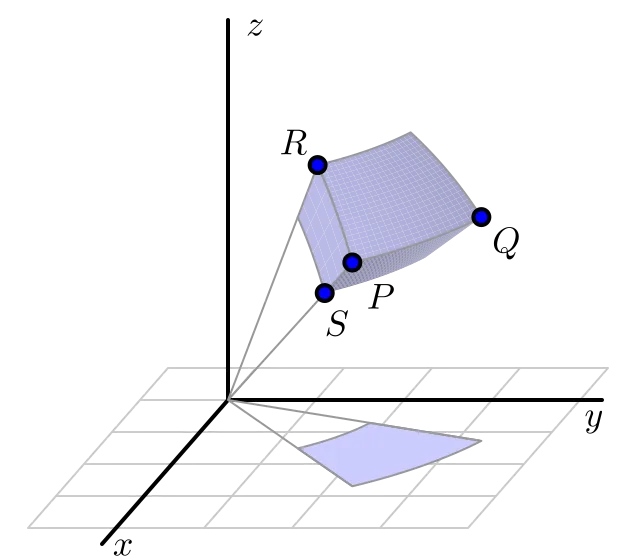
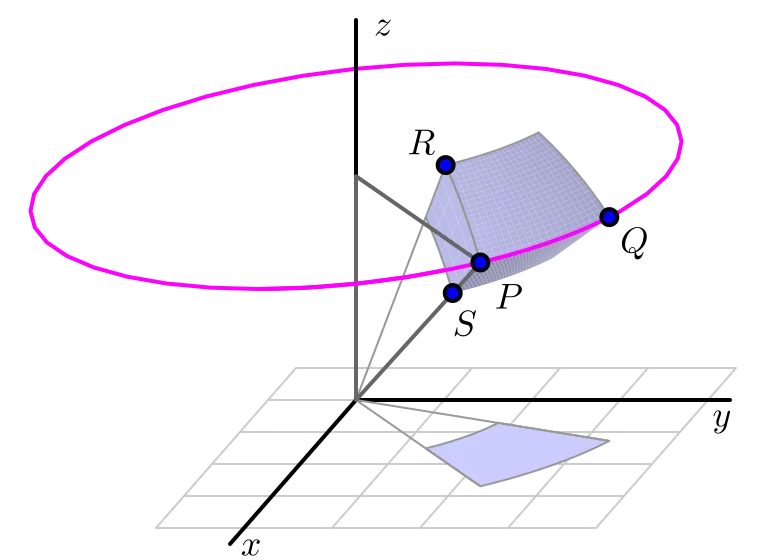
- What is the length in terms of
- What is the length of the arc (Hint: The arc is an arc of a circle of radius and arc length along a circle is the product of the angle measure (in radians) and the circle's radius.)
- What is the length of the arc (Hint: The arc lies on a horizontal circle as illustrated at right in Figure . What is the radius of this circle?)
- Use your work in (a), (b), and (c) to determine an approximation for in spherical coordinates.
Letting and go to 0, it follows from the final result in Activity that in spherical coordinates, and thus allows us to state the following general rule.
Triple integrals in spherical coordinates
Given a continuous function over a region in the triple integral is converted to the integral
in spherical coordinates.
The latter expression is an iterated integral in spherical coordinates.
Finally, in order to actually evaluate an iterated integral in spherical coordinates, we must of course determine the limits of integration in and The process is similar to our earlier work in the other two coordinate systems.
Activity
We can use spherical coordinates to help us more easily understand some natural geometric objects.
- Recall that the sphere of radius has spherical equation Set up and evaluate an iterated integral in spherical coordinates to determine the volume of a sphere of radius
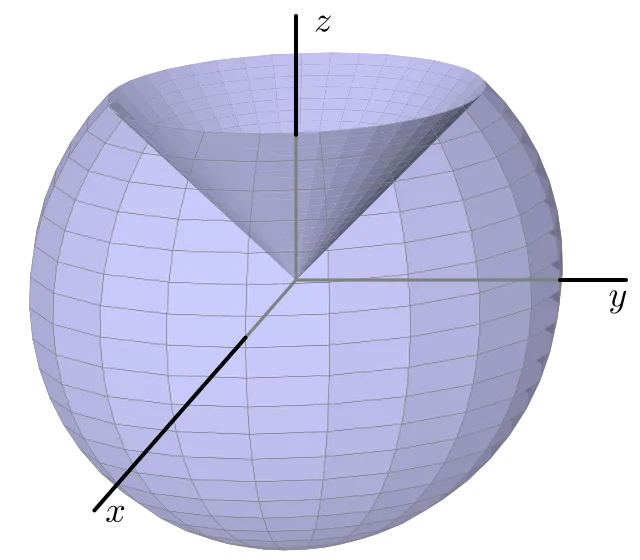
- Set up, but do not evaluate, an iterated integral expression in spherical coordinates whose value is the mass of the solid obtained by removing the cone from the sphere if the density at the point is An illustration of the solid is shown in Figure .
-
Figure . The solid cut from the sphere by the cone
Summary
- The cylindrical coordinates of a point are where is the distance from the origin to the projection of onto the -plane, is the angle that the projection of onto the -plane makes with the positive -axis, and is the vertical distance from to the projection of onto the -plane. When has rectangular coordinates it follows that its cylindrical coordinates are given by
When has given cylindrical coordinates its rectangular coordinates are
- The volume element in cylindrical coordinates is Hence, a triple integral can be evaluated as the iterated integral
- The spherical coordinates of a point in 3-space are (rho), and (phi), where is the distance from to the origin, is the angle that the projection of onto the -plane makes with the positive -axis, and is the angle between the positive axis and the vector from the origin to When has Cartesian coordinates the spherical coordinates are given by
Given the point in spherical coordinates its rectangular coordinates are
- The volume element in spherical coordinates is Thus, a triple integral can be evaluated as the iterated integral