Motivating Questions
- What is a parameterization of a surface?
- How do we find the surface area of a parametrically defined surface?
We have now studied at length how curves in space can be defined parametrically by functions of the form and surfaces can be represented by functions In what follows, we will see how we can also define surfaces parametrically. A one-dimensional curve in space results from a vector function that relies upon one parameter, so a two-dimensional surface naturally involves the use of two parameters. If and are functions of independent parameters and then the terminal points of all vectors of the form
form a surface in space. The equations and are the parametric equations for the surface, or a parametrization of the surface. In Preview Activity we investigate how to parameterize a cylinder and a cone.
Preview Activity
Recall the standard parameterization of the unit circle that is given by
where
- Determine a parameterization of the circle of radius 1 in that has its center at and lies in the plane
- Determine a parameterization of the circle of radius 1 in 3-space that has its center at and lies in the plane
- Determine a parameterization of the circle of radius 1 in 3-space that has its center at and lies in the plane
- Taking into account your responses in (a), (b), and (c), describe the graph that results from the set of parametric equations
where and Explain your thinking.
- Just as a cylinder can be viewed as a “stack” of circles of constant radius, a cone can be viewed as a stack of circles with varying radius. Modify the parametrizations of the circles above in order to construct the parameterization of a cone whose vertex lies at the origin, whose base radius is 4, and whose height is 3, where the base of the cone lies in the plane Use appropriate technology to plot the parametric equations you develop. (Hint: The cross sections parallel to the -plane are circles, with the radii varying linearly as increases.)
Parametric Surfaces
In a single-variable setting, any function may have its graph expressed parametrically. For instance, given by considering the parameterization (where belongs to the domain of ), we generate the same curve. What is more important is that certain curves that are not functions may be represented parametrically; for instance, the circle (which cannot be represented by a single function) can be parameterized by where
In the same way, in a two-variable setting, the surface may be expressed parametrically by considering
where varies over the entire domain of Therefore, any familiar surface that we have studied so far can be generated as a parametric surface. But what is more powerful is that there are surfaces that cannot be generated by a single function (such as the unit sphere), but that can be represented parametrically. We now consider an important example.
Example
Consider the torus (or doughnut) shown in Figure .
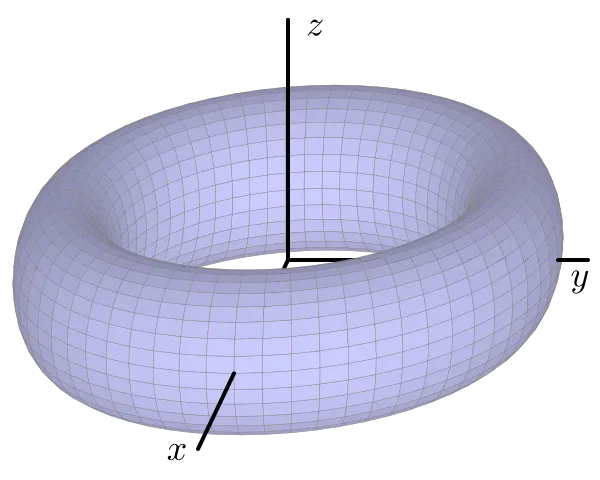
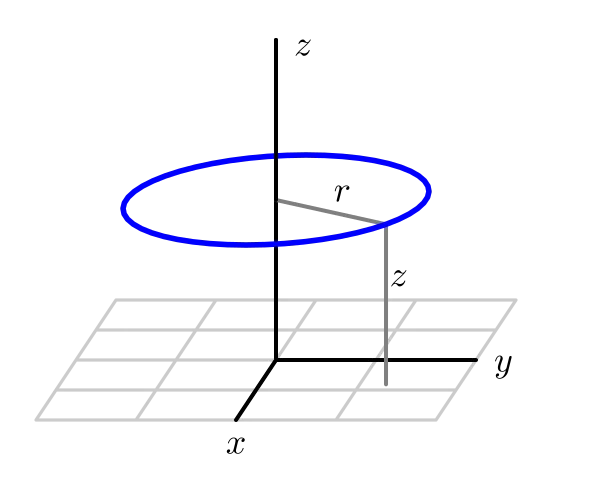
To find a parametrization of this torus, we recall our work in Preview Activity . There, we saw that a circle of radius that has its center at the point and is contained in the horizontal plane as shown in Figure , can be parametrized using the vector-valued function defined by
where
To obtain the torus in Figure , we begin with a circle of radius in the -plane centered at as shown on the left of Figure . We may parametrize the points on this circle, using the parameter by using the equations
where
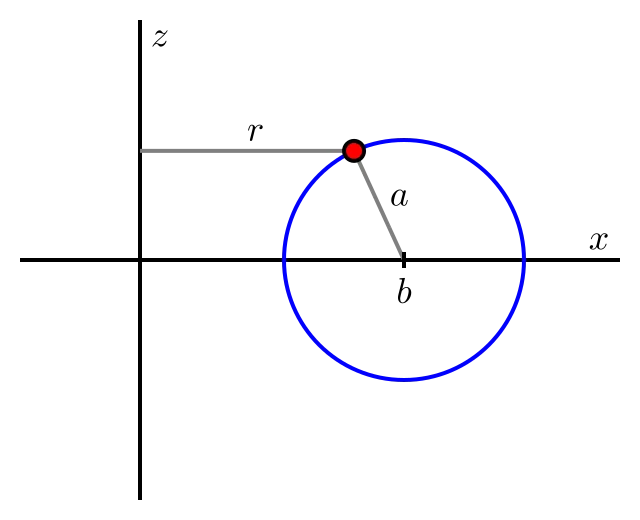
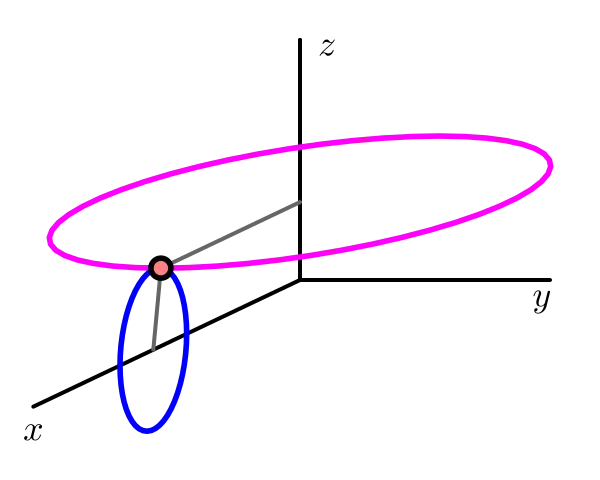
Let's focus our attention on one point on this circle, such as the indicated point, which has coordinates for a fixed value of the parameter When this point is revolved about the -axis, we obtain a circle contained in a horizontal plane centered at and having radius as shown on the right of Figure . If we let be the new parameter that generates the circle for the rotation about the -axis, this circle may be parametrized by
Now using our earlier parametric equations for and for the original smaller circle, we have an overall parameterization of the torus given by
To trace out the entire torus, we require that the parameters vary through the values and
Activity
In this activity, we seek a parametrization of the sphere of radius centered at the origin, as shown on the left in Figure . Notice that this sphere may be obtained by revolving a half-circle contained in the -plane about the -axis, as shown on the right.
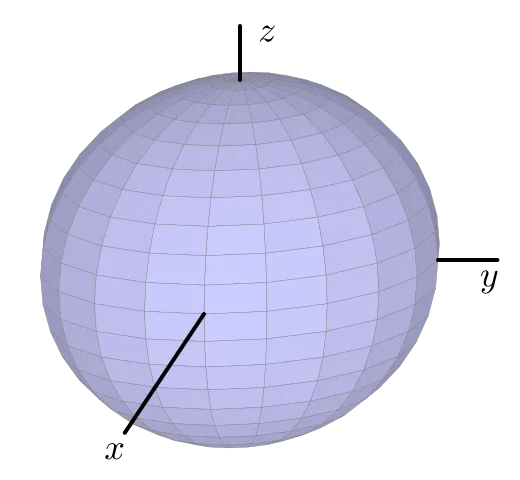
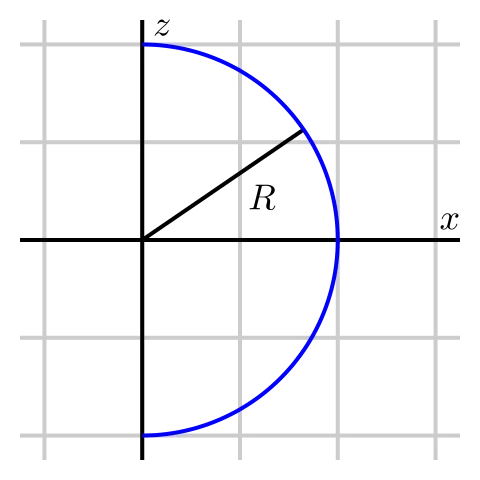
- Begin by writing a parametrization of this half-circle using the parameter
Be sure to state the domain of the parameter
- By revolving the points on this half-circle about the -axis, obtain a parametrization of the points on the sphere of radius Be sure to include the domain of both parameters and (Hint: What is the radius of the circle obtained when revolving a point on the half-circle around the axis?)
- Draw the surface defined by your parameterization with appropriate technology.
The Surface Area of Parametrically Defined Surfaces
Recall that a differentiable function is locally linear — that is, if we zoom in on the surface around a point, the surface looks like its tangent plane. We now exploit this idea in order to determine the surface area generated by a parametrization The basic idea is a familiar one: we will subdivide the surface into small pieces, in the approximate shape of small parallelograms, and thus estimate the entire the surface area by adding the areas of these approximation parallelograms. Ultimately, we use an integral to sum these approximations and determine the exact surface area.
Let
define a surface over a rectangular domain and As a function of two variables, and it is natural to consider the two partial derivatives of the vector-valued function which we define by
In the usual way, we slice the domain into small rectangles. In particular, we partition the interval into subintervals of length and let be the endpoints of these subintervals, where Also partition the interval into subintervals of equal length and let be the endpoints of these subintervals, where These two partitions create a partition of the rectangle in -coordinates into sub-rectangles with opposite vertices and for between and and between and These rectangles all have equal area
Now we want to think about the small piece of area on the surface itself that lies above one of these small rectangles in the domain. Observe that if we increase by a small amount from the point in the domain, then changes by approximately Similarly, if we increase by a small amount from the point then changes by approximately So we can approximate the surface defined by on the -rectangle with the parallelogram determined by the vectors and as seen in Figure .
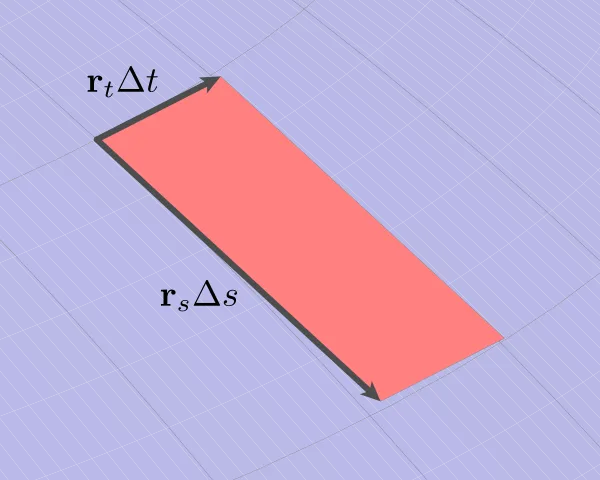
Say that the small parallelogram has area If we can find its area, then all that remains is to sum the areas of all of the generated parallelograms and take a limit. Recall from our earlier work in the course that given two vectors and the area of the parallelogram spanned by and is given by the magnitude of their cross product, In the present context, it follows that the area, of the parallelogram determined by the vectors and is
where the latter equality holds from standard properties of the cross product and length.
We sum the surface area approximations from Equation \ref{eq_11_6_parallelogram_area} over all sub-rectangles to obtain an estimate for the total surface area, given by
Taking the limit as shows that the surface area of the surface defined by over the domain is given as follows.
Surface area
Let be a parameterization of a smooth surface over a domain The area of the surface defined by on is given by
Activity
Consider the cylinder with radius and height defined parametrically by
for and as shown in Figure .
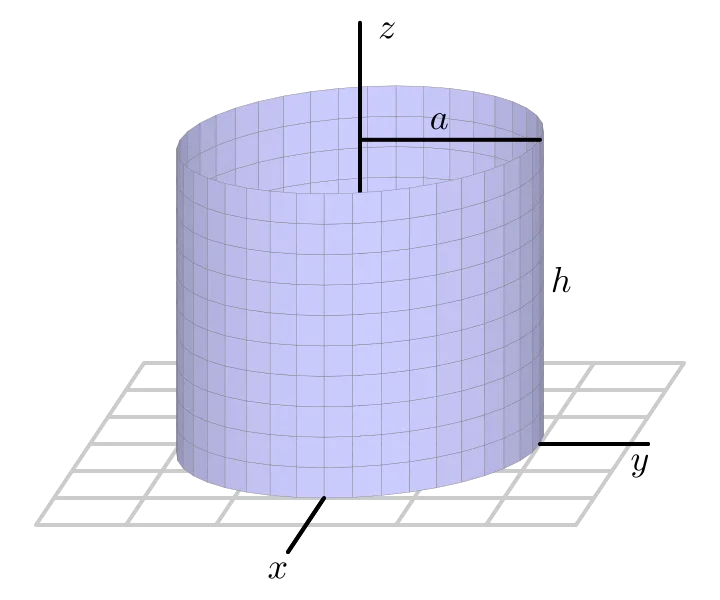
- Set up an iterated integral to determine the surface area of this cylinder.
- Evaluate the iterated integral.
- Recall that one way to think about the surface area of a cylinder is to cut the cylinder horizontally and find the perimeter of the resulting cross sectional circle, then multiply by the height. Calculate the surface area of the given cylinder using this alternate approach, and compare your work in (b).
As we noted earlier, we can take any surface and generate a corresponding parameterization for the surface by writing Hence, we can use our recent work with parametrically defined surfaces to find the surface area that is generated by a function over a given domain.
Activity
Let define a smooth surface, and consider the corresponding parameterization
- Let be a region in the domain of Using Equation \ref{E_surface_area}, show that the area, of the surface defined by the graph of over is
- Use the formula developed in (a) to calculate the area of the surface defined by over the rectangle
- Observe that the surface of the solid describe in (b) is half of a circular cylinder. Use the standard formula for the surface area of a cylinder to calculate the surface area in a different way, and compare your result from (b).
Summary
- A parameterization of a curve describes the coordinates of a point on the curve in terms of a single parameter while a parameterization of a surface describes the coordinates of points on the surface in terms of two independent parameters.
- If describes a smooth surface in 3-space on a domain then the area, of that surface is given by