6Motivating Questions
- How are a triple Riemann sum and the corresponding triple integral of a continuous function defined?
- What are two things the triple integral of a function can tell us?
We have now learned that we define the double integral of a continuous function over a rectangle as a limit of a double Riemann sum, and that these ideas parallel the single-variable integral of a function on an interval Moreover, this double integral has natural interpretations and applications, and can even be considered over non-rectangular regions, For instance, given a continuous function over a region the average value of is given by
where is the area of Likewise, if describes a mass density function on a lamina over the mass, of the lamina is given by
It is natural to wonder if it is possible to extend these ideas of double Riemann sums and double integrals for functions of two variables to triple Riemann sums and then triple integrals for functions of three variables. We begin investigating in Preview Activity .
Preview Activity
Consider a solid piece of granite in the shape of a box whose density varies from point to point. Let represent the mass density of the piece of granite at point in kilograms per cubic meter (so we are measuring and in meters). Our goal is to find the mass of this solid.
Recall that if the density was constant, we could find the mass by multiplying the density and volume; since the density varies from point to point, we will use the approach we did with two-variable lamina problems, and slice the solid into small pieces on which the density is roughly constant.
Partition the interval into 2 subintervals of equal length, the interval into 3 subintervals of equal length, and the interval into 2 subintervals of equal length. This partitions the box into sub-boxes as shown in Figure .
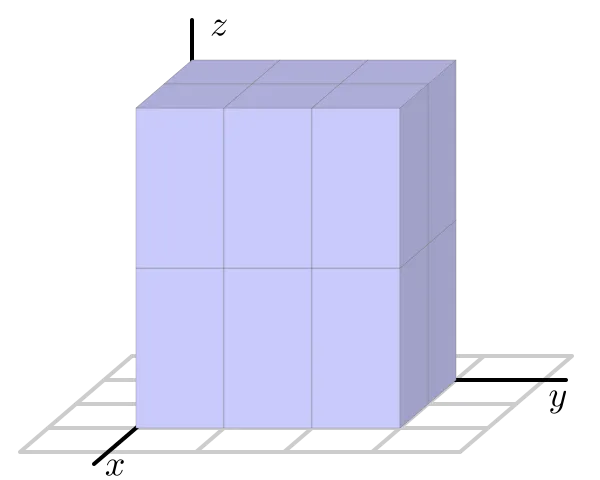
- Let be the endpoints of the subintervals of after partitioning. Draw a picture of Figure and label these endpoints on your drawing. Do likewise with and What is the length of each subinterval for from 1 to 2? the length of of
- The partitions of the intervals and partition the box into sub-boxes. How many sub-boxes are there? What is volume of each sub-box?
- Let denote the sub-box Say that we choose a point in the th sub-box for each possible combination of What is the meaning of What physical quantity will approximate?
- What final step(s) would it take to determine the exact mass of the piece of granite?
Triple Riemann Sums and Triple Integrals
Through the application of a mass density distribution over a three-dimensional solid, Preview Activity suggests that the generalization from double Riemann sums of functions of two variables to triple Riemann sums of functions of three variables is natural. In the same way, so is the generalization from double integrals to triple integrals. By simply adding a -coordinate to our earlier work, we can define both a triple Riemann sum and the corresponding triple integral.
Definition
Let be a continuous function on a box The triple Riemann sum of over is created as follows.
- Partition the interval into subintervals of equal length Let be the endpoints of these subintervals, where Do likewise with the interval using subintervals of equal length to generate and with the interval using subintervals of equal length to have
- Let be the sub-box of with opposite vertices and for between and between and and between 1 and The volume of each is
- Let be a point in box for each and The resulting triple Riemann sum for on is
If represents the mass density of the box then, as we saw in Preview Activity , the triple Riemann sum approximates the total mass of the box In order to find the exact mass of the box, we need to let the number of sub-boxes increase without bound (in other words, let and go to infinity); in this case, the finite sum of the mass approximations becomes the actual mass of the solid More generally, we have the following definition of the triple integral.
Definition
With following notation defined as in a triple Riemann sum, the triple integral of over is
As we noted earlier, if represents the density of the solid at each point then
is the mass of Even more importantly, for any continuous function over the solid we can use a triple integral to determine the average value of over We note this generalization of our work with functions of two variables along with several others in the following important boxed information. Note that each of these quantities may actually be considered over a general domain in not simply a box,
- The triple integral
represents the volume of the solid .
- The average value of the function over a solid domain is given by
where is the volume of the solid
- The center of mass of the solid with density is where
and is the mass of the solid
In the Cartesian coordinate system, the volume element is and, as a consequence, a triple integral of a function over a box in Cartesian coordinates can be evaluated as an iterated integral of the form
If we want to evaluate a triple integral as an iterated integral over a solid that is not a box, then we need to describe the solid in terms of variable limits.
Activity
a. Set up and evaluate the triple integral of over the box
b. Let be the solid cone bounded by and A picture of is shown at right in Figure . Our goal in what follows is to set up an iterated integral of the form
to represent the mass of in the setting where tells us the density of at the point Our particular task is to find the limits on each of the three integrals.
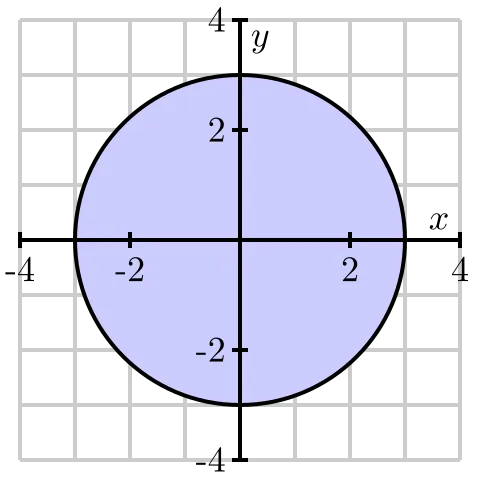
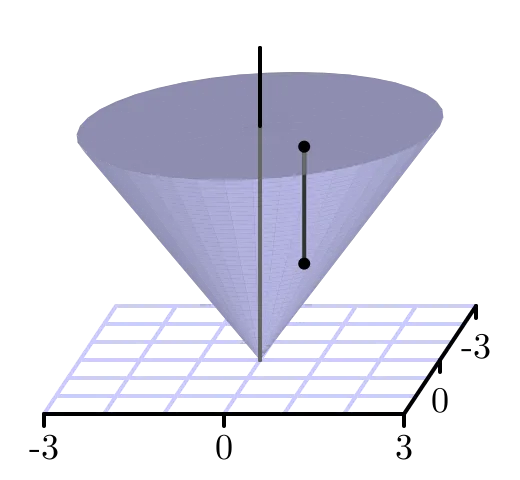
i. If we think about slicing up the solid, we can consider slicing the domain of the solid's projection onto the -plane (just as we would slice a two-dimensional region in ), and then slice in the -direction as well. The projection of the solid onto the -plane is shown at left in Figure . If we decide to first slice the domain of the solid's projection perpendicular to the -axis, over what range of constant -values would we have to slice?
ii. If we continue with slicing the domain, what are the limits on on a typical slice? How do these depend on What, therefore, are the limits on the middle integral?
iii. Finally, now that we have thought about slicing up the two-dimensional domain that is the projection of the cone, what are the limits on in the innermost integral? Note that over any point in the plane, a vertical slice in the direction will involve a range of values from the cone itself to its flat top. In particular, observe that at least one of these limits is not constant but depends on and
iv. In conclusion, write an iterated integral of the form \ref{eq_11_7_TI_not_box} that represents the mass of the cone
Note well: When setting up iterated integrals, the limits on a given variable can be only in terms of the remaining variables. In addition, there are multiple different ways we can choose to set up such an integral. For example, two possibilities for iterated integrals that represent a triple integral over a solid are
where and are functions of the indicated variables. There are four other options beyond the two stated here, since the variables and can (theoretically) be arranged in any order. Of course, in many circumstances, an insightful choice of variable order will make it easier to set up an iterated integral, just as was the case when we worked with double integrals.
Example
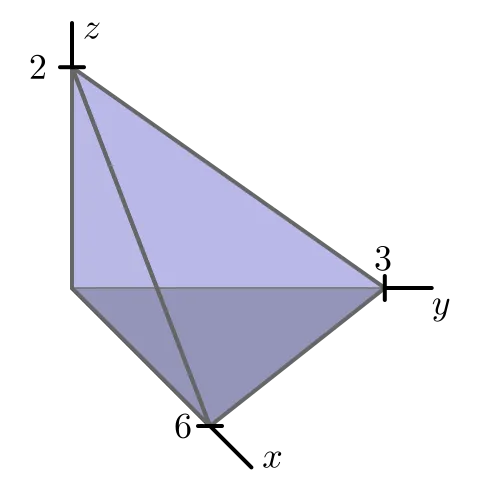
Find the mass of the tetrahedron in the first octant bounded by the coordinate planes and the plane if the density at point is given by A picture of the solid tetrahedron is shown at left in Figure .
We find the mass, of the tetrahedron by the triple integral
where is the solid tetrahedron described above. In this example, we choose to integrate with respect to first for the innermost integral. The top of the tetrahedron is given by the equation
solving for then yields
The bottom of the tetrahedron is the -plane, so the limits on in the iterated integral will be
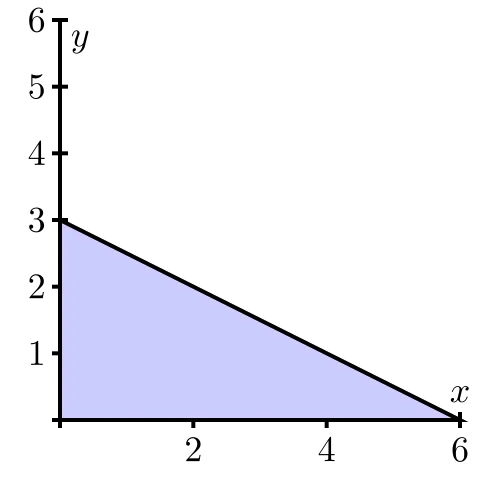
To find the bounds on and we project the tetrahedron onto the -plane; this corresponds to setting in the equation The resulting relation between and is
The right image in Figure shows the projection of the tetrahedron onto the -plane.
If we choose to integrate with respect to for the middle integral in the iterated integral, then the lower limit on is the -axis and the upper limit is the hypotenuse of the triangle. Note that the hypotenuse joins the points and and so has equation Thus, the bounds on are Finally, the values run from 0 to 6, so the iterated integral that gives the mass of the tetrahedron is
Evaluating the triple integral gives us
Setting up limits on iterated integrals can require considerable geometric intuition. It is important to not only create carefully labeled figures, but also to think about how we wish to slice the solid. Further, note that when we say “we will integrate first with respect to ” by “first” we are referring to the innermost integral in the iterated integral. The next activity explores several different ways we might set up the integral in the preceding example.
Activity
There are several other ways we could have set up the integral to give the mass of the tetrahedron in Example .
- How many different iterated integrals could be set up that are equal to the integral in Equation \ref{eq_11_7_Tetrahedron_mass}?
- Set up an iterated integral, integrating first with respect to then then that is equivalent to the integral in Equation \ref{eq_11_7_Tetrahedron_mass}. Before you write down the integral, think about Figure , and draw an appropriate two-dimensional image of an important projection.
- Set up an iterated integral, integrating first with respect to then then that is equivalent to the integral in Equation \ref{eq_11_7_Tetrahedron_mass}. As in (b), think carefully about the geometry first.
- Set up an iterated integral, integrating first with respect to then then that is equivalent to the integral in Equation \ref{eq_11_7_Tetrahedron_mass}.
Now that we have begun to understand how to set up iterated triple integrals, we can apply them to determine important quantities, such as those found in the next activity.
Activity
A solid is bounded below by the square and above by the surface A picture of the solid is shown in Figure .
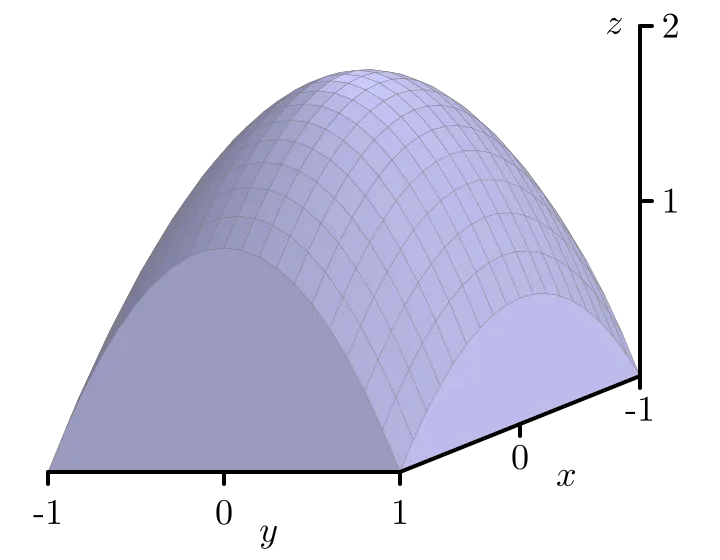
- First, set up an iterated double integral to find the volume of the solid as a double integral of a solid under a surface. Then set up an iterated triple integral that gives the volume of the solid You do not need to evaluate either integral. Compare the two approaches.
- Set up (but do not evaluate) iterated integral expressions that will tell us the center of mass of if the density at point is
- Set up (but do not evaluate) an iterated integral to find the average density on using the density function from part (b).
- Use technology appropriately to evaluate the iterated integrals you determined in (a), (b), and (c); does the location you determined for the center of mass make sense?
Summary
- Let be a continuous function on a box The triple integral of over is defined as
where the triple Riemann sum is defined in the usual way. The definition of the triple integral naturally extends to non-rectangular solid regions
- The triple integral can tell us
- the volume of the solid if
- the mass of the solid if represents the density of at the point
Moreover,
is the average value of over