Motivating Questions
- What is a vector?
- What does it mean for two vectors to be equal?
- How do we add two vectors together and multiply a vector by a scalar?
- How do we determine the magnitude of a vector? What is a unit vector, and how do we find a unit vector in the direction of a given vector?
Quantities like length, speed, area, and mass are all measured by numbers (called scalars). Other quantities, like velocity, force, and displacement, have two attributes: magnitude and direction. These quantities are represented by vectors and are the study of this section. For example, we will use vectors to calculate work done by a constant force, calculate torque, determine direction vectors for lines and normal vectors for planes, define curvature, and determine the direction of greatest increase on a surface. For most of these applications, we will be interested in using vectors to measure direction and/or speed. Vectors will be a major tool for us in determining the behavior of functions of several variables.
If we are at a point in the domain of a function of one variable, there are only two directions in which we can move: in the positive or negative -direction. If, however, we are at a point in the domain of a function of two variables, there are many directions in which we can move. Thus, it is important for us to have a means to indicate direction, and we will do so using vectors. This notion of direction in space will be critical for us to find direction vectors for lines, tangent lines to curves, normal vectors to planes, and to determine direction of motion.
Preview Activity
Postscript is a programming language whose primary purpose is to describe the appearance of text or graphics. A simple set of Postscript commands that produces the triangle in the plane with vertices and is the following:
          (0,0) moveto
          (1,1) lineto stroke
          (1,-1) lineto stroke
          (0,0) lineto stroke
The key idea in these commands is that we start at the origin, then tell Postscript that we want to start at the point draw a line from the point to the point (this is what the lineto and stroke commands do), then draw lines from to and back to the origin. Each of these commands encodes two important pieces of information: a direction in which to move and a distance to move. Mathematically, we can capture this information succinctly in a vector. To do so, we record the movement on the map in a pair (this pair is a vector), where is the horizontal displacement and the vertical displacement from one point to another. So, for example, the vector from the origin to the point is represented by the vector
- What is the vector that describes the displacement from the point to the point How can we use this vector to determine the distance from the point to the point
- Suppose we want to draw the triangle with vertices and As a shorthand notation, we will denote the vector from the point to the point as
- Determine the vectors and
- What relationship do you see among the vectors and Explain why this relationship should hold.
Representations of Vectors
Preview Activity shows how we can record the magnitude and direction of a change in position using an ordered pair of numbers There are many other quantities, such as force and velocity, that possess the attributes of magnitude and direction, and we will call each such quantity a vector.
Definition
A vector is a quantity that possesses the attributes of magnitude and direction.
We can represent a vector geometrically as a directed line segment, with the magnitude as the length of the segment and an arrowhead indicating direction, as shown at left in Figure .
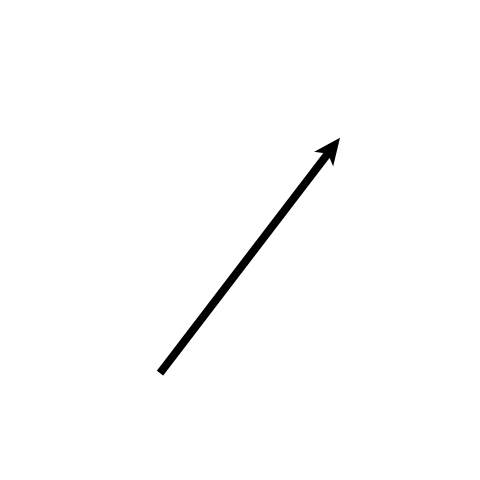
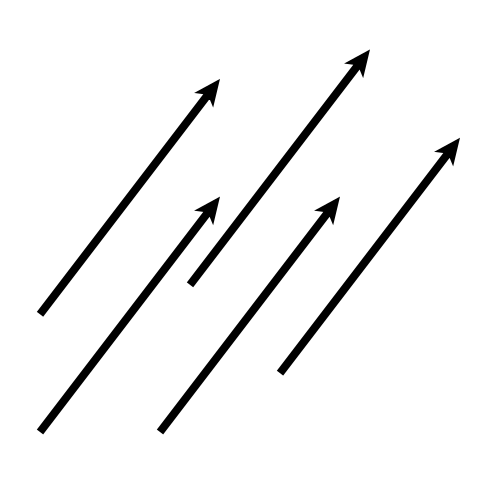
According to the definition, a vector possesses the attributes of length (magnitude) and direction; the vector's position, however, is not mentioned. Consequently, we regard as equal any two vectors having the same magnitude and direction, as shown at right in Figure . In other words, two vectors are equal provided they have the same magnitude and direction.
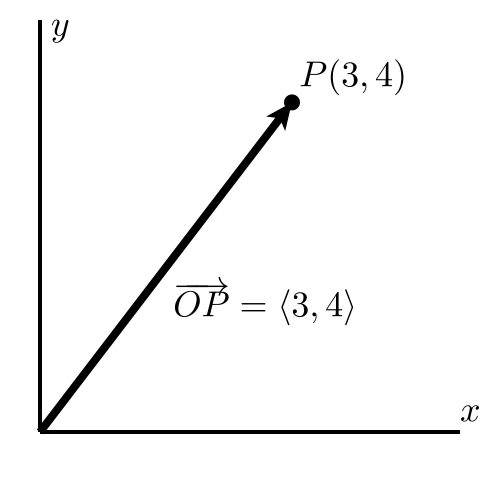
This means that the same vector may be drawn in the plane in many different ways. For instance, suppose that we would like to draw the vector which represents a horizontal change of three units and a vertical change of four units. We may place the tail of the vector (the point from which the vector originates) at the origin and the tip (the terminal point of the vector) at as illustrated at left in Figure . A vector with its tail at the origin is said to be in standard position.
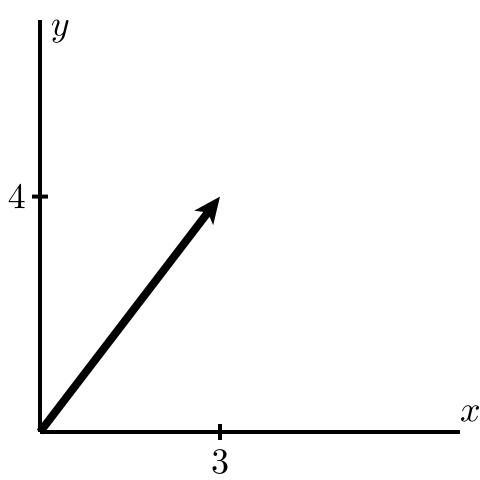
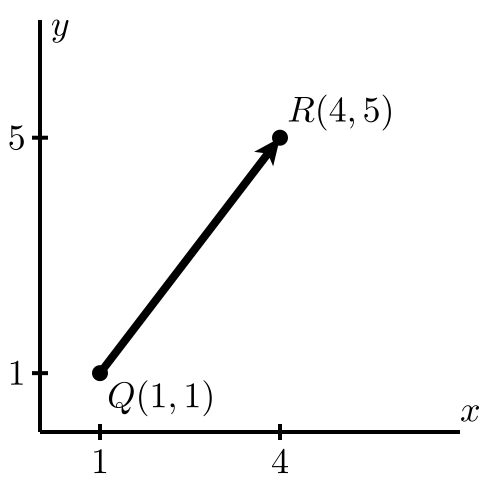
Alternatively, we may place the tail of the vector at another point, such as After a displacement of three units to the right and four units up, the tip of the vector is at the point (see the vector at right in Figure ).
In this example, the vector led to the directed line segment from to which we denote as We may also turn the situation around: given the two points and we obtain the vector because we move horizontally three units and vertically four units to get from to In other words, In general, the vector from the point to is found by taking the difference of coordinates, so that
We will use boldface letters to represent vectors, such as to distinguish them from scalars. The entries of a vector are called its components; in the vector the component is 3 and the component is 4. We use pointed brackets and the term components to distinguish a vector from a point and its coordinates. There is, however, a close connection between vectors and points. Given a point we will frequently consider the vector from the origin to For instance, if then as in Figure . In this way, we think of a point as defining a vector whose components agree with the coordinates of The vector is called the position vector of
While we often illustrate vectors in the plane since it is easier to draw pictures, different situations call for the use of vectors in three or more dimensions. For instance, a vector in -dimensional space, has components and may be represented as
The next activity will help us to become accustomed to vectors and operations on vectors in three dimensions.
Activity
An article by C.Kenneth Tanner of the University of Georgia argues that, due to the concept of social distance, a secondary school classroom for 20 students should have 1344 square feet of floor space. Suppose a classroom is 32 feet by 42 feet by 8 feet. Set the origin of the classroom to be its center. In this classroom, a student is sitting on a chair whose seat is at location an overhead projector is located at position and the teacher is standing at point all distances measured in feet. Determine the components of the indicated vectors and explain in context what each represents.
| a. | b. | c. | d. | e. | f. |
Equality of Vectors
Because location is not mentioned in the definition of a vector, any two vectors that have the same magnitude and direction are equal. It is helpful to have an algebraic way to determine when this occurs. That is, if we know the components of two vectors and we will want to be able to determine algebraically when and are equal. There is an obvious set of conditions that we use.
Equality of Vectors
Two vectors and in are equal if and only if their corresponding components are equal: and More generally, two vectors and in are equal if and only if for each possible value of
Operations on Vectors
Vectors are not numbers, but we can now represent them with components that are real numbers. As such, we naturally wonder if it is possible to add two vectors together, multiply two vectors, or combine vectors in any other ways. In this section, we will study two operations on vectors: vector addition and scalar multiplication. To begin, we investigate a natural way to add two vectors together, as well as to multiply a vector by a scalar.
Activity
Let
- Using the two specific vectors above, what is the natural way to define the vector sum
- In general, how do you think the vector sum of vectors and in should be defined? Write a formal definition of a vector sum based on your intuition.
- In general, how do you think the vector sum of vectors and in should be defined? Write a formal definition of a vector sum based on your intuition.
- Returning to the specific vector given above, what is the natural way to define the scalar multiple
- In general, how do you think a scalar multiple of a vector in by a scalar should be defined? how about for a scalar multiple of a vector in by a scalar Write a formal definition of a scalar multiple of a vector based on your intuition.
We can now add vectors and multiply vectors by scalars, and thus we can add together scalar multiples of vectors. This allows us to define vector subtraction, as the sum of and times so that
Using vector addition and scalar multiplication, we will often represent vectors in terms of the special vectors and For instance, we can write the vector in as
which means that
In the context of we let and and we can write the vector in as
The vectors and are called the standard unit vectors (as we will learn momentarily, unit vectors have length 1), and are important in the physical sciences.
Properties of Vector Operations
We know that the scalar sum is equal to the scalar sum This is called the commutative property of scalar addition. Any time we define operations on objects (like addition of vectors) we usually want to know what kinds of properties the operations have. For example, is addition of vectors a commutative operation? To answer this question we take two arbitrary vectors and and add them together and see what happens. Let and Now we use the fact that and are scalars, and that the addition of scalars is commutative to see that
So the vector sum is a commutative operation. Similar arguments can be used to show the following properties of vector addition and scalar multiplication.
Properties of vector operations
Let and be vectors in and let and be scalars. Then
- The vector has the property that The vector is called the zero vector.
- The vector is called the additive inverse of the vector
We verified the first property for vectors in it is straightforward to verify that the rest of the eight properties just noted hold for all vectors in
Geometric Interpretation of Vector Operations
Next, we explore a geometric interpretation of vector addition and scalar multiplication that allows us to visualize these operations. Let and Then as shown on the left in Figure .
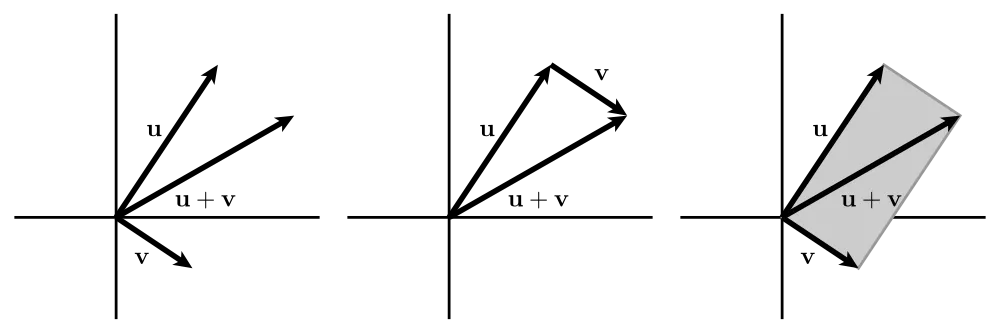
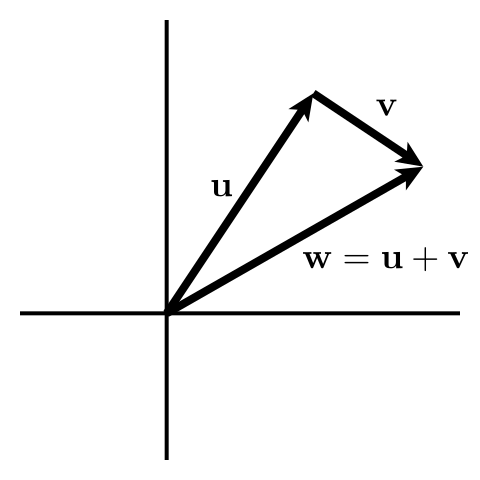
If we think of these vectors as displacements in the plane, we find a geometric way to envision vector addition. For instance, the vector will represent the displacement obtained by following the displacement with the displacement We may picture this by placing the tail of at the tip of as seen in the center of Figure .
Of course, vector addition is commutative so we obtain the same sum if we place the tail of at the tip of We therefore see that appears as the diagonal of the parallelogram determined by and as shown at right in Figure .
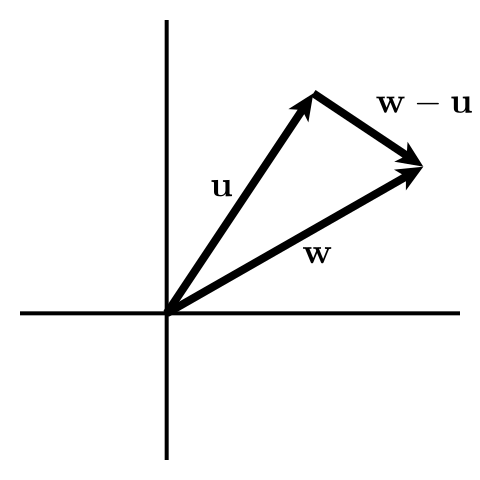
Vector subtraction has a similar interpretation. At left in Figure we see vectors and If we rewrite we have the arrangement shown at right in Figure . In other words, to form the difference we draw a vector from the tip of to the tip of
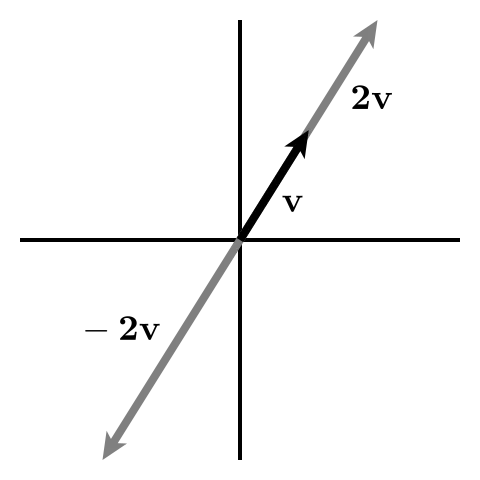
In a similar way, we may geometrically represent a scalar multiple of a vector. For instance, if then As shown in Figure , multiplying by 2 leaves the direction unchanged, but stretches by 2. Also, which shows that multiplying by a negative scalar gives a vector pointing in the opposite direction of
Activity
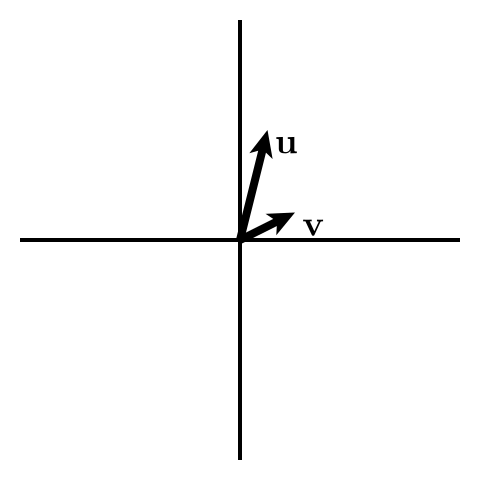
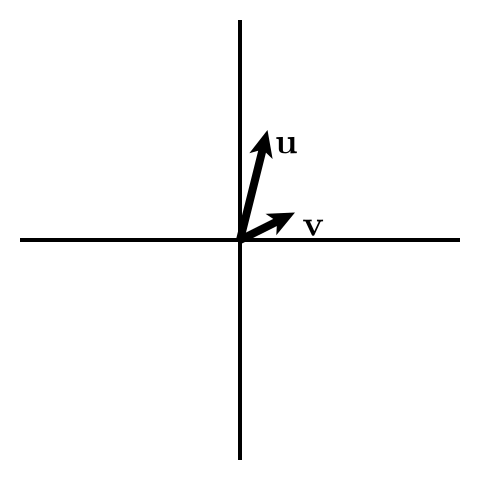
Suppose that and are the vectors shown in Figure .
- On the axes at left in Figure , sketch the vectors and
- What is
- On the axes at right in Figure , sketch the vectors and
- Give a geometric description of the set of terminal points of the vectors where is any scalar.
- On the set of axes at right in Figure , sketch the vectors and
- Give a geometric description of the set of terminal points of the vectors where is any scalar.
The Magnitude of a Vector
By definition, vectors have both direction and magnitude (or length). We now investigate how to calculate the magnitude of a vector. Since a vector can be represented by a directed line segment, we can use the distance formula to calculate the length of the segment. This length is the magnitude of the vector and is denoted
Activity
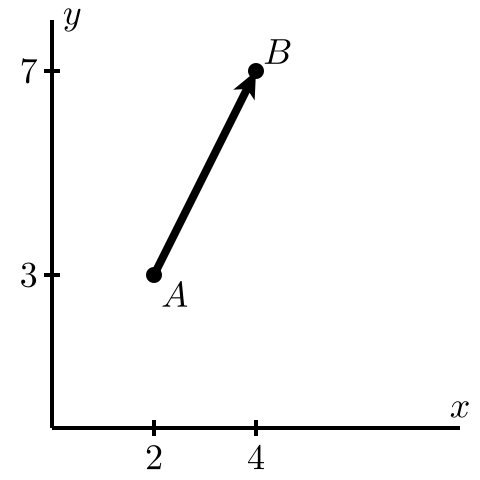
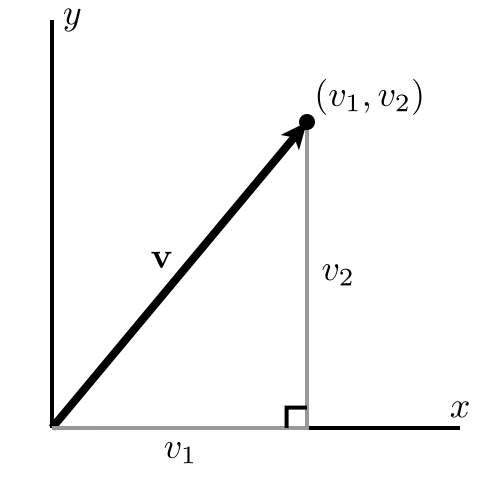
- Let and as shown at left in Figure . Compute
- Let be the vector in with components and as shown at right in Figure . Use the distance formula to find a general formula for
- Let be a vector in Use the distance formula to find a general formula for
- Suppose that and Find and Is it true that
- Under what conditions will (Hint: Think about how and form the sides of a triangle.)
- With the vector find the lengths of and respectively, and use proper notation to label your results.
- If is any scalar, how is related to
- A unit vector is a vector whose magnitude is 1. Of the vectors and which are unit vectors?
- Find a unit vector whose direction is the same as (Hint: Consider the result of part (g).)
Summary
- A vector is an object that possesses the attributes of magnitude and direction. Examples of vector quantities are position, velocity, acceleration, and force.
- Two vectors are equal if they have the same direction and magnitude. Notice that position is not considered, so a vector is independent of its location.
- If and are two vectors in then their vector sum is the vector
- If is a vector in and is a scalar, then the scalar multiple is the vector
- The magnitude of the vector in is the scalar
- A vector is a unit vector provided that If is a nonzero vector, then the vector is a unit vector with the same direction as